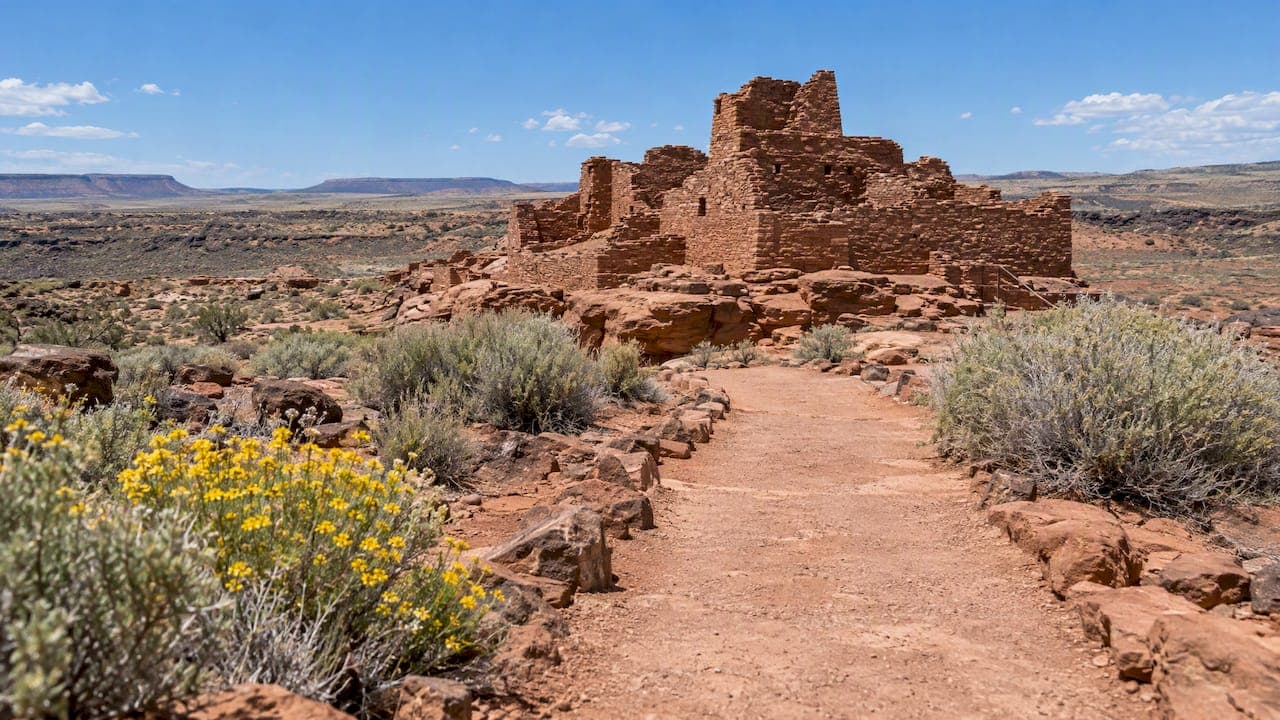
The best time to visit Wupatki National Monument is spring or fall, when daytime highs sit in a comfortable range and you can walk the pueblo trails without fighting the sun. The monument is open year-round, though, and each season gives you something different: wildflowers in spring, cool light in fall, quiet in winter, and dramatic storm skies in late summer. What matters most is timing your day, not just your month.
Below, we break down the seasons, the best hours of the day, what is open when, and how to fit Wupatki together with Sunset Crater Volcano and the rest of the loop north of Flagstaff.
TL;DR
- Best seasons: spring and fall, when temperatures are milder than in the heat of summer.
- Open year-round: the trails and pueblos are open from sunrise to sunset every day of the year.
- Best time of day: early morning or late afternoon, especially from late spring through early fall.
- Plan for 1 to 3 hours at Wupatki itself, longer if you pair it with Sunset Crater and the scenic loop.
- Winter is quiet but cold: nights often drop below freezing, and the visitor center has a seasonal midweek closure.
Table of Contents
- Why Wupatki's seasons matter more than most monuments'
- The best seasons: spring and fall
- Summer: hot, windy, and stormy
- Winter: cold nights, empty trails
- Season at a glance
- Best time of day
- How much time to plan
- What it costs
- What to bring, in any season
- Our perspective: go for the light, not just the date
- See Wupatki with a private guide
- Pairing Wupatki with the rest of your Arizona trip
- FAQ
- Sources
Why Wupatki's seasons matter more than most monuments'
Wupatki sits in high desert, a wide, open basin north of Flagstaff with almost no shade at the main ruins. There are no big trees to stand under at Wupatki Pueblo, and the red sandstone walls hold the heat. The National Park Service warns visitors to be ready for variable and extreme weather and to dress in layers, since conditions can change quickly at any time of year.
The walks themselves are short. The NPS says the full Wupatki Pueblo trail takes an average of 30 minutes, and the overlook only 5. That is a gift in any season, but it also means the site is easy to enjoy when the weather is kind and easy to skip when it is not. Choosing your window well changes the whole experience.
The best seasons: spring and fall
Park partner Western National Parks Association says Wupatki is best visited in spring and fall, when temperatures are milder. It describes daytime highs of roughly 60 to 80°F, with cooler lows in the 30s or 40s. That matches what we see on the ground: you can stand at the pueblo walls in a light jacket at 10 a.m. and be in a T-shirt by noon.
Spring (March to May)
Spring brings blooming desert plants and long, clear light. Wind can pick up in the afternoons, so morning is still the better window. Early March mornings can still be near freezing, so bring a layer you can take off.
Fall (September to November)
Fall is our favorite for photography. The light turns golden, the crowds thin out after the summer rush, and the afternoon thunderstorms of late summer fade. The drive through the lava fields and red-rock basin is at its best, and there is usually time to continue from Wupatki to a sunset viewpoint without rushing.
Summer: hot, windy, and stormy
The NPS describes summer at Wupatki as dry and windy, with temperatures in the 90s that occasionally exceed 100°F. Brief daily thunderstorms from July through September bring most of the monument's annual 8 inches of precipitation.
That does not mean you should skip summer. Flagstaff is far cooler than Phoenix, and many travelers visit Wupatki in July simply because it fits their trip. If that's you:
- Go early. Be at the pueblo shortly after sunrise or save it for late afternoon.
- Carry more water than you think you need. Drink it, don't just carry it.
- Watch the sky. Storms build quickly in the afternoon, and lightning in an open basin is a real hazard. If you hear thunder, head back to your vehicle.
- Wear a hat, sunscreen and sturdy shoes. Rock surfaces get hot.
Winter: cold nights, empty trails
Winter is the quietest season. The NPS notes that winter nights are often below freezing, with a few small snow showers. Days are often clear and pleasant in the sun, and a light dusting of snow over red rock is a rare and lovely sight.

The trade-off is services. The visitor center's regular hours are 9:00 a.m. to 4:30 p.m. daily, but the NPS lists a seasonal Tuesday-through-Thursday closure that runs from early November to early March, along with closures for extreme weather and select holidays. Trails and pueblos stay open from sunrise to sunset, so you can still walk everything. Just don't count on a bookstore or restrooms inside the building on those midweek days, and check the official page for the current schedule before you drive out.
Winter is also when ranger-led hikes are most likely to run, as some tour listings note that October through April is the season for them. The NPS says ranger-led hikes require reservations and last from 2 to 8 hours, so book ahead through the park if one interests you.
Season at a glance
| Season | What to expect | Best for | Watch out for |
|---|---|---|---|
| Spring (Mar to May) | Mild days, cold mornings early on, desert blooms | Walking, photography, wildflowers | Afternoon wind |
| Summer (Jun to Aug) | Hot, dry, windy; storms July to September | Early-morning visits, sunset light | Heat above 100°F, lightning |
| Fall (Sep to Nov) | Mild days, golden light, fewer storms | Photography, combining monuments | Cold mornings by November |
| Winter (Dec to Feb) | Freezing nights, occasional snow | Solitude, snow on red rock | Visitor center midweek closure |
Best time of day
There is no official hour-by-hour guide, so this comes from what we see guiding the area. The pueblo trails are open from sunrise to sunset, so you have more freedom here than at most monuments with gated hours.
- Early morning (sunrise to 10 a.m.): the coolest, calmest and quietest window, with low, warm light on the walls. Ideal from May through September.
- Midday: best in winter, when the sun is welcome. In summer, spend it in the visitor center or on the road.
- Late afternoon: the light on the red masonry is at its richest, and the heat eases. In summer, keep an eye on storm clouds.
One detail worth knowing: Wupatki observes Mountain Standard Time year-round. Arizona doesn't change its clocks, so if you arrive from a state that does, your phone may jump an hour depending on the season.
How much time to plan
Wupatki on its own is short. The NPS puts the front-country hikes at 5 to 30 minutes each. A relaxed visit with the visitor center, the Wupatki Pueblo trail and a stop at the nearby pueblos is typically 1 to 2 hours.
Most travelers pair Wupatki with Sunset Crater Volcano National Monument. The two are linked by a scenic loop road. The NPS says the 35-mile loop takes about an hour to drive, and the drive from Flagstaff to the Wupatki Visitor Center is 45 to 60 minutes. The Forest Service suggests allowing 2 to 3 hours for the Volcanoes and Ruins Loop, which is realistic once you stop to walk. Wupatki Pueblo is 19.5 miles from Sunset Crater.

A good half-day order is Sunset Crater first, then Wupatki, then back to Flagstaff. Add Walnut Canyon National Monument and you have a full day, but it will be a busy one.
What it costs
The entrance fee is $25 per vehicle, and America the Beautiful passes are honored. That fee includes the Wupatki Pueblo and its trail. Fees can change, so confirm the amount on the NPS page before you go. On our private tours, park fees are included.
What to bring, in any season
- Layers. High-desert temperatures swing widely through the day.
- Water. Plenty of it, even in winter. The WNPA recommends carrying and drinking plenty.
- Sun protection. Hat, sunglasses, sunscreen.
- Sturdy shoes. Trails are short but the ground is uneven rock.
- Leave pets at home. Pets are not permitted on the trails, since the pueblos are ancient and fragile.
Our perspective: go for the light, not just the date
People often ask us which month is best, and the answer is that it depends on what kind of day you want. If you only have a single day in the Flagstaff area, we'd rather you see Wupatki at 8 a.m. in July than at 1 p.m. in May. The hour changes the experience more than the calendar does.
The other thing we tell guests: these ruins were built by people who watched the climate closely, because their survival depended on it. The NPS makes this point on its weather page. Standing in the basin, you feel why. A place that looks empty is actually full of decisions about water, wind and sun. Visiting at a comfortable time lets you notice that instead of just enduring the heat.
We design our Northern Arizona days around those windows. Because every tour is private, we can start early in summer, linger in the golden hour in fall, or reshuffle the day when a storm builds. That flexibility is the real advantage of not being on a fixed schedule.
— Chris
See Wupatki with a private guide
If you would rather not drive the loop yourself, our Four National Monuments tour covers Montezuma Castle, Tuzigoot, Wupatki and Sunset Crater in one private day, starting at $309 per person. It is a door-to-door private experience, so your guide can set the pace around the weather and the light.
We also run private Grand Canyon tours from Flagstaff for travelers who want to combine the monuments with the South Rim. You can read more on our Wupatki National Monument page and our guide to Sunset Crater Volcano National Monument. To see everything we offer, browse the full list of private tours.
Pairing Wupatki with the rest of your Arizona trip
Wupatki fits naturally into a Flagstaff base. A common pattern for our guests is one day on the monuments, one day at the Grand Canyon, and one day around Sedona or Page. Because the seasons differ by elevation, you can use that to your advantage:
- Summer: do Wupatki early, then spend the heat of the day at higher elevation or indoors. Our Grand Canyon Sunset Tour works well as an evening plan.
- Winter: Wupatki is clear and calm, but check the forecast for snow on the roads and the Grand Canyon rim.
- Spring and fall: the easiest time to stack two destinations in one day.
For a wider look at the region, our Flagstaff area guide and Grand Canyon travel planner help you sequence the days.
FAQ
Is Wupatki worth visiting?
Yes, especially if you like archaeology and open landscapes. The pueblo walls are remarkably intact, the trails are short, and the setting is unlike anywhere else near Flagstaff. It pairs easily with Sunset Crater for a half-day or full-day outing.
What is the best month to visit Wupatki?
April, May, September and October are the most comfortable for most visitors. The WNPA points to spring and fall as the best seasons. If you can only go in summer, start at sunrise.
Is Wupatki open in winter?
Yes. The trails and pueblos are open year-round from sunrise to sunset. The visitor center has a seasonal Tuesday-through-Thursday closure from early November to early March, so check the NPS page for current hours.
How long do you need at Wupatki?
Plan on 1 to 2 hours for Wupatki alone. The full pueblo trail takes an average of 30 minutes. If you add Sunset Crater and drive the whole scenic loop, allow 2 to 3 hours or more.
How much does it cost to visit Wupatki?
The NPS lists a $25 per vehicle entrance fee, and America the Beautiful passes are honored. Check the NPS page for the current amount.
Sources
- Weather, Wupatki National Monument (NPS)
- Weather and planning, Wupatki National Monument (NPS)
- Operating Hours & Seasons, Wupatki National Monument (NPS)
- Visit Wupatki Pueblo (NPS)
- Things To Do, Wupatki National Monument (NPS)
- Directions & Transportation, Wupatki National Monument (NPS)
- Volcanoes and Ruins Loop Scenic Drive (Coconino National Forest)
- Experience Wupatki National Monument (Western National Parks Association)