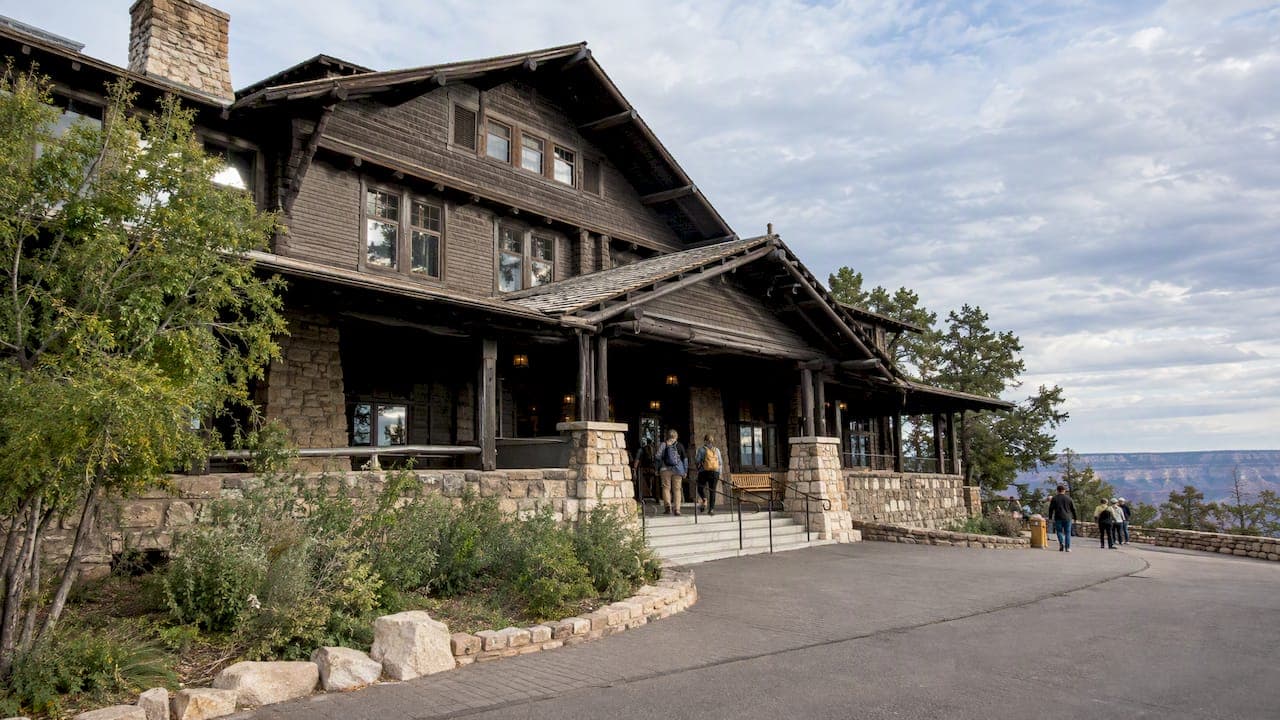
El Tovar Hotel opened in January 1905, built by the Atchison, Topeka, and Santa Fe Railway and designed by architect Charles Whittlesey. Named for Spanish explorer Pedro de Tovar, it remains the oldest hotel still operating inside Grand Canyon National Park and a defining landmark in early national park lodging.
TL;DR:
- The Santa Fe Railway placed El Tovar beside the depot so arriving passengers could walk directly to the resort without a wagon transfer.
- Whittlesey combined Swiss chalet, Norwegian villa, Second Empire, and Adirondack influences, creating a design that preceded the National Park Service’s later rustic lodge style.
- Pedro de Tovar likely never saw the Grand Canyon; Spanish authorities credited him with being the first to report its existence.
- The South Rim is the traditional homeland of seven tribes, and early tourism infrastructure coincided with forced removals from lands that became the park.
- The dining room still serves meals, and the hotel offers a lounge, gift shop, concierge services, and accessible rooms for visitors planning a stop.
Table of Contents
- Quick facts about El Tovar's history
- How the railroad and Fred Harvey Company built El Tovar
- The architecture behind Charles Whittlesey's design
- Why the hotel is named El Tovar
- El Tovar's role in building Grand Canyon tourism
- Notable guests who shaped El Tovar's reputation
- National landmark status and major renovations
- Indigenous history behind El Tovar's canyon setting
- Visiting El Tovar on a South Rim trip today
- Why El Tovar's history matters for your visit
- Plan a private tour that includes El Tovar and the South Rim
- FAQ
- Sources
Quick facts about El Tovar's history
El Tovar sits on the South Rim in Grand Canyon Village, a short walk from the Grand Canyon Depot and the trailhead for Bright Angel Trail. That location was no accident: the railroad built the hotel exactly where train passengers would step off and need a place to stay.
- Location: Grand Canyon Village, South Rim, steps from the Grand Canyon Depot and Bright Angel Trail
- Construction: planning began in 1902, building started June 6, 1903, and the hotel opened in January 1905
- Cost: approximately $250,000, a notable sum for a log and stone structure at the time
- Designations: listed on the National Register of Historic Places and named a National Historic Landmark
- Today: still an operating hotel with guest rooms, a dining room, a lounge, and a gift shop, following a centennial renovation and later system upgrades
How the railroad and Fred Harvey Company built El Tovar
By the turn of the 20th century, the Santa Fe Railway had extended a spur line to the South Rim and needed a reason for wealthy passengers to stop, stay, and spend. El Tovar was that reason. Working with the Fred Harvey Company, which operated dining and hospitality along the Santa Fe line, the railroad planned a resort meant to compete with the finest hotels in the country, not just serve as a rest stop.
- 1902: Planning and design work began, with architect Charles F. Whittlesey drawing up plans for the Fred Harvey Company and the Santa Fe Railway.
- June 6, 1903: Construction broke ground at the chosen site near the planned rail depot.
- January 1905: The hotel opened to guests, having cost roughly $250,000 to build.
The site itself mattered as much as the building. Placing El Tovar next to the depot meant visitors could step off a train and walk directly into a resort, with no wagon transfer or extended journey required. That convenience reshaped the local economy. Before the railroad's arrival, independent operators ran modest tourist camps and stage lines to the canyon rim. Once the Santa Fe Railway and Fred Harvey Company poured capital into a destination resort, as one history of the South Rim describes it, smaller pioneer businesses struggled to compete.
The architecture behind Charles Whittlesey's design
Charles Whittlesey, chief architect for the Santa Fe Railway, gave El Tovar a look unlike anything else being built at national parks at the time. Rather than choosing a single architectural style, he blended several, producing a building historians still find difficult to categorize neatly.
- Stylistic influences: elements of Swiss chalet and Norway villa design, combined with touches of Second Empire detailing and Adirondack-style log construction
- Foundation: rubble masonry built from local limestone
- Superstructure: Oregon pine framing with log-slab siding and peeled-log structural elements, including a distinctive turret
- Roofline: intentionally varied and irregular, paired with jigsawn balusters along porches and balconies
One contemporary description called El Tovar "probably the most expensively constructed and appointed log house in America," according to architectural records from PCAD, underscoring how far the Santa Fe Railway pushed the budget for a frontier lodging project.
Architectural historians often describe El Tovar as a transitional building. It came before the National Park Service formalized what later became known as NPS rustic architecture, the log-and-stone style still visible in park lodges across the American West. El Tovar's mix of European resort styling and rough-hewn Western materials helped set a template that later park architects would refine and simplify.
Why the hotel is named El Tovar
The name El Tovar honors Pedro de Tovar, a Spanish officer who served under Francisco Vázquez de Coronado during the 1540 expedition into the American Southwest. The Santa Fe Railway and Fred Harvey Company favored Spanish colonial names for their Harvey House properties, tying new hotels to a romanticized version of regional history.
- Pedro de Tovar's role: he was a member of Coronado's expedition, sent to investigate reports of a great river, which led Spanish forces toward the canyon region
- An important clarification: according to Historic Hotels of America, de Tovar likely never saw the Grand Canyon himself; he was credited with being the first to report its existence to Spanish authorities
- An early alternative: before settling on El Tovar, planners reportedly considered the name "Bright Angel Tavern" for the property
The final choice fit the branding pattern the Fred Harvey Company used across its Southwestern properties, where Spanish and Indigenous names lent an air of history and exoticism to new tourist infrastructure.
El Tovar's role in building Grand Canyon tourism
El Tovar functioned less like a simple hotel and more like a resort, which was the point. The Fred Harvey Company built its reputation on service across remote outposts, and El Tovar became a flagship for that model.
- Staffing: Harvey Girls served meals at the hotel
- On-site operations: the hotel historically ran a greenhouse, dairy, and telegraph office
- Guest programming: dining, music, and lectures gave visitors reasons to linger
- Broader effect: El Tovar helped shape expectations for lodging and dining at national park destinations
Pro Tip: If you want a sense of the hotel's original dining concept, read about the dining room's history before your visit; it remains one of the most atmospheric places on the South Rim to eat a meal.
This full-service approach made an extended stay at the Grand Canyon more comfortable, helping make the canyon an appealing destination for travelers.
Notable guests who shaped El Tovar's reputation
El Tovar's guest registry reads like a cross-section of early 20th century American culture, and that reputation did not happen by accident. The Santa Fe Railway promoted the hotel heavily in national advertising, often alongside paintings by artists like Thomas Moran that introduced the canyon to audiences who had never traveled West.
- Presidents: Theodore Roosevelt, William Howard Taft, and Bill Clinton all stayed at the hotel
- Scientists and public figures: Albert Einstein and Guglielmo Marconi both visited
- Writers and performers: George Bernard Shaw, Zane Grey, and Paul McCartney are also listed among the hotel's historic guests
Roosevelt's visits link El Tovar's early years to the larger story of how the Grand Canyon gained federal protection.
National landmark status and major renovations
El Tovar's preservation record runs alongside its guest history. The hotel earned a listing on the National Register of Historic Places on September 6, 1974, and received the more significant designation of National Historic Landmark on May 28, 1987, placing it among a small group of nationally recognized historic properties.
- 1931: private bathrooms were added to some guest rooms, a significant upgrade for the era
- 1983: all guest rooms had private baths, according to Historic Hotels of America
- A centennial renovation refreshed guest rooms and public spaces
- Ongoing work: preservation records note continued system upgrades to keep the historic structure functional for modern guests
These renovations reflect a careful balance that historic hotels often face: updating plumbing, electrical systems, and guest comfort without erasing the architectural details that earned landmark status in the first place.
Indigenous history behind El Tovar's canyon setting
El Tovar's 1905 opening marks only a brief chapter in the Grand Canyon's human history. The canyon has long been home to multiple tribes, and that presence predates any railroad or hotel.
- Tribal homelands: the Grand Canyon region is recognized by the National Park Service as the traditional homeland of the Havasupai, Hualapai, Hopi, Navajo, Southern Paiute, Zuni, and Apache peoples
- A history of disruption: the growth of rail tourism and park infrastructure in the early 1900s coincided with forced removals of Indigenous communities from traditional lands within what became the park
- Recent changes: the National Park Service renamed Indian Garden to Havasupai Gardens in recent years, an acknowledgment of the area's original inhabitants and an example of ongoing efforts to correct historical place names
- Seeking deeper context: travelers interested in the canyon's full history can read more through our Havasupai Tribe page, which covers tribal background relevant to the region
Understanding El Tovar within this longer timeline means recognizing that the hotel's commercial success in the early 1900s unfolded on land with a much older, living history, one that continues through tribal communities still connected to the canyon today.
Visiting El Tovar on a South Rim trip today
El Tovar still anchors Grand Canyon Village the way it did in 1905, standing close to the Grand Canyon Depot and within walking distance of the Bright Angel Trail. The hotel's porch and dining room remain two of the most historically significant vantage points on the South Rim, offering canyon views that guests have been photographing for well over a century.
- Dining: the historic dining room continues to serve meals in a space largely unchanged in character since the early 1900s; our El Tovar dining guide covers what to expect
- Amenities: current offerings include a lounge, gift shop, concierge services, and accessible rooms
- Planning a visit: readers mapping out a broader South Rim itinerary can use our Grand Canyon travel planner to organize timing around the park's historic sites
- Deeper background: our Grand Canyon history guide covers the park's broader historical arc beyond El Tovar alone
Seeing El Tovar in person adds a layer that photos cannot. Standing on the porch where Roosevelt once stood, looking at the same canyon walls Thomas Moran painted for Santa Fe Railway advertisements, connects the hotel's history directly to the landscape it was built to showcase.
Why El Tovar's history matters for your visit

Knowing where El Tovar came from changes how you experience the South Rim. The hotel is not simply a place to grab a meal near the rim; it is a physical record of how railroads, hospitality companies, and architects turned a remote canyon into one of the most visited landscapes in the country, often at the expense of the communities who lived there first.
A guide who can point out Whittlesey's mixed architectural influences, explain why the Harvey Girls mattered, or connect the hotel's story to Havasupai and Hualapai history turns a quick stop into something more substantial. That is the kind of context a private, guided tour can add that a self-guided walk through the lobby usually cannot.
— Chris
Plan a private tour that includes El Tovar and the South Rim
Seeing El Tovar's architecture and the canyon views from its porch works well as part of a South Rim visit. We run private, guided tours of Grand Canyon National Park from Sedona, Flagstaff, Williams, and Tusayan, with pickup and a flexible itinerary built around what you want to see.
- Our Private Grand Canyon Day Tour offers a way to explore the Grand Canyon
- Guests traveling with us ride in custom luxury vehicles with an expert local guide, rather than joining a shared bus tour with strangers
- Check the tour details for information about park fees and what is included in the price
If you want to build a longer stay around Grand Canyon history, our travel planner helps you sequence a visit to El Tovar with other South Rim highlights. Reach out to book a private Grand Canyon day tour and see the hotel's history firsthand with a guide who can walk you through it.
FAQ
What famous people have stayed at the El Tovar Hotel?
El Tovar's guest list includes Presidents Theodore Roosevelt, William Howard Taft, and Bill Clinton, along with Albert Einstein, George Bernard Shaw, Guglielmo Marconi, Zane Grey, and Paul McCartney. The hotel's reputation as a national landmark drew prominent visitors from its earliest years through the modern era.
What does El Tovar mean?
El Tovar is named for Pedro de Tovar, a Spanish officer on Coronado's 1540 expedition who was credited with being the first to report the Grand Canyon's existence to Spanish authorities, though he likely never saw it himself. The Santa Fe Railway and Fred Harvey Company used Spanish names across their Southwestern hotels, and El Tovar fit that naming tradition.
What is the real history of the Grand Canyon area?
The Grand Canyon has been home to multiple tribes, including the Havasupai, Hualapai, and Hopi, for thousands of years before European exploration or railroad tourism arrived. El Tovar's 1905 construction represents a relatively recent chapter within a much longer Indigenous history tied to the canyon.
Who owns the El Tovar Hotel?
El Tovar is currently managed by Xanterra Travel Collection, which took over the concession model originally established by the Fred Harvey Company and its long partnership with the Santa Fe Railway. The hotel remains an operating property within Grand Canyon National Park.
Sources
- El Tovar Hotel (U.S. National Park Service)
- PCAD - Fred Harvey Company, El Tovar Hotel, Grand Canyon National Park, AZ
- Sacred Canyon - Grand Canyon National Park (U.S. National Park Service)
- History