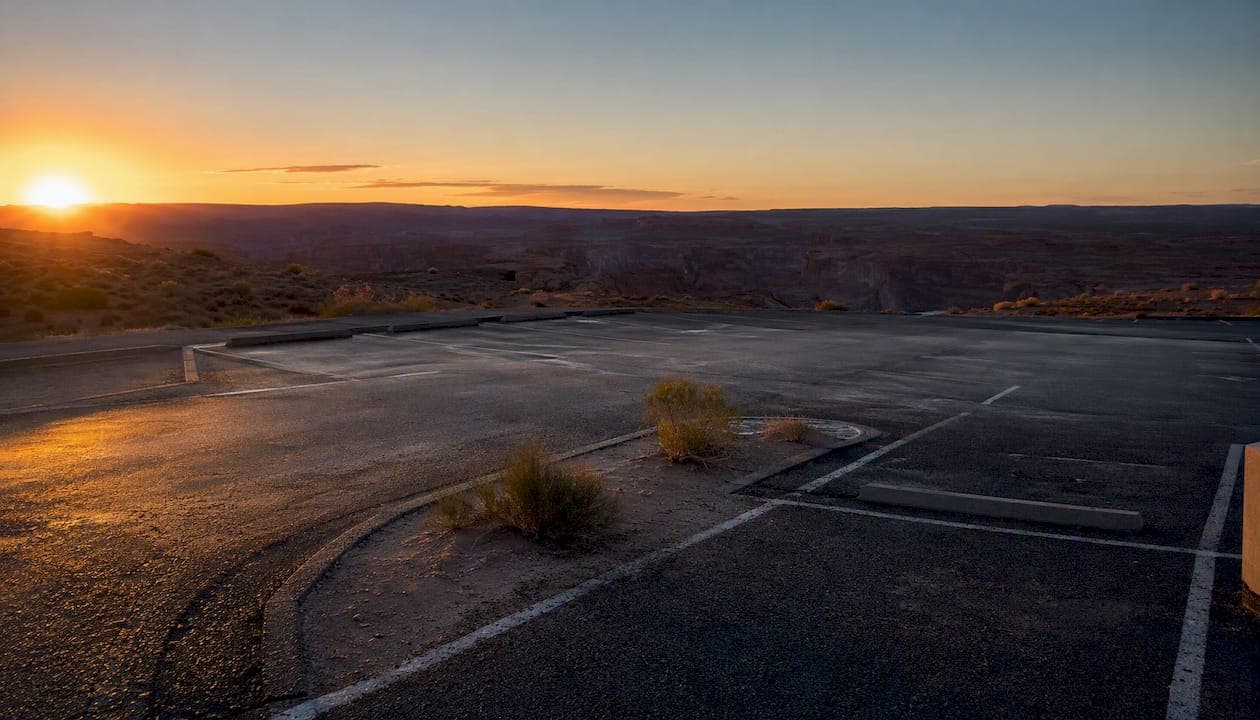
Park in the City of Page lot off US-89, budget for the standard fee the City of Page charges for passenger vehicles, and plan on a round-trip walk of about 1.5 miles to the overlook. That's the whole plan in one sentence. Federal park passes don't work here, the lot has no reliable overflow space, and the single best move you can make is arriving at or just after sunrise, before the parking booth sees its first rush of the day.
Everything else is detail, but the details matter. The City of Page charges per vehicle, not per person, and that fee structure catches a lot of families off guard when they assume the cost scales with headcount. The walk itself is short but exposed, with almost no shade for most of its length. And the lot fills. When it's full, attendants turn cars away, and there's no dependable backup lot waiting down the road.
Three things guarantee you get in without wasting a morning:
- Arrive at sunrise or within the first hour after gate opening, when the lot is emptiest and the light is best anyway.
- Bring both a card and cash, since holiday crowds can push the booth to cash-only during peak surges.
- Pack water and sun protection before you leave Page, because there's no shade structure worth relying on along most of the trail.
Pro Tip: The single behavior that most reliably avoids a turnaway isn't a secret entrance or a workaround. It's showing up before 8:00 AM. Every other strategy, including sunset visits, runs into the same crowd Photoshop instructors are shooting through by mid-morning.
Key Takeaways
Guaranteed access to Horseshoe Bend depends on arriving at or near sunrise, paying the City of Page's per-vehicle fee, and budgeting a round-trip walk of approximately 1.5 miles with little shade.
| Point | Details |
|---|---|
| Where to park | Use the City of Page lot off US-89, about 5 miles south of the Carl Hayden Visitor Center. |
| Budget the fee correctly | Expect $10 for a standard car, $5 for a motorcycle, and up to $140 for oversized or commercial vehicles. |
| Arrive at sunrise | This is the single most reliable way to avoid the full-lot turnaway, since 9:00 AM to 2:00 PM is peak season's busiest stretch. |
| Pack for the walk | Bring water, sun protection, and closed-toe shoes for the 1.5-mile round trip with minimal shade. |
| No passes, no overnight parking | Federal park passes aren't accepted and overnight parking isn't allowed in the lot. |
| Consider a guaranteed alternative | Grandcanyonjourneys offers private, door-to-door tours that include Horseshoe Bend without the parking risk. |
Table of Contents
- Where the Horseshoe Bend Parking Lot Actually Is
- Horseshoe Bend Parking Fee and How to Pay
- When Does the Lot Get Full, and What Happens Then?
- RV, Bus, and Accessible Parking Rules
- The Walk From the Lot to the Overlook
- What to Do if the Lot Is Full
- Rules and Safety at the Rim
- Checking for Closures and Last-Minute Changes
- A Guaranteed Way to See Horseshoe Bend Without the Parking Gamble
- Sources
Where the Horseshoe Bend Parking Lot Actually Is
The lot sits just off US-89, a few miles south of the Carl Hayden Visitor Center, and the entrance is on the west side of the highway as you're heading south from Page. If you're driving up from Flagstaff or down from Kanab, you'll pass the visitor center first, then watch for the marked turn on your right.
Cell coverage gets patchy on this stretch of highway, so pin your destination or drop an offline waypoint before you leave town. Google Maps and most navigation apps have the location correctly flagged as "Horseshoe Bend," but a saved pin beats a live search when your signal drops to one bar.
Quick directions to keep handy:
- From downtown Page: head south on Lake Powell Boulevard to US-89, then continue south about 5 miles to the marked lot entrance on your right.
- From the Carl Hayden Visitor Center: continue south on US-89; the turn appears within a few minutes of driving, well before you'd expect it if you're used to longer approach roads at national park sites.
- Map check: confirm current lot access on the City of Page's official parking page before you drive, since seasonal construction occasionally shifts entry points.
One hard rule: don't stop on the US-89 shoulder if the lot looks full or you're tempted to unload passengers roadside. This stretch is actively patrolled, and Grandcanyonjourneys has heard enough stories about tickets and tows to say it plainly: the shoulder is not a parking option, ever, no matter how close the overlook looks from the road.
Horseshoe Bend Parking Fee and How to Pay
The City of Page collects the fee, and the current schedule runs like this: $10 for a standard passenger vehicle, $5 for a motorcycle, and commercial or oversized vehicle rates that scale from roughly $35 to $140 depending on size and passenger capacity. Every fee is charged once, per vehicle, at entry, so a minivan with six people pays the same $10 as a sedan with one driver.
This is the detail that trips up visitors who've driven through a lot of national parks: your America the Beautiful Annual Pass, senior pass, or any other federal park pass does not work here. That's because the parking lot itself sits on City of Page land, not National Park Service land, even though Horseshoe Bend is inside Glen Canyon National Recreation Area. Different landowner, different rules, no exceptions.
- Card and cash are both accepted under normal operations.
- On major holidays, expect the booth to occasionally shift to cash-only during the busiest surge windows.
- Bring a few small bills as backup, since a $10 fee paid with a $100 note slows down the whole line behind you.
- Check the City of Page parking page close to your travel date, since fees have changed before without much advance notice.
When Does the Lot Get Full, and What Happens Then?
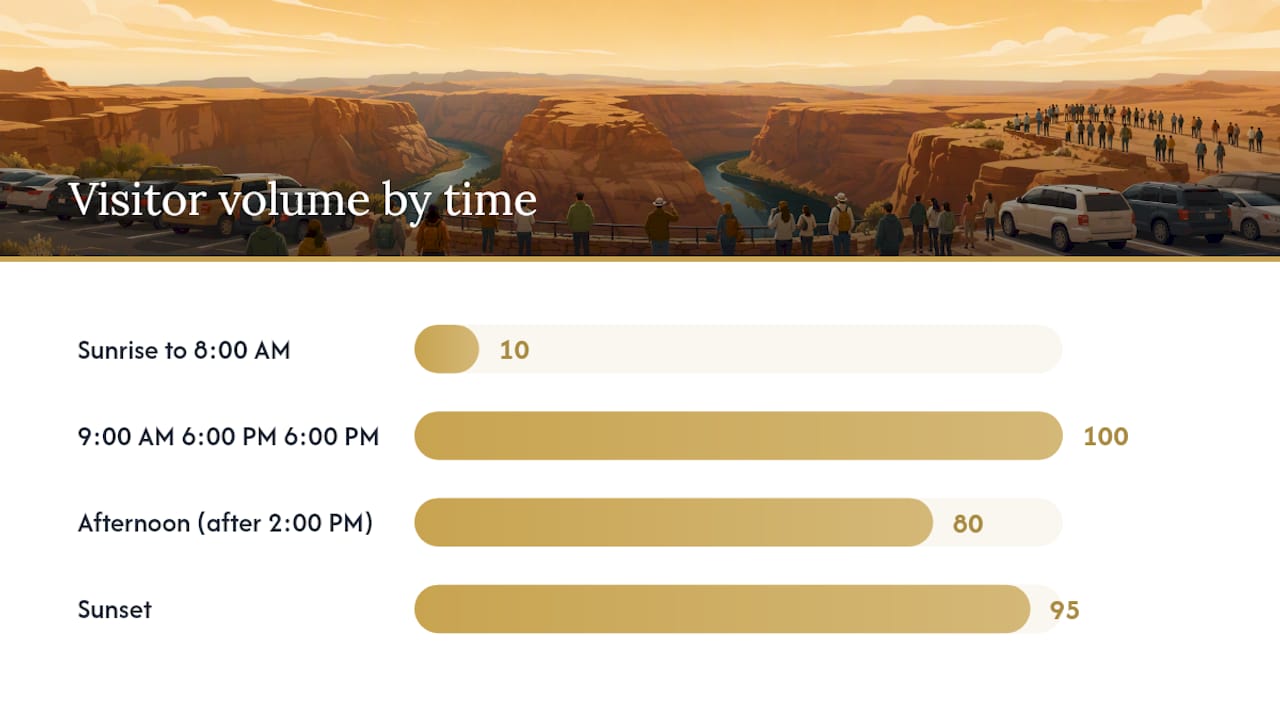
Sunrise is your quietest window, hands down. Traffic builds steadily from there, and 9:00 AM to 2:00 PM tends to be the busiest stretch during peak season, with afternoons holding a steady, if slightly lower, crowd level through the rest of the day. Sunset draws a crowd nearly as large as midday, which surprises a lot of visitors who assume the golden hour rush only happens at other overlooks.
The City of Page runs a strict full-lot policy. When every space is taken, attendants turn cars away at the entrance, and there's no standing overflow lot or shuttle service to fall back on during normal operations. You either wait it out somewhere nearby and try again later, or you drive off without seeing the bend that day.
Best arrival windows, ranked by reliability:
- Sunrise to 8:00 AM: lowest crowd, coolest temperatures, and the light works in your favor for photos.
- Right before 9:00 AM: still manageable, but you're racing the wave of visitors arriving from Page hotels.
- Late afternoon, well before sunset: a second decent window, though not as empty as sunrise.
Pro Tip: If you're traveling in summer or over a holiday weekend, plan to be at the gate when it opens, or skip the gamble entirely and book a private tour that handles the timing for you. A wasted round trip to Page and back eats hours you won't get back.
RV, Bus, and Accessible Parking Rules
Oversized vehicles, RVs over 22 feet, and anything towing a trailer get directed to separate bays by lot attendants, and the fee schedule reflects that with graduated commercial and oversized rates running roughly $35 to $140. There's no ambiguity here; you'll be waved toward the right section rather than left to guess.
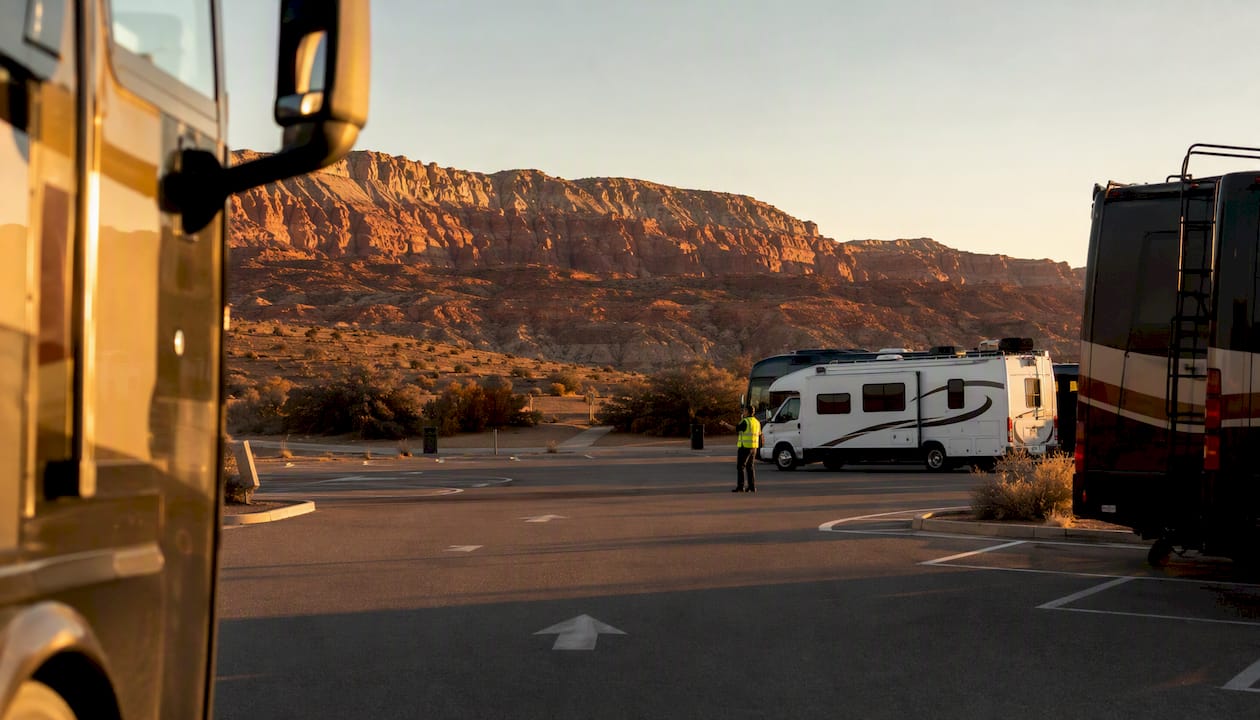
ADA-designated spaces exist near the trailhead, but are limited and tend to fill quickly once the morning rush starts. The same $10 standard fee applies to vehicles with an ADA placard; there's no discount tied to accessibility status. If accessible parking matters to your plan, sunrise arrival isn't optional, it's the only reliable way to secure one of those spaces.
A few practical notes for RV travelers: there are no hookups, no dump stations, and no overnight parking allowed in the lot. If you need a place to park an RV overnight near Page, plan that separately; this lot exists purely for day-visit access to the overlook.
The trailhead includes an ADA-accessible section of path with restrooms that have accessible stalls, but shade along that accessible stretch is just as limited as it is on the rest of the trail. For broader trip planning around accessibility in the region, Grandcanyonjourneys' accessibility guide covers considerations beyond this single stop.
The Walk From the Lot to the Overlook
Round trip, you're looking at about 1.5 miles, or roughly 0.7 miles each way from the parking lot to the rim. Most families cover that one-way stretch in a typical relaxed pace, while faster walkers do it noticeably quicker.
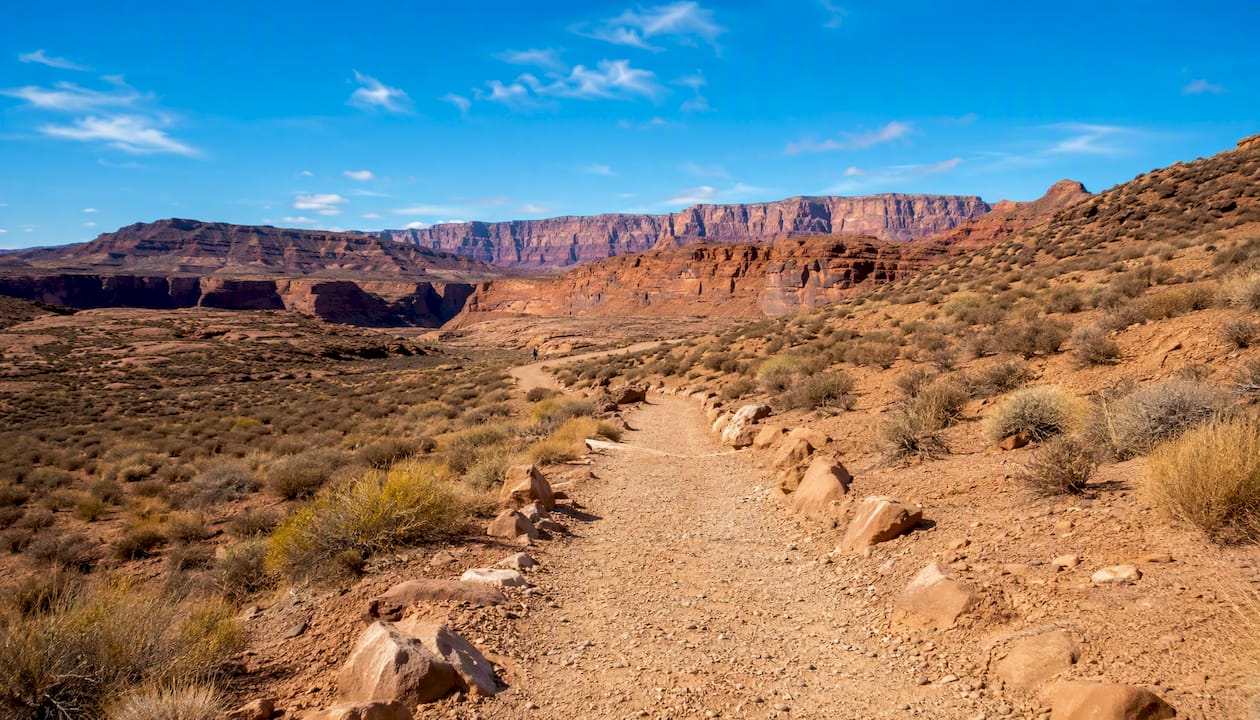
The path starts as a hardened, ADA-accessible surface near the lot, then transitions to compacted sand as you get closer to the rim. Shade is essentially nonexistent for most of the walk, which matters more than it sounds like it should once you're doing it under a July sun at noon.
Pack for exposure, not for a stroll:
- Water, more than you think you'll need. One liter per person is a reasonable minimum, and doubling that in summer isn't excessive.
- Sun protection: hat, sunscreen, sunglasses.
- Closed-toe shoes, since the sandy sections shift underfoot.
- A headlamp if you're staying past sunset; the gate stops admitting new visitors at dusk, but people already inside can finish their visit and walk back in the dark.
- Keep a close eye on children near the rim itself. There's no fence at the edge.
Pro Tip: Heat sneaks up on this trail because it looks short on a map. Pace yourself on the walk back, especially midday in summer, and carry more water than feels necessary. The overlook is worth the trip, but dehydration on an unshaded sand path is a preventable problem, not an unlucky one.
What to Do if the Lot Is Full
If you pull up and the attendant waves you off, you've got a few realistic options, and none of them involve circling the lot hoping a spot magically opens. Try arriving earlier next time, obviously, but in the moment, you can wait nearby and swing back in 30 to 45 minutes, since turnover does happen throughout the day. Some visitors head to the Glen Canyon Dam Overlook instead, a shorter detour that doesn't require the parking gamble.
On major holidays or unusually busy weekends, the City of Page has implemented temporary shuttle requirements once the lot fills, though this isn't standard practice on a typical weekday. Don't count on a shuttle being available; treat it as a possible bonus, not a plan.
The option that removes the guesswork entirely is booking a private tour that includes Horseshoe Bend on a fixed itinerary. A guide who already knows the arrival windows and lot patterns isn't gambling with your morning the way a self-drive visit can.
Can I visit Horseshoe Bend without a tour? Yes, self-driving and parking yourself is completely legal and common; you just need to accept the timing risk that comes with it.
Is Horseshoe Bend free? No, the overlook itself has no separate entry fee, but the parking lot charges $10 for a standard vehicle, and that's effectively the cost of admission for anyone arriving by car.
Rules and Safety at the Rim
There's no fence at the main overlook, and every year brings preventable close calls from people getting too close to the edge for a photo. A few rules keep you and your group safe and out of trouble:
- Stay well back from unfenced edges; wind gusts at the rim are stronger than they feel.
- Watch children constantly near the drop-off; there's no barrier to catch a wrong step.
- No drones without prior authorization.
- No overnight parking or camping in the lot itself.
- Never stop on the US-89 shoulder, even briefly.
The jurisdiction here is genuinely unusual: the overlook and the land south of the trail sit on Navajo Nation land, the surrounding recreation area is managed by the National Park Service, and the parking lot itself belongs to the City of Page. That three-way split explains why the rules and enforcement don't always match what you'd expect from a typical national park visit.
Expect active enforcement on all three fronts: ticketing and towing along US-89, attendants strictly applying the full-lot policy at the gate, and parking staff directing traffic flow inside the lot itself. None of this is arbitrary; it's what keeps a genuinely small piece of land functioning for the volume of visitors it sees.
Checking for Closures and Last-Minute Changes
Before you drive to Page, confirm three things: the lot is open, the fee hasn't changed, and there's no holiday-specific cash policy or temporary shuttle requirement you'd be walking into blind.
The sources worth checking, in order:
- The City of Page parking page for the most current fee schedule and operational hours.
- The National Park Service's Horseshoe Bend page for jurisdiction notes and general visitor information.
- Local public notices around major holidays, since that's when temporary rule changes are most likely.
Screenshot or save these pages before you leave, since cell service on the drive into Page is inconsistent at best. You don't want to be troubleshooting a dead signal in the parking lot line trying to confirm whether today's fee is still $10.
A Practical Read on Managing Parking Risk
Most of the frustration visitors report at Horseshoe Bend traces back to one decision: arriving between 10:00 AM and noon and assuming a spot will be there. It usually isn't, not in peak season. The visitors who get in without drama are almost always the ones who treated sunrise as non-negotiable, not optional.
For travelers who'd rather not build their whole morning around a parking gamble, a private tour that already accounts for lot timing and includes Horseshoe Bend on a fixed schedule removes that variable completely. It costs more than a $10 parking fee, obviously, but it also removes the chance of driving 45 minutes each way for nothing.
A Guaranteed Way to See Horseshoe Bend Without the Parking Gamble
Self-parking works fine when the timing lines up, but it puts the entire visit on a single roll of the dice: arrive at the wrong hour and you drive home without seeing the bend at all. Grandcanyonjourneys removes that risk from the equation entirely. A private, door-to-door tour with a Wilderness First Responder-certified guide means someone else is tracking lot timing, fees, and access windows while you sit back in a climate-controlled vehicle.
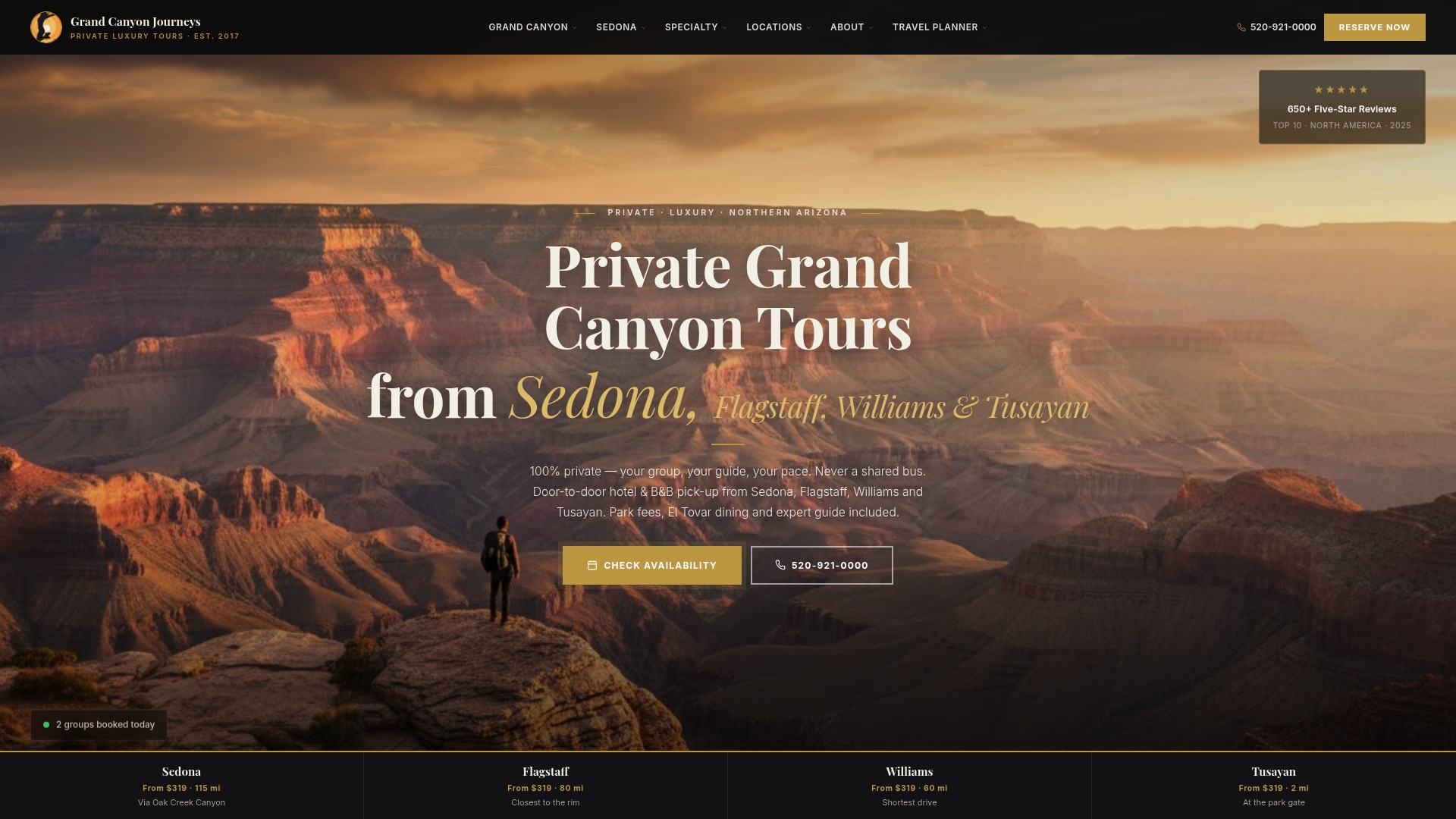
The trade-off is straightforward: self-drive costs you $10 at the gate but risks a wasted afternoon; a private tour costs more upfront but guarantees you actually see the overlook, along with whatever else is on your itinerary that day. Combine it with a slot canyon stop through the Antelope Canyon & Horseshoe Bend tour, or build a fully custom day through the Grand Canyon Travel Planner. If you're staying in the area longer, rental options in nearby St. George are worth a look for multi-day itineraries. Reach out through the planner page to check dates and lock in a guaranteed visit.
Sources
The City of Page parking page covers current fees, hours, and payment policies directly from the authority that manages the lot. The National Park Service's Horseshoe Bend page explains the surrounding recreation area and jurisdictional boundaries that affect what passes work and where. Checking both matters, since local and federal rules diverge here more than they do at most park destinations. For a fully planned alternative, Grandcanyonjourneys' homepage outlines private tour options that sidestep the parking question entirely.
- Horseshoe Bend Parking Fees & Hours 2024 | City of Page, AZ
- Horseshoe Bend on the Colorado River (U.S. National Park Service)
- City of Page official site