Choose a private tour when time, accessibility, or a tailored experience matter most. Choose a group tour when budget and a ready-made social itinerary are the priority.
TL;DR: The decision comes down to control versus structure. Private tours give you the day; group tours give you the plan.
- Time and pace: Private tours let you linger or move fast. Group schedules are fixed.
- Price: Group tours cost less per person upfront. Private tours become cost-competitive for parties of 3–6 splitting a flat-rate booking.
- Social experience: Group tours connect you with other travelers. Private tours keep the experience within your party.
- Accessibility: Private operators can accommodate mobility needs, dietary restrictions, and custom pacing far more easily than group formats.
Table of Contents
- What's the difference between a group tour and a private tour?
- How do private and group tours compare on what actually matters?
- Which traveler type gets the most from each format?
- What should you ask an operator before you book?
- What do private and group tours actually cost?
- How Grand Canyon Journeys shows what private tours can actually deliver
- Do private and group tours have different environmental footprints?
- How do booking and cancellation policies differ?
- What hidden fees should you watch for in each format?
- How do private and group tours handle accessibility and inclusivity?
- Key Takeaways
- The trade-off nobody talks about honestly
- What Grandcanyonjourneys offers readers who choose private
- Useful sources and where to check current details
What's the difference between a group tour and a private tour?
A group tour runs on a shared itinerary with a fixed departure time, a set list of stops, and per-person pricing. You join strangers on a coach, minibus, or walking route. The guide speaks to everyone. The schedule moves at a pace designed for the whole group, not for you.
A private tour is booked exclusively for your party. The vehicle, guide, and itinerary belong to you for the duration. Pricing is typically flat-rate per booking rather than per person, which means the per-person cost drops as your group grows. Start times, stops, and pace are negotiable before you go.
Between those two poles sit a few intermediate formats worth knowing:
- Small-group tours (4–12 people): Better guide attention than a coach tour, often more comfortable transport, but itinerary control is still limited. Per-person pricing is usually lower than a true private booking.
- Semi-private tours: A hybrid where a small number of unrelated parties share a guide and vehicle, sometimes with slight itinerary flexibility.
- Tailored day-share tours: Operator-curated routes sold to multiple buyers but marketed as "flexible." Read the fine print — these are group tours with better branding.
How do private and group tours compare on what actually matters?
The control vs. structure framework cuts through most of the noise. Here is how the two formats stack up across the dimensions that drive real booking decisions.
| Dimension | Group Tour | Private Tour |
|---|---|---|
| Flexibility / itinerary control | Fixed schedule, pre-set stops | Fully customizable; adjust in real time |
| Price / value for time | Lower upfront per-person cost | Higher ticket price; cost-competitive for parties of 3–6 splitting a flat-rate booking |
| Social dynamics / group size | Meet other travelers; coach or minibus | Your party only; intimate and focused |
| Depth of experience / guide attention | Guide divided among all participants | Undivided guide attention throughout |
| Convenience / logistics & transport | Shared pickup points; may require self-transfer | Door-to-door transport in private vehicle |
| Safety & guide qualifications | Varies by operator; rarely disclosed | Top operators list WFR certification and credentials |
| Best for | Budget travelers, solo adventurers, first-timers | Families, couples, time-constrained or accessibility-focused travelers |
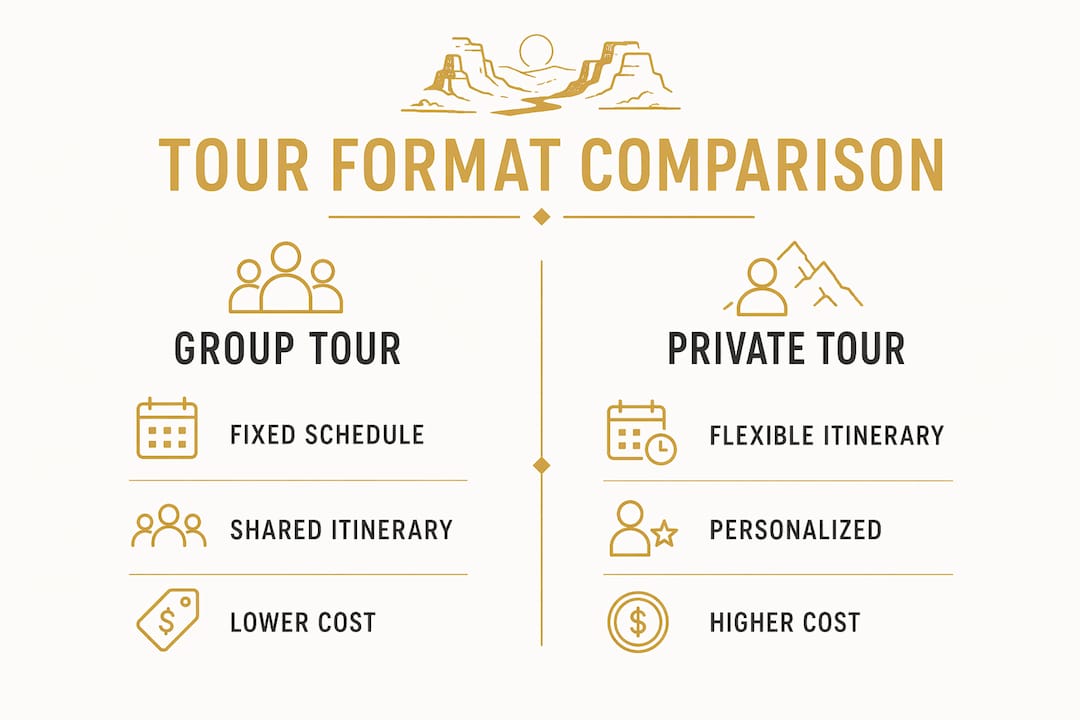
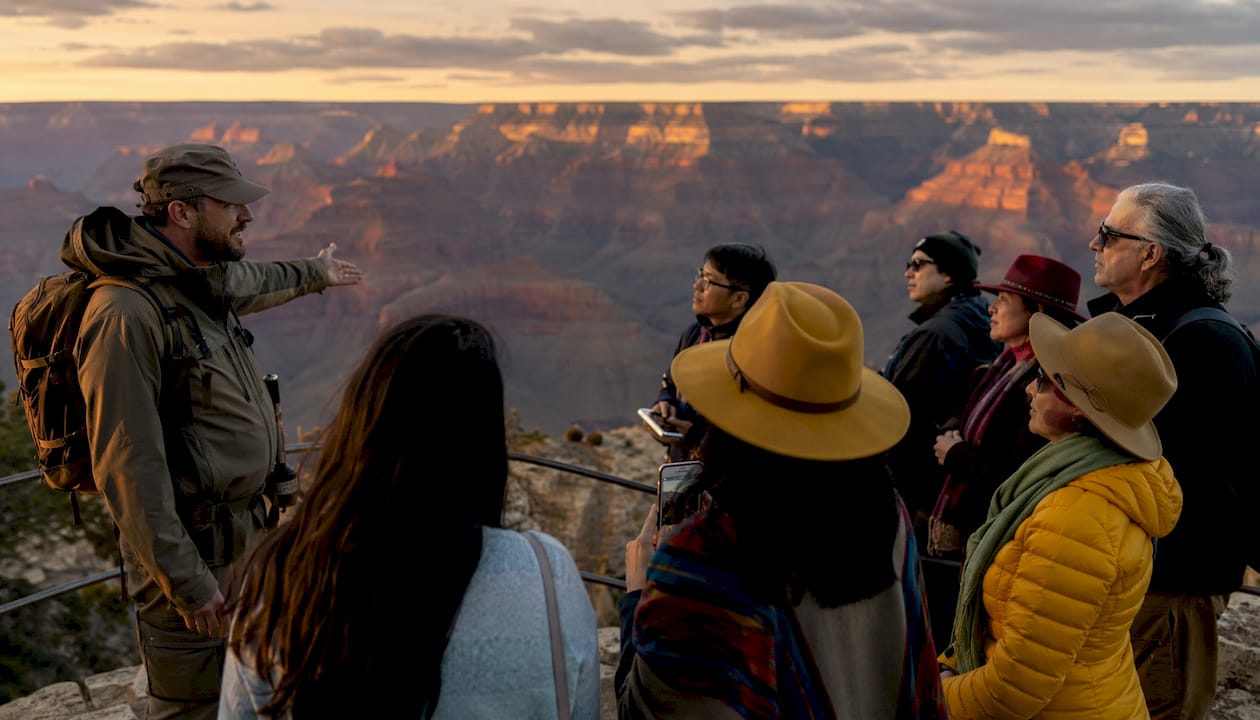
The table tells most of the story, but a concrete example makes it real. Imagine visiting a canyon viewpoint. On a group tour, the guide announces 20 minutes at the overlook, then the bus moves on whether you are ready or not. On a private tour, you stay until the light is right for your photo, ask your guide about the geology you just noticed, and decide together whether to skip the next stop in favor of a longer lunch. Same destination, completely different day.
One thing group tours rarely advertise: mandatory shopping stops. Many operators offset their low per-person pricing by routing groups through partner retail outlets. That "free" afternoon in town may cost you 90 minutes in a souvenir shop.
Pro Tip: When comparing costs, add up the full day: private transfers, park entry fees, meals, and waiting time at shared pickup points. For a short trip, the total value of a private tour often closes the price gap faster than the headline numbers suggest.
Which traveler type gets the most from each format?
Most travelers fall into one of these profiles. Match yours to the format that fits.
- Solo budget traveler: Group tours are the clear call. Per-person pricing is lowest, and shared itineraries remove the planning burden. The social upside is real too.
- First-time visitor to a destination: Either format works, but group tours offer a structured introduction with less decision fatigue. If the destination is complex or the traveler is risk-averse, a group tour's built-in logistics help.
- Couple on a short trip (3–5 days): Private is almost always worth it. Two people split a flat-rate booking, the guide focuses entirely on them, and they set the pace. A private Grand Canyon sunset tour, for instance, is a fundamentally different experience than watching the same view from a crowded overlook with 40 strangers.
- Family with young kids: Private tours handle the unpredictability of traveling with children. Bathroom breaks, nap schedules, and picky eaters are not problems on a private itinerary. For families visiting the Grand Canyon, child-friendly pacing and flexible stops make the day far less stressful.
- Multi-generational group (6–10 people): At this size, a private booking often costs less per person than a premium group tour, and the group controls the day. Private operators can accommodate mixed mobility levels in a way group coaches rarely can.
- Photography or special-interest traveler: Private, without question. Lingering for the right light, revisiting a location, or asking a guide to detour to an off-map site requires the kind of flexibility that private guided excursions are built for.
- Time-constrained traveler (fewer than 7 days): Private tours deliver higher marginal value when every hour counts. Think of the private cost as a fee for certainty rather than a luxury add-on.
One edge case worth noting: mixing formats across a longer trip makes sense. Start a two-week itinerary with a group city tour to get oriented, then switch to private for the experiences you care most about. The two formats are not mutually exclusive.
What should you ask an operator before you book?
The difference between a great tour and a frustrating one often comes down to questions you did not ask. Run through this checklist before confirming any booking.
- What exactly is included? Meals, park entry fees, transport, and gratuity should be itemized, not bundled under "all-inclusive."
- Is the transport private or shared? "Private tour" sometimes means a private guide on a shared shuttle. Confirm the vehicle is exclusively yours.
- What is the maximum group size? For group tours, ask the hard cap. For private tours, confirm no other parties will join.
- What is the cancellation policy? Get the exact terms in writing: full refund window, partial refund thresholds, and what happens if the operator cancels.
- Are there single-supplement fees? Solo travelers on group tours often pay a surcharge for single occupancy on multi-day trips.
- What are the guide's qualifications? For hiking or adventure tours, ask specifically about Wilderness First Responder (WFR) certification. Operators who list guide credentials openly are signaling accountability.
- Is pickup door-to-door or at a central meeting point? Door-to-door matters most for families, seniors, and travelers with mobility considerations.
- Are shopping stops included, and are they optional? If the answer is vague, treat it as a red flag.
- What accessibility accommodations are available? Ask about vehicle type, trail difficulty, and whether the operator has experience with mobility aids.
- What is the exact pricing breakdown? Confirm whether the quoted price is per person or per booking, and whether any fees are added at checkout.
Red flags to watch for: Vague inclusions ("meals may be included"), no mention of guide credentials, reviews that mention unexpected fees, and refund policies that require 30+ days notice for a full refund. Any operator unwilling to answer these questions directly is telling you something.
What do private and group tours actually cost?
Price ranges vary by destination, season, and inclusions, but the general pattern holds across most U.S. tour markets.
- Group day tours: Per-person prices commonly run from low to mid-price ranges for standard itineraries, though premium small-group products can cost more.
- Private day tours: Per-person pricing varies widely depending on party size, vehicle type, and inclusions. Costs per person decrease as group size increases, sometimes approaching or falling within the range of group tour pricing.
- Multi-day private tours: Costs scale with accommodation choices, guide days, and add-ons. The per-person math shifts significantly as party size grows.
Key pricing drivers to understand:
- Flat-rate vs. per-person structure: Private tours charge a flat daily rate covering guide and vehicle. That rate divided by four people looks very different from the same rate divided by two.
- Inclusions: Park entry fees, curated meals, and private-access surcharges add real value but also real cost. Confirm what is in the price before comparing numbers.
- Seasonality: Peak-season pricing at high-demand destinations like the Grand Canyon can push both group and private rates up. Visiting in shoulder season often cuts costs without sacrificing experience. The best time to visit the South Rim affects both availability and price.
- Add-ons: Optional excursions on group tours are a common upsell. Private tours typically build the day around your priorities from the start, so surprise add-ons are less common.
| Tour type | Typical day-tour pricing | Notes |
|---|---|---|
| Large group tour | Generally lower per-person costs with fixed itinerary; may include shopping stops | |
| Small-group tour (4–12) | Moderate per-person costs; better attention with some flexibility | |
| Private day tour (2 people) | Higher per-person cost due to flat-rate split among fewer people | |
| Private day tour (4–6 people) | More competitive per-person costs due to flat-rate split among more participants |
Pricing varies widely by destination and operator. Confirm current pricing directly with operators.
How Grand Canyon Journeys shows what private tours can actually deliver
Grandcanyonjourneys is a Sedona-based private tour operator that makes the abstract advantages of private travel concrete and verifiable. Here is what the offering actually includes, mapped to the decision dimensions above.
- Door-to-door transport in premium vehicles: Late-model luxury SUVs and custom transit vans with leather seating and panoramic windows. No shared shuttles, no central meeting points.
- WFR-certified guides for hiking: Below-rim hikes on Bright Angel and South Kaibab trails are led by guides holding Wilderness First Responder certification, a standard rarely disclosed by group operators.
- Curated dining at El Tovar: The South Rim day tour includes a sit-down lunch at El Tovar, the historic rim-side lodge. That is a meaningfully different experience from a packed lunch on a group bus.
- Customizable itineraries: South Rim, Sedona red rocks, Wupatki National Monument, Secret Antelope Canyon, and Verde Valley wine tastings are all available as private itineraries. The day is built around your party's priorities.
- All logistics handled: Park entry fees, dining reservations, and routing are managed in advance. You show up; the day runs.
Consider a practical scenario: a couple with two days in Sedona. Day one, a private ancient ruins and canyon tour covering Wupatki and the South Rim, with lunch at El Tovar and a flexible pace at each viewpoint. Day two, a Sedona highlights and wine tasting in the afternoon. Both days door-to-door, no shared vehicles, no fixed group schedule. The per-hour value of that itinerary, compared with two days of group bus tours covering the same ground, is where private travel makes its case most clearly.
Pro Tip: Before your tour, send the operator a short note: your must-see priorities, any physical limitations, preferred pace, and one or two questions you want answered on the day. A pre-tour briefing like this turns a private tour from a scripted route into a genuine conversation with a local expert.
Do private and group tours have different environmental footprints?
Group tours have a structural efficiency advantage: one vehicle carrying 20 people produces far less carbon per traveler than 20 separate cars or 10 private SUVs. On that metric alone, large group formats win.
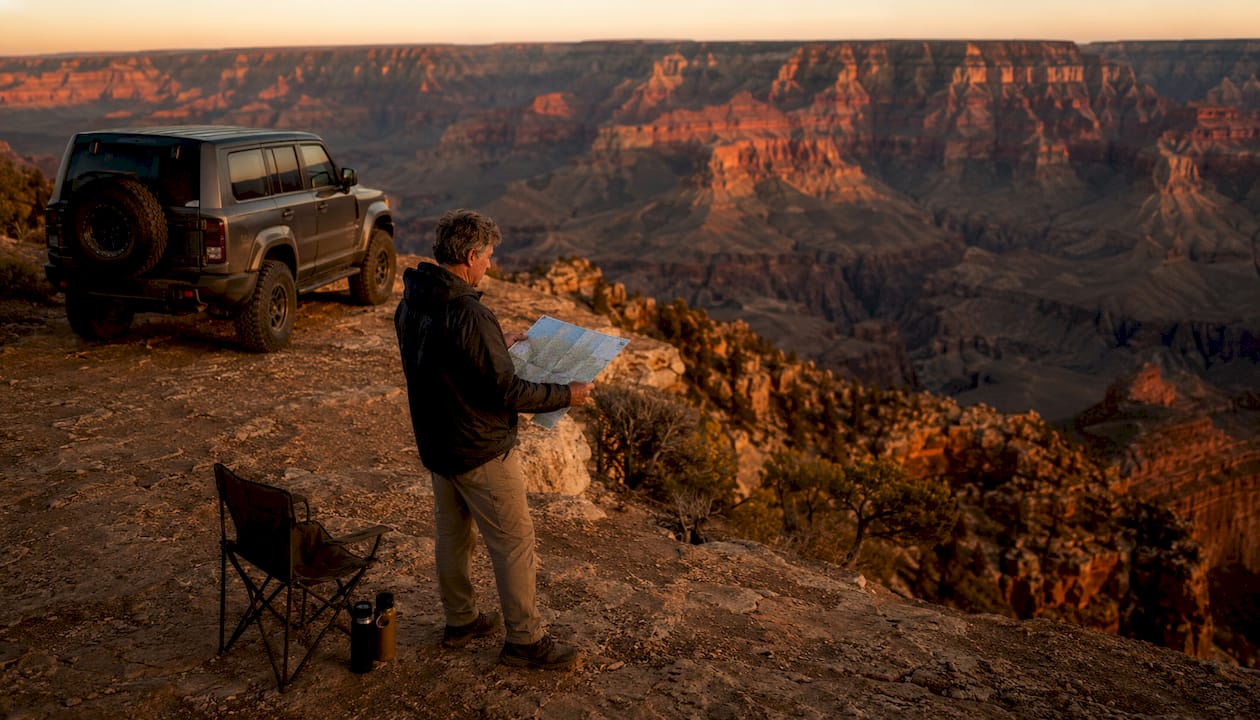
The picture gets more complicated at the destination level. Large coach groups concentrate foot traffic at the same viewpoints at the same time, which accelerates erosion on popular trails and degrades the experience for everyone. Private tours spread that impact across more departure times and, with a good guide, can route visitors to less-trafficked areas.
Ethical considerations follow a similar pattern. Group operators serving high-volume destinations sometimes prioritize throughput over stewardship. Private operators with strong local ties tend to have more accountability: their reputation depends on repeat clients and referrals, not volume. Ask any operator, group or private, whether they follow Leave No Trace principles, whether guides are trained in site-specific conservation practices, and whether any portion of fees supports local communities or conservation programs.
How do booking and cancellation policies differ?
Group tours typically require a deposit at booking, with the balance due closer to departure. Cancellation windows are often strict: many operators offer a full refund only if you cancel 30 or more days out, with partial refunds or no refund inside that window. Because group tours run on fixed departures, a last-minute cancellation leaves a seat the operator cannot easily resell.
Private tours vary more by operator. Many boutique private operators offer more flexible cancellation terms because they can rebook a vehicle and guide more easily than a group operator can fill a single seat. That said, premium private operators with high demand, particularly at popular destinations during peak season, may hold firm on deposits.
What to look for regardless of format: a written cancellation policy before you pay, clarity on what happens if the operator cancels (weather, guide illness), and whether travel insurance is recommended or required. The Grand Canyon FAQ page covers booking specifics for Grandcanyonjourneys tours directly.
What hidden fees should you watch for in each format?
Both formats have common fee traps that do not show up in the headline price.
Group tour hidden costs:
- Mandatory shopping stops that consume paid tour time
- Optional excursions upsold on the day (often the best experiences are "extra")
- Single-supplement fees for solo travelers on multi-day trips
- Gratuity not included in the quoted price
- Luggage fees on coach transfers
Private tour hidden costs:
- Park entry fees listed as "not included" in the base price
- Fuel surcharges on long-distance routes
- Gratuity for guide and driver listed separately
- Premium dining or exclusive-access fees added at the operator's discretion
- Cancellation fees if you change the itinerary after booking
The cleanest operators, group or private, list every line item before checkout. If a price looks unusually low, ask what is not included before you book. For types of group travel arrangements, the structure of what is and is not included varies considerably by format and operator.
How do private and group tours handle accessibility and inclusivity?
Private tours have a clear structural advantage for travelers with mobility limitations, sensory needs, or medical requirements. The operator configures the vehicle, route, and pace around your specific situation before departure. A traveler using a wheelchair, a senior with limited walking endurance, or a guest with dietary restrictions can communicate needs directly and have them addressed in the itinerary rather than accommodated as an afterthought.
Grandcanyonjourneys, for example, offers specific guidance for seniors visiting the Grand Canyon, with pacing and vehicle access adapted to the traveler rather than the group average.
Group tours present more friction. A coach tour designed for the median traveler may move too fast for someone with limited mobility, offer no alternative to a staircase-heavy site, or lack the flexibility to adjust when a participant needs more time. Some group operators do offer accessibility-focused departures, but these are the exception rather than the standard product.
For travelers with significant accessibility needs, the question of private vs. group is less about preference and more about practicality. A private operator who answers your accessibility questions in detail before booking is the right choice. One who gives vague reassurances is not.
Key Takeaways
Private tours deliver more control, personalization, and accessibility; group tours deliver lower per-person cost and a built-in social structure. For most U.S. travelers on short trips or with specific needs, private tours offer better value per hour than their headline price suggests.
| Point | Details |
|---|---|
| Control vs. structure | Private tours give itinerary control; group tours provide a ready-made, low-friction plan. |
| Per-person cost math | Private tours become cost-competitive for parties of 3–6 splitting a flat-rate booking. |
| Time-constrained trips | On trips under 7–10 days, private tours often deliver higher value per hour spent sightseeing. |
| Red flags to screen | Vague inclusions, undisclosed shopping stops, and missing guide credentials signal a poor-fit operator. |
| Grandcanyonjourneys | Offers fully private Grand Canyon and Sedona tours with WFR-certified guides, door-to-door transport, and curated dining. |
The trade-off nobody talks about honestly
Most articles frame private vs. group as a money question. It is not, or at least not primarily. The real question is what you are willing to give up.
Group tours ask you to give up control in exchange for convenience and cost savings. That is a fair trade for a lot of travelers, particularly first-timers who do not yet know what they want from a destination. There is genuine value in having someone else make every decision for a day.
Private tours ask you to give up the social serendipity of meeting strangers in exchange for a day that is entirely yours. That trade is worth it when you have specific priorities, limited time, or people in your group with particular needs. It is less worth it when you are traveling solo on a tight budget and would genuinely enjoy the company.
The mistake most travelers make is treating the private option as automatically superior. It is not. A private tour with a mediocre guide and no pre-tour communication is worse than a well-run small-group tour with an expert leader. Format matters less than operator quality. The questions in the checklist above exist precisely to separate operators who deliver on the format's promise from those who just charge private prices.
One practical note: mixing formats across a trip is underrated. A group orientation tour on day one, followed by private experiences for the moments you care most about, often produces a better overall trip than committing entirely to one format.
What Grandcanyonjourneys offers readers who choose private
If you have decided that private is the right format for your trip to Northern Arizona, Grandcanyonjourneys is built specifically for that decision. Every tour is fully private, meaning no shared vehicles, no strangers joining your group, and no fixed group schedule overriding your day.
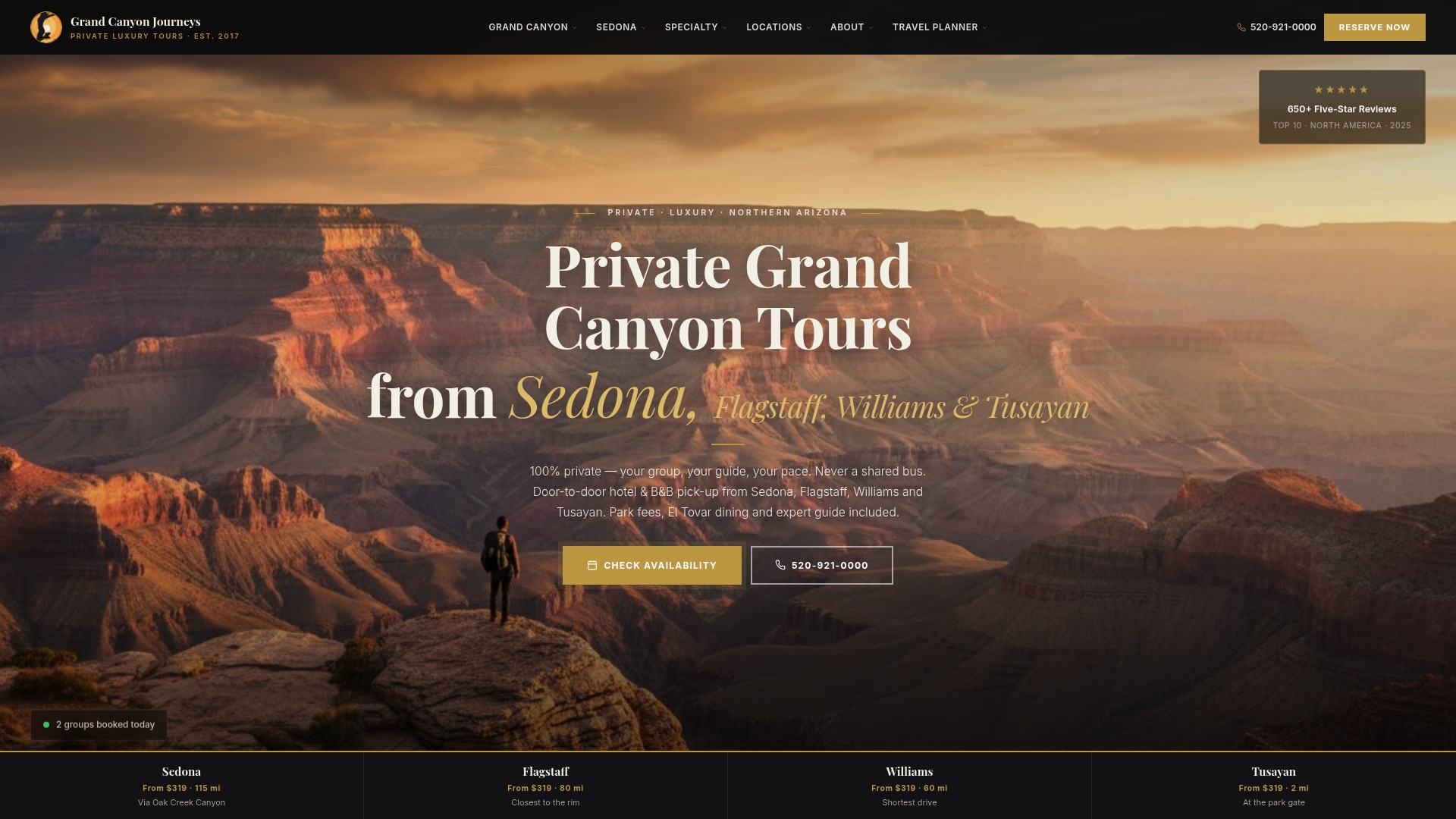
The core offerings cover the region's best experiences: the Grand Canyon South Rim day tour with lunch at El Tovar, sunset expeditions timed for golden hour at west-facing rim viewpoints, below-rim hiking with WFR-certified guides, Sedona red rock sightseeing, Sedona wine country tastings in the Verde Valley, and private stargazing under some of the darkest skies in the Southwest. All tours include door-to-door pickup in premium vehicles, park entry fees, and curated dining where applicable.
To check availability and current pricing, visit the Grand Canyon travel planner or browse specific tours directly. Booking typically requires a deposit at reservation, with balance due closer to your tour date. Lead times vary by season, so checking availability a few weeks out is advisable for peak months.
Useful sources and where to check current details
These are the principal references used throughout this article. Use them to cross-check inclusions, guide credentials, and pricing before you book.
- Private Tours vs Group Tours: Which is Right for You? — TourHQ's overview of itinerary control and transport differences between formats.
- Private vs Small Group Tours: Which travel experience is better? — Source for the "control vs. structure" framing used throughout this article.
- Private vs Group Tours: Which Fits Your Trip? — Covers total-value comparisons and the per-person math for small parties.
- Group Tour vs Private Tour Cost Breakdown — Detailed breakdown of flat-rate vs. per-person pricing structures and how party size affects cost.
- Grand Canyon Journeys — Grandcanyonjourneys's main booking page; check current tour availability, pricing, and cancellation terms directly here.
- Grand Canyon Day Tour — Specific inclusions, pricing, and pickup details for the South Rim private day tour.
- Grand Canyon Hiking Tour — Guide credentials and below-rim hiking details, including WFR certification information.
What to cross-check before booking any operator: confirm that inclusions are itemized (not bundled), that guide qualifications are listed by name or certification, that the vehicle type is specified, and that the cancellation policy is in writing before you pay a deposit.
Recommended
- Private Grand Canyon Day Tour from Sedona | South Rim — Grand Canyon Journeys
- Private Grand Canyon Sunset Tour from Sedona | Golden Hour — Grand Canyon Journeys
- Grand Canyon & Ancient Ruins Tour from Sedona | Wupatki — Grand Canyon Journeys
- Our Vehicles | 2023 Ford Transit, Ford Expedition & More — Grand Canyon Journeys