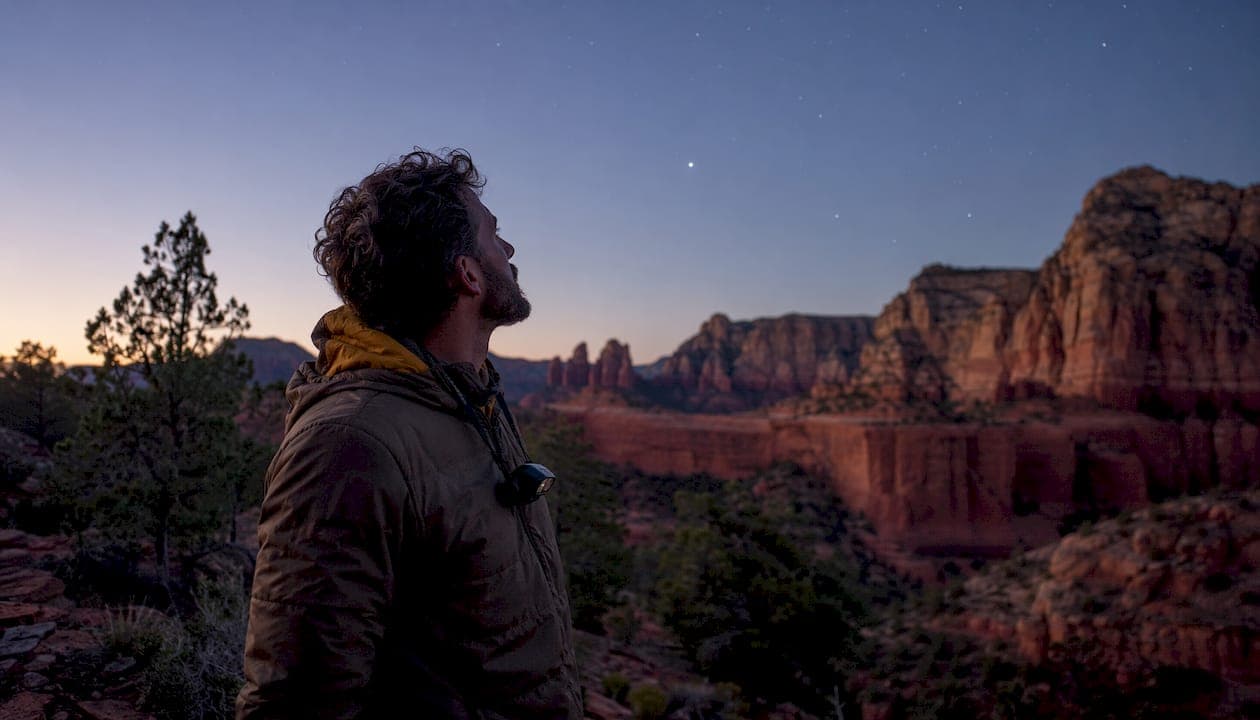
Sedona holds one of the clearest, darkest night skies in the American Southwest. The town earned its International Dark Sky Community designation in 2014 from the International Dark-Sky Association, making it one of a select group of municipalities in the United States formally recognized for protecting natural darkness. Sitting at roughly 4,500 feet elevation, Sedona benefits from a thinner atmosphere, low humidity, and a dry desert climate that delivers sharp, transparent skies for most of the year. The red rock formations that define the landscape by day become dramatic silhouettes against a star-filled sky at night.
Why Sedona stands out for night sky viewing:
- Official dark sky status since 2014, with town-wide lighting ordinances that limit light pollution
- High desert elevation reduces atmospheric interference compared to lower-altitude cities
- Dry climate with roughly 278 sunny days annually and low atmospheric water vapor
- Multiple accessible sites within minutes of town, many framing iconic red rock formations
- Guided tours led by professional astronomers with large-aperture telescopes and 4K video astronomy rigs
Table of Contents
- Where are the best places to stargaze in Sedona?
- When is the best time to stargaze in Sedona?
- What can you actually see in Sedona's night sky?
- Are guided stargazing tours in Sedona worth it?
- What to bring for a night out under Sedona's stars
- Expert insights on getting the most from Sedona's night sky
- See Sedona's night sky with Grandcanyonjourneys
- Key Takeaways
Where are the best places to stargaze in Sedona?
The darkest skies near Sedona sit outside town in the surrounding national forest, but several public trailheads within the community deliver genuinely impressive views. A good site needs three things: an open horizon, distance from streetlights, and legal nighttime access.
- Beaverhead Flat Scenic Overlook is one of Sedona's best-kept secrets. It offers unobstructed 360-degree views with minimal foot traffic, giving photographers room to set up long-exposure rigs without competing for space.
- Aerie Trailhead (off Boynton Pass Road near Doe Mountain) features paved access and wide-open views of the red rock landscape, making it comfortable for extended viewing sessions.
- Fay Canyon sits less than 10 miles west of central Sedona off Dry Creek Road. Walk past the tree-lined entrance and the sky opens into a wide clearing, ideal for meteor shower watching.
- Two Trees Observation Area off SR 89A toward Cottonwood is a designated viewing field with a restroom and flat terrain. The local astronomy club, the Sirius Lookers, uses it for public star parties.
- Baldwin Trailhead near Cathedral Rock is the top astrophotography spot in Sedona. The gentle 1.6–1.75-mile loop frames Cathedral Rock's spires against the Milky Way.
Most U.S. Forest Service trailhead lots require a Red Rock Pass to park. Check current rates at the trailhead machines before you go; a federal America the Beautiful pass is accepted in place of one. Guided tours operate from permitted dark-sky sites in the national forest that are darker than any public trailhead and are shared with guests upon booking confirmation.
When is the best time to stargaze in Sedona?
Sedona rewards night sky visitors in every season, but the conditions vary enough that timing genuinely matters.
- Fall (September through November) is the best overall window. Skies are consistently clear, nighttime temperatures are mild, and the summer monsoon season has ended.
- Winter brings the sharpest, most transparent skies of the year. Cold temperatures keep atmospheric moisture low, and the lack of humidity produces pin-sharp star views. Dress accordingly.
- Spring is a strong secondary season. Humidity stays low, and the Milky Way's galactic core begins rising in the east by late February, with visibility extending through October.
- Summer monsoon season (July through mid-September) is the least reliable period. Afternoon storms can linger into the evening, though skies after a storm clears are sometimes spectacular.
Moon phase matters as much as season. Planning within five days of the new moon maximizes darkness and reveals faint objects the naked eye misses entirely during a full moon. For 2026, check the lunar calendar in advance and book guided tours around new moon dates for the best experience.
What can you actually see in Sedona's night sky?
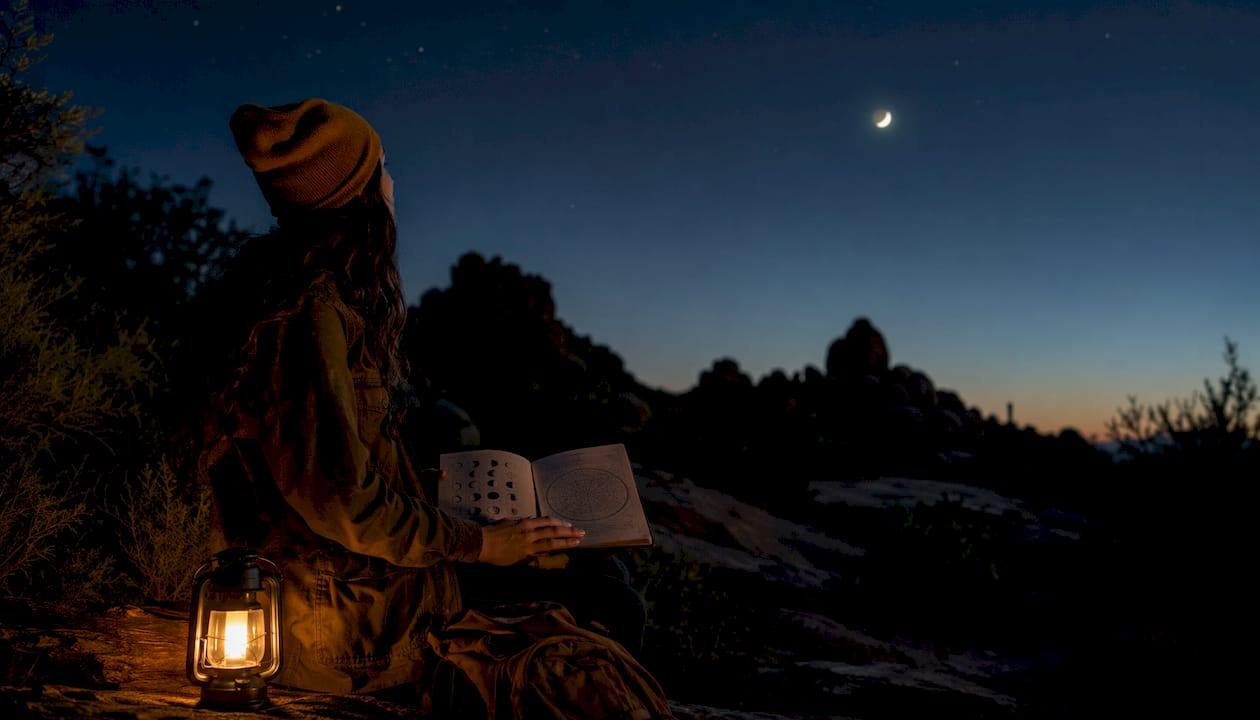
The difference between a dark sky site and a suburban backyard is not subtle. From Sedona, the Milky Way appears as a luminous, textured band stretching across the full sky, not just a faint smear.
With the naked eye, you can identify major constellations, zodiac signs, and dozens of bright stars. Satellites cross the sky regularly, and during peak meteor showers like the Perseids in August, shooting stars appear every few minutes. The Milky Way's galactic core is visible from roughly late February through October, peaking for evening viewing in May through July.
Through a telescope, the experience expands considerably. Saturn's rings resolve into a crisp, three-dimensional image. The Moon's craters and mountain ranges become geological features rather than a flat disc. Deep-sky objects like the Orion Nebula, the Andromeda Galaxy, and open star clusters become visible in color and detail that photographs rarely capture accurately. Guided tours using 4K video astronomy rigs project these views in real time, so every person in the group sees the same image simultaneously.
Are guided stargazing tours in Sedona worth it?
Free public stargazing from Sedona's trailheads is genuinely good. What a guided tour adds is equipment and expertise that changes what you actually understand about what you're seeing.
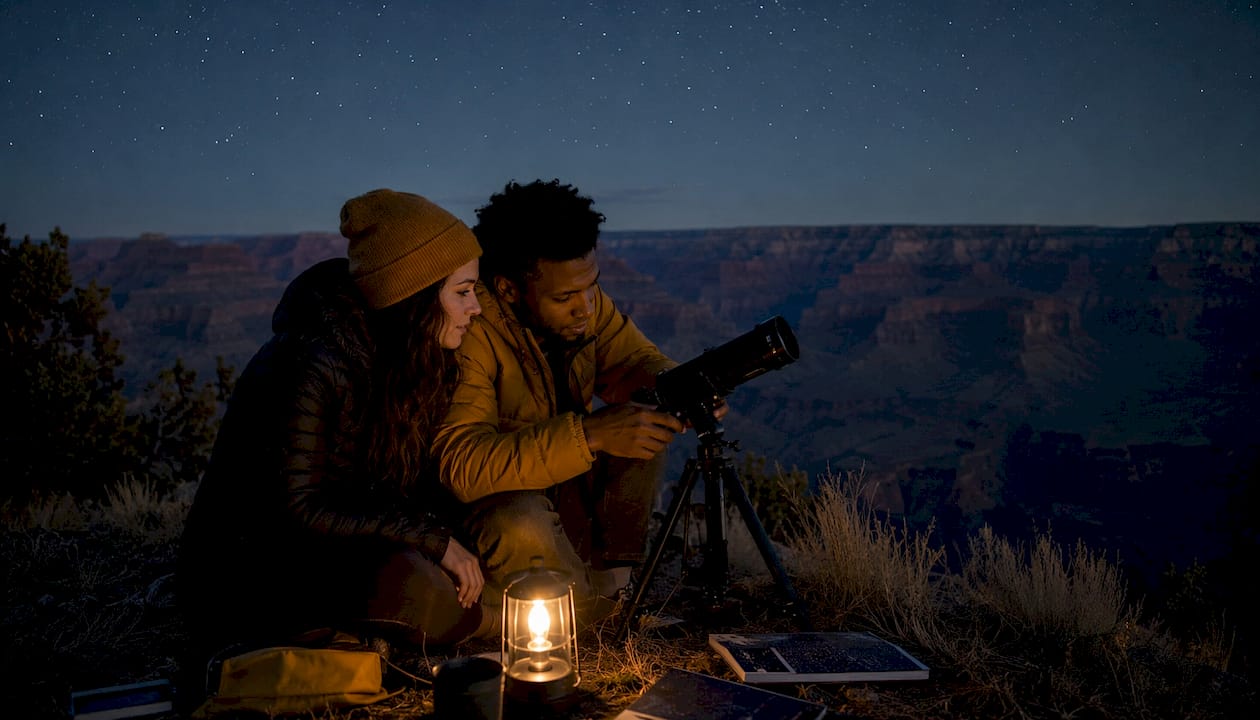
Professional tours use large-aperture telescopes paired with 4K video astronomy setups that reveal color in nebulae and structural detail in galaxies that the naked eye cannot detect. Tours typically run about 1.5 hours, cost around $125 per person, and include padded seating, blankets, and an astronomer who narrates constellations, explains mythology, and points out objects using a high-power laser pointer. Free cancellation up to 24 hours before is standard for most reputable operators.
Guided tours also operate from permitted dark-sky sites under U.S. Forest Service authorization, rotating locations seasonally to find optimal horizons. These sites are always within 30 minutes of Uptown Sedona. You drive yourself there; the exact location arrives with your booking confirmation. For anyone serious about seeing Saturn's rings or a distant galaxy rather than just counting stars, the guided experience is the more rewarding option.
What to bring for a night out under Sedona's stars
Desert nights cool fast, even in summer. Preparation makes the difference between a memorable evening and a miserable one.
- Warm, layered clothing. Fall and winter nights can drop into the low 40s°F. A fleece, a wind layer, and warm socks are not optional.
- Blanket or reclining chair. Extended sky-watching is far more comfortable lying back than standing.
- Red-light flashlight. White light destroys night vision instantly. A red-light headlamp lets you navigate without resetting your eyes.
- Water and snacks. Dry desert air dehydrates quickly, especially at elevation.
- Camera gear. For astrophotography, bring a wide-angle lens, a sturdy tripod, and a remote shutter release. A smartphone works well when paired with a telescope on a guided tour.
Pro Tip: Allow at least 20 minutes for your eyes to fully adapt to darkness before judging what you can see. Most casual observers give up too early and miss the faint objects that make dark sky viewing extraordinary.
Expert insights on getting the most from Sedona's night sky
Fall and winter consistently deliver the most transparent skies, with low humidity and stable atmospheric conditions that sharpen star contrast. Serious observers plan around these seasons and combine them with new moon timing for maximum effect.
Beaverhead Flat Scenic Overlook earns its reputation among local astronomers specifically because it sits away from even Sedona's modest town glow, with a full 360-degree horizon that lets you track objects from rise to set. It rarely draws crowds, which matters when you're setting up a tripod or trying to hold a dark-adapted eye.
For astrophotographers on guided tours, telescopes function as powerful telephoto lenses when paired with a smartphone adapter. The result is a close-up image of Saturn or the lunar surface that most people have never captured with their own phone. Ask your guide whether the tour permits this before booking.
The rotation of permitted Forest Service sites through the year is more than a logistical detail. It means tour operators actively seek the best available horizon for each season rather than defaulting to a fixed location. That seasonal optimization is part of what separates a guided experience from a self-guided visit to a public trailhead.
Pro Tip: Target nights within five days of the new moon and arrive at your site 30 minutes before full darkness. That combination gives your eyes time to adapt while the last light fades, so you catch the Milky Way core the moment it becomes visible.
Sedona's dark sky community designation, awarded in 2014, reflects a town-wide commitment to lighting ordinances that actively protect the night sky — one of the few cities in Arizona to hold this status.
See Sedona's night sky with Grandcanyonjourneys
Grandcanyonjourneys offers a private Sedona stargazing tour built for travelers who want more than a public trailhead and a phone flashlight. The experience pairs expert astronomy guidance with the same personalized, small-group format that defines every Grandcanyonjourneys expedition. No crowded buses, no rushed timelines. You get a professional astronomer, large-aperture telescopes, and access to permitted dark-sky sites in the national forest that most visitors never find on their own.
For those who want to combine Sedona's red rock scenery by day with its extraordinary night sky, the Sedona Highlights Tour pairs naturally with an evening under the stars. Both experiences reflect the same standard: private, unhurried, and genuinely worth the trip. Check availability and reserve your night at grandcanyonjourneys.com/luxury-arizona-experiences.
Key Takeaways
Sedona's combination of an official dark sky designation, high desert elevation, and dry climate makes it one of the best places in the United States to see the Milky Way, planets, and deep-sky objects with exceptional clarity.
| Point | Details |
|---|---|
| Dark sky designation | Sedona has been an International Dark Sky Community since 2014, with lighting ordinances that actively limit light pollution. |
| Best season | Fall (September through November) offers the clearest skies and mild nighttime temperatures for comfortable viewing. |
| Moon phase matters | Plan within five days of the new moon to maximize darkness and reveal faint objects like nebulae and distant galaxies. |
| Guided tours add depth | Tours typically last about 1.5 hours and cost around $125 per person, using large-aperture telescopes and 4K video astronomy from permitted Forest Service sites. |
| Grandcanyonjourneys | Offers private Sedona stargazing tours with professional astronomers and access to dark-sky sites beyond public trailheads. |
Recommended
- Sedona Stargazing Tour | Private Astronomy Under Dark Skies — Grand Canyon Journeys
- Private Grand Canyon Sunset Tour from Sedona | Golden Hour — Grand Canyon Journeys
- Sedona Highlights Tour | Private Red Rock Sightseeing — Grand Canyon Journeys
- Arizona Stargazing Guide: Best Dark Sky Spots | Grand Canyon Journeys