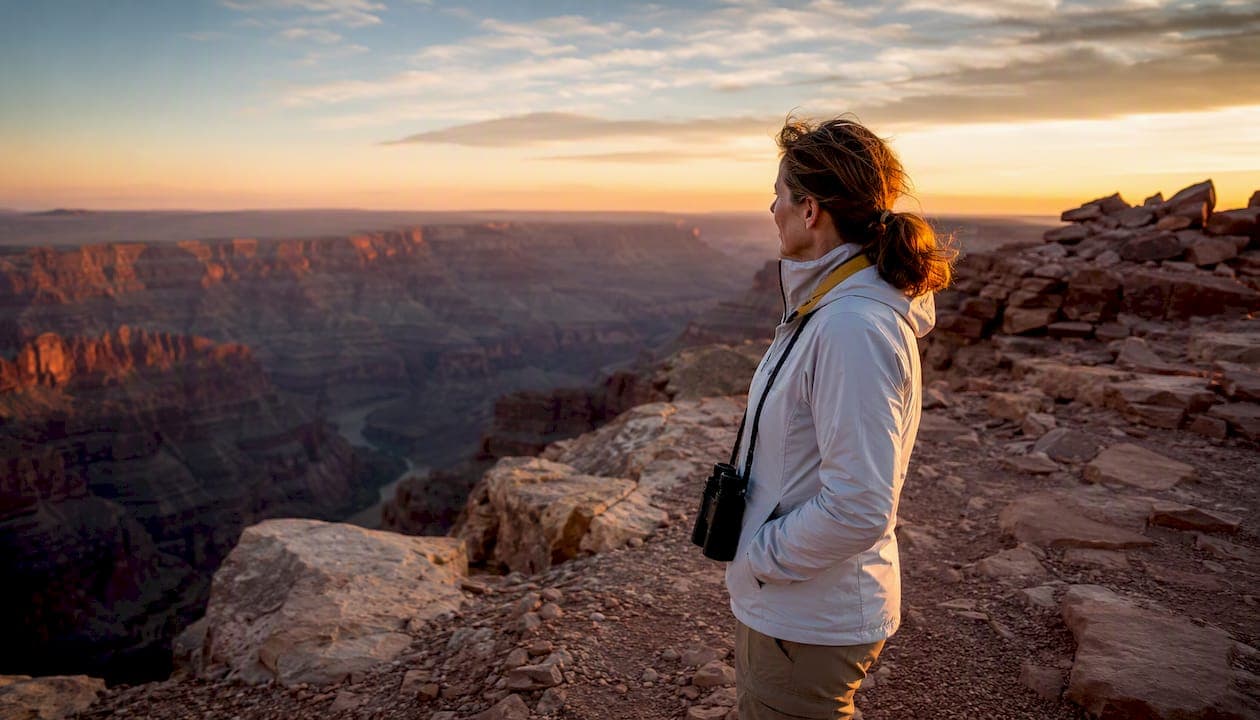
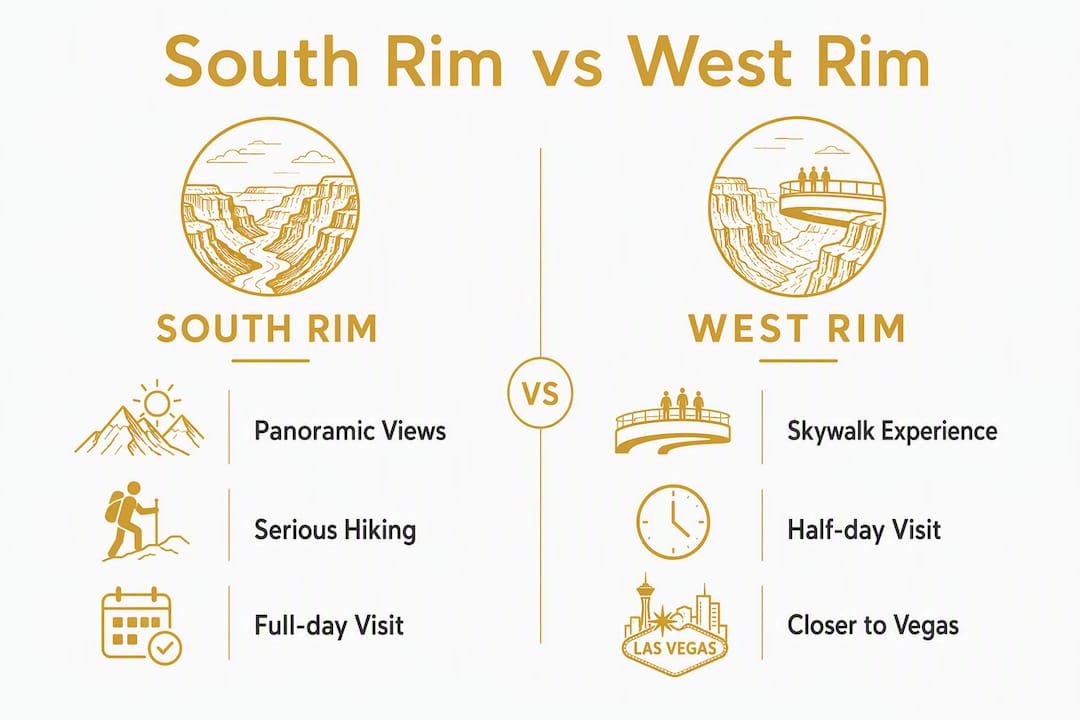
Choose the South Rim for a classic, multi-day Grand Canyon experience with world-class hiking and iconic panoramic views. Choose the West Rim if you're coming from Las Vegas and want a high-impact half-day built around the Skywalk glass bridge.
The decisive factors come down to three things:
- Management and rules: The South Rim falls under Grand Canyon National Park and NPS regulations, with full trail infrastructure, lodging, and shuttle systems. The West Rim sits on Hualapai Tribal land with separate entry fees and a pay-per-attraction model.
- Views and depth: South Rim delivers wide, layered panoramas from dozens of overlooks along a 33-mile rim drive. West Rim puts you closer to the Colorado River with steeper, narrower walls and the Skywalk's glass-floor vantage point.
- Hiking vs. thrill attractions: Bright Angel Trail and South Kaibab Trail offer serious multi-mile descents into the canyon. The West Rim's Eagle Point and Guano Point are short walks; the Skywalk is the main draw.
Your origin city and available time settle it faster than anything else. Las Vegas travelers can reach the West Rim in roughly two hours. The South Rim sits about four and a half hours from Las Vegas but less than ninety minutes from Flagstaff.
Table of Contents
- How far is each rim, and how do you get there?
- How much time do you actually need at each rim?
- How the scenery actually differs between the two rims
- What can you actually do at each rim?
- What does each rim actually cost?
- Crowds, facilities, and accessibility: what to expect
- When to go: seasonal weather and best months
- Safety, permits, and the rules that differ between rims
- Which rim is right for your trip?
- Planning checklist and three sample itineraries
- How Grandcanyonjourneys makes the South Rim easier
- Key Takeaways
- The view from here
- Plan your private Grand Canyon experience with Grandcanyonjourneys
- Useful sources for planning your visit
How far is each rim, and how do you get there?
Travel time is the single most practical filter in the grand canyon south rim vs west rim decision. Here's how the numbers break down from the most common origin cities:
| Origin City | West Rim Distance | West Rim Drive Time | South Rim Distance | South Rim Drive Time |
|---|---|---|---|---|
| Las Vegas, NV | 122 miles | ~2 hours | 277 miles | four and a half hours |
| Phoenix, AZ | 225 miles | — | 228 miles | ~3 hours |
| Flagstaff, AZ | — | ~3 hours | ~80 miles | ~1.5 hours |
| Sedona, AZ | 210 miles | ~3 hours | 115 miles | ~2 hours |
| Williams, AZ | 195 miles | ~3 hours | 60 miles | ~1 hour |
Sources: grandcanyon.net
The pattern is clear. If you're based in Arizona, the South Rim is almost always the closer and more practical choice. If you're flying into Las Vegas for a short trip, the West Rim is the obvious pick for a day excursion.
Getting there: your transport options
Driving a rental car gives you the most flexibility at both rims, but it comes with real trade-offs. South Rim parking fills by 9 AM in peak season, and the park's free shuttle system is the only practical way to move between overlooks once you're inside. At the West Rim, you park at the Hualapai terminal and board a shuttle to Eagle Point and Guano Point; private vehicles don't drive to the rim itself.
Helicopter and small-plane air tours operate from Las Vegas to the West Rim, cutting travel time dramatically and adding an aerial perspective before you land at the canyon floor. These are popular for visitors who want maximum impact in minimum time.
Private guided tours, like those offered by Grandcanyonjourneys, handle door-to-door pickup, park entry, and all logistics. For travelers coming from Sedona, Flagstaff, or Williams, that means no parking stress, no shuttle confusion, and a guide who knows the rim's best spots at the right time of day.
Pro Tip: Leave before 7 AM for the South Rim from Flagstaff or Sedona. You'll hit Mather Point before the first shuttle rush and have the overlooks largely to yourself for the first hour.
How much time do you actually need at each rim?
The West Rim and South Rim are built for entirely different time budgets, and mismatching your schedule to the wrong rim is the most common planning mistake.
West Rim: two to four hours on the ground
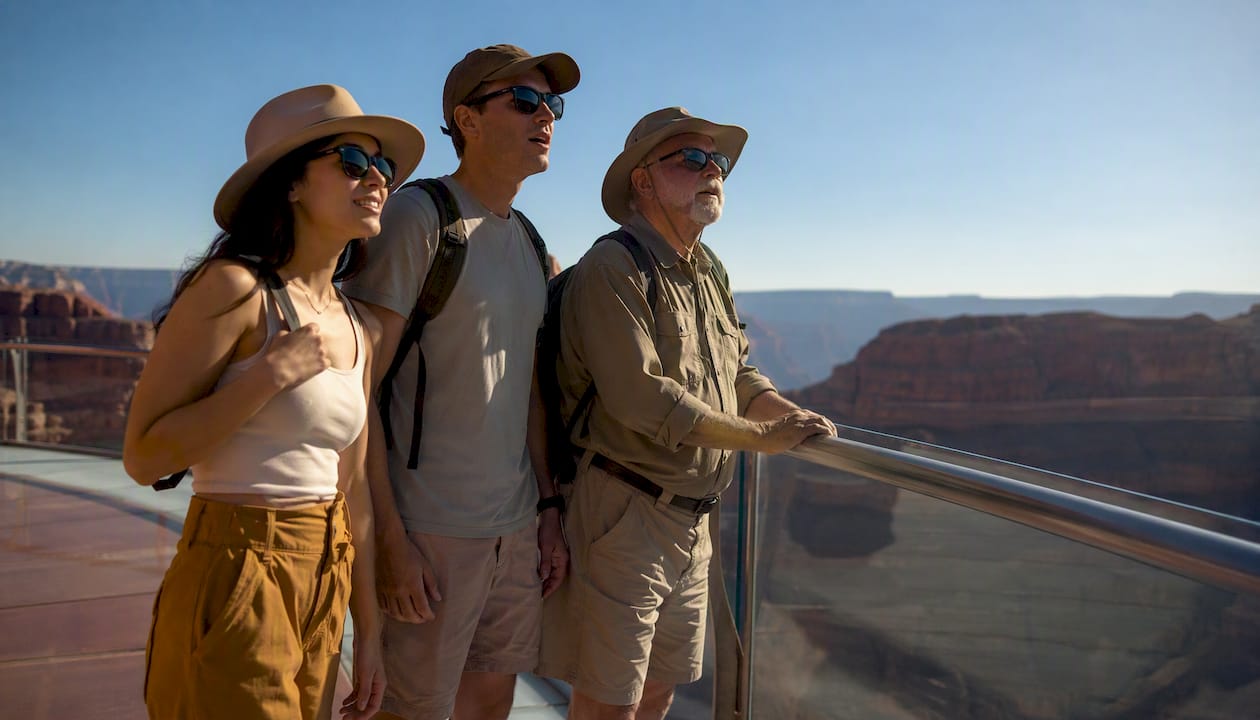
The West Rim runs on a curated attraction model. Once you've walked the Skywalk, hiked to Eagle Point, and taken in the views from Guano Point, you've seen what the rim offers. Most visitors spend two to four hours total, which makes it a genuine half-day option from Las Vegas.
South Rim: one full day minimum, two days to do it properly
The South Rim rewards time. A rushed three-hour visit leaves you with a few overlooks and a crowded shuttle ride. One full day lets you cover Mather Point, Yavapai Geology Museum, a stretch of the Rim Trail, and a meal at El Tovar. Two days opens up a below-rim hike on Bright Angel or South Kaibab, a sunrise at Desert View, and a real sense of the canyon's scale.
Here are three realistic itineraries:
-
Half-day West Rim from Las Vegas: Depart Las Vegas by 7 AM, arrive at the Hualapai terminal by 9–9:30 AM. Board the shuttle to Eagle Point, walk the Skywalk, continue to Guano Point for lunch, return to the terminal by 1 PM. Back in Las Vegas by 3:30 PM. Total ground time: roughly three hours.
-
One full day at the South Rim from Flagstaff or Sedona: Depart by 7 AM, arrive at the South Rim by 8:30–9 AM. Start at Mather Point, ride the shuttle west to Hermits Rest, walk sections of the Rim Trail back east, stop at Yavapai Point for geology context, and have a sit-down lunch at El Tovar. Afternoon: short descent on Bright Angel Trail (1.5 miles down to the first rest house and back). Depart by 5 PM. This is the one-day South Rim itinerary that delivers the most complete picture without an overnight stay.
-
Two-day South Rim overnight: Day one follows the full-day itinerary above. Evening: sunset from Hopi Point or Mohave Point, dinner at El Tovar. Day two: early morning hike on South Kaibab Trail to Ooh Aah Point or Cedar Ridge, then Desert View Drive east to Watchtower. Depart after lunch. This is the format that turns a Grand Canyon visit into something you actually remember.
The Skywalk itself typically takes 20–30 minutes including the wait. A Bright Angel descent to Indian Garden (now Havasupai Gardens) and back is a full-day commitment of six to nine hours depending on pace and heat.
How the scenery actually differs between the two rims
The South Rim and West Rim show you different versions of the same canyon, and the difference matters more than most comparison articles admit.
South Rim: the classic panorama
Standing at Mather Point or Yavapai Point, you're looking across a canyon that stretches 10 miles wide and more than a mile deep. The layered geology, from the pale Kaibab limestone at the rim down through the Redwall and Tonto Platform to the dark Vishnu schist at the bottom, reads like a textbook left open. The South Rim's elevation of roughly 7,000 feet means the light changes dramatically through the day. Morning turns the inner canyon walls amber; late afternoon goes deep red and violet. The Hermit Road overlooks (Pima Point, Mohave Point, Hopi Point) are the best places to watch the sun move across the canyon walls, and the Grand Canyon Sunset Tour times this perfectly.
Desert View Watchtower, 25 miles east of Grand Canyon Village, adds a different perspective: you can see the Colorado River from here, and on clear days the view extends to the Painted Desert.
West Rim: closer, steeper, more intimate
The West Rim sits at a lower elevation, and the canyon walls here are narrower and more vertical. You're not getting the sweeping 10-mile panorama; you're looking almost straight down at the Colorado River. That proximity is the West Rim's visual signature. The Skywalk amplifies it by putting you 70 feet out over the canyon on a glass floor, 4,000 feet above the river. It's a visceral experience that the South Rim simply doesn't offer.
Photography notes
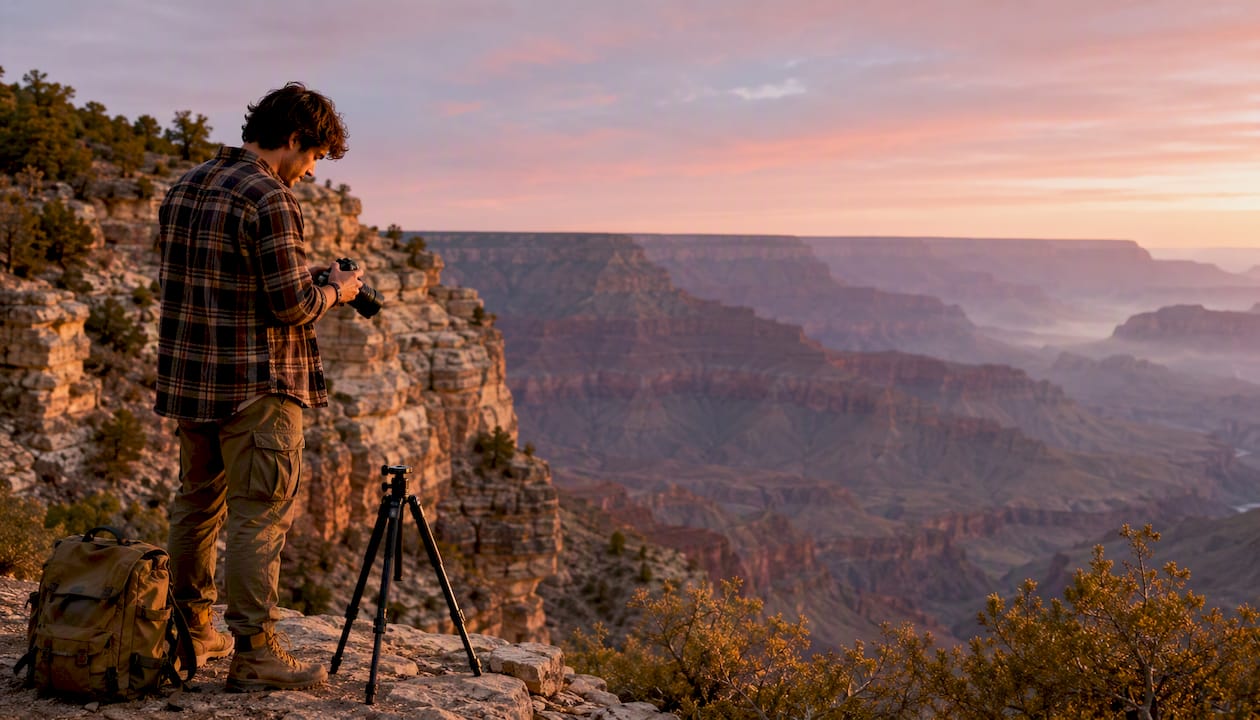
At the South Rim, golden hour at Hopi Point or Yavapai Point produces the most photographed canyon images in the world. No restrictions on cameras anywhere along the rim. For the best Grand Canyon viewpoints and timing, arriving at Mather Point before 8 AM in summer gives you soft light and manageable crowds.
At the West Rim, the Skywalk enforces a strict no-personal-camera policy on the glass bridge itself. The Hualapai operate an official photo service on the Skywalk; you can purchase those images. Outside the Skywalk, cameras are permitted at Eagle Point and Guano Point.
What can you actually do at each rim?
The activity gap between the two rims is significant, and it's the clearest argument for the South Rim if you want more than one thing to do.
South Rim activities
- Bright Angel Trail: — The most accessible below-rim trail, starting at Grand Canyon Village. Paved for the first stretch, with water and rest houses at 1.5 and 3 miles. Day hikers can turn around at either rest house; overnight backpackers continue to Havasupai Gardens (formerly Indian Garden) and the Colorado River. Overnight trips require a backcountry permit from NPS.
- Grand Canyon Railway: — A historic train running from Williams, AZ to Grand Canyon Village. A genuinely fun alternative to driving, especially for families.
West Rim activities
Reservations and permits to know about
Overnight backcountry camping at the South Rim requires an NPS backcountry permit, which opens for applications four months in advance and fills quickly for spring and fall dates. Mule ride overnights at Phantom Ranch book similarly far out. Skywalk admission is purchased through Hualapai operators and does not require advance booking, though peak-season lines can add 30–45 minutes to your visit.
What does each rim actually cost?
The fee structures are fundamentally different, and the West Rim can surprise visitors who expect a simple park entrance fee.
| Fee Category | South Rim (NPS) | West Rim (Hualapai) |
|---|---|---|
| Vehicle entrance | $35 per vehicle (7-day pass) | Not applicable |
| America the Beautiful Pass | Accepted (covers entrance) | Not accepted |
| General admission | Included in vehicle fee | Separate Hualapai admission fee required |
| Skywalk | Not available | Additional fee on top of admission |
| Helicopter add-on | Available from private operators | Available; often bundled in tour packages |
| Parking | Free within park | Free at Hualapai terminal |
| Shuttle | Free within park | Free between terminal and viewpoints |
The West Rim's pay-per-attraction model means your total cost depends on what you do. A basic visit with general admission, Skywalk access, and a meal at Guano Point adds up quickly. Helicopter packages from Las Vegas that bundle transportation, Skywalk admission, and a river landing can run several hundred dollars per person. The South Rim's $35 vehicle fee covers seven days of unlimited access to all overlooks, trails, and shuttle routes, which makes it significantly better value for multi-day visitors.
One cost that catches people off guard at the West Rim: the Skywalk's no-personal-camera policy means you'll pay for official photos if you want images from the glass bridge. At the South Rim, your phone camera works everywhere.
Pro Tip: If you hold an America the Beautiful Annual Pass ($80/year), it covers South Rim entrance for 12 months across all NPS sites. It does not apply at the West Rim, which is tribal land.
Crowds, facilities, and accessibility: what to expect
The visitor volume difference between the two rims is substantial. The South Rim draws millions of visitors each year, while the West Rim sees significantly fewer visitors. That gap shapes everything from parking to the quality of facilities.
South Rim facilities
- Lodging: Grand Canyon Village has six lodges operated by the park's concessionaire, ranging from the historic El Tovar Hotel directly on the rim to more modest options like Bright Angel Lodge and Maswik Lodge. El Tovar opened in 1905, designed by Charles Whittlesey as a cross between a Swiss chalet and a Norwegian villa, and its dining room remains one of the most atmospheric places to eat in the American Southwest. Rooms book months in advance for spring and fall.
- Shuttle system: Free, frequent shuttles run three routes covering the Hermit Road overlooks, the Village, and the South Kaibab trailhead. In peak season, shuttles run every 10–15 minutes.
- Visitor centers: Mather Visitor Center, Yavapai Geology Museum, and Desert View Watchtower all offer exhibits, ranger programs, and restrooms.
- Accessibility: The Rim Trail is largely paved and accessible. Several overlooks have ADA-compliant viewing areas. The free shuttle system accommodates wheelchairs.
West Rim facilities
- Lodging: The Hualapai Ranch near Peach Springs offers cabins and camping. There is no lodging at the rim itself. Most West Rim visitors do not stay overnight.
- Services: A café at Guano Point, a gift shop at Eagle Point, and restrooms at both viewpoints. The facilities are functional but limited compared to Grand Canyon Village.
- Accessibility: The Skywalk and viewpoint areas are relatively flat and accessible, though the terrain is uneven in places. Visitors with mobility limitations can reach the main viewpoints without significant difficulty.
Timing to avoid peak crowds
At the South Rim, the worst congestion runs from late June through August, with parking lots full by 9 AM and shuttle waits of 20–30 minutes. Arriving before 8 AM or after 4 PM dramatically improves the experience. At the West Rim, summer heat is the bigger concern than crowds; the canyon floor can exceed 110°F in July and August.
When to go: seasonal weather and best months
Elevation drives the seasonal difference between the two rims, and it's more dramatic than most visitors expect.
The South Rim sits at approximately 7,000 feet. Snow is common from November through March, and the rim occasionally closes to private vehicles after heavy snowfall. Winter visits are genuinely beautiful, with far fewer crowds and snow-dusted canyon walls, but you need chains or all-wheel drive and should check NPS road conditions before departing. Spring (April through May) and fall (September through October) are the best months: temperatures at the rim run 50–70°F, inner-canyon trails are manageable, and crowds are lighter than summer.
The West Rim sits at roughly 4,000 feet, which means warmer temperatures year-round and almost no snow risk. Winter visits are comfortable and uncrowded. Summer is the trade-off: while the rim itself is hot, the canyon floor near the Colorado River can be dangerously hot from June through August.
Heat safety for inner-canyon hiking
The NPS advises against hiking below the rim at the South Rim between 10 AM and 4 PM from May through September. Inner-canyon temperatures regularly exceed 110°F in summer, and heat-related rescues are common on Bright Angel and South Kaibab trails. Carry at least one liter of water per hour of hiking, eat salty snacks to replace electrolytes, and turn around before you feel tired, not after.
Safety note: The most dangerous hike at the Grand Canyon is not the steepest one. It's the one where you walk down feeling great and realize on the way back up that you've run out of water and energy simultaneously. Plan your turnaround point before you start.
Safety, permits, and the rules that differ between rims
The governance difference between the South Rim and West Rim has real practical consequences, not just administrative ones.
South Rim: NPS rules apply
The South Rim operates under Grand Canyon National Park regulations. Key rules and requirements:
- Overnight backcountry camping requires an NPS backcountry permit. Applications open four months before the intended trip month and fill quickly for popular corridors.
- Drones are prohibited within Grand Canyon National Park boundaries. Violations carry significant fines.
- Pets are allowed on the Rim Trail and in developed areas but not on below-rim trails.
- Campfires are prohibited below the rim and restricted to designated areas above.
- Leave No Trace principles are enforced; rangers actively patrol popular trails.
West Rim: Hualapai Tribal land rules apply
The West Rim operates under Hualapai Tribal authority, not NPS. National Park passes are not accepted. Drone policies and photography rules are set by the tribe and can differ from NPS standards. The most notable restriction is the Skywalk's no-personal-camera policy: phones and cameras must be stored before stepping onto the glass bridge. The Hualapai operate an official photography service on the Skywalk for a fee.
Practical safety checklist for either rim
- Carry more water than you think you need: at least one liter per hour of active hiking below the rim.
- Wear sun protection year-round; the canyon reflects UV radiation from the walls.
- At the South Rim in winter, bring traction devices (Yaktrax or microspikes) for icy trails.
- Tell someone your planned route and return time before any below-rim hike.
- Download offline maps before entering the park; cell service is unreliable on most trails.
Which rim is right for your trip?
The right answer depends almost entirely on who you are and what you have to work with.
First-time visitors: South Rim, without question. The panoramic views from Mather Point and Yavapai Point are the images you've seen your whole life, and the trail infrastructure, visitor centers, and lodging options make it the complete Grand Canyon experience. The South Rim is the canonical Grand Canyon that appears in every photograph and film.
Serious hikers: South Rim. Bright Angel and South Kaibab trails offer genuine multi-mile descents with real elevation change, water sources, and the possibility of reaching the Colorado River. The West Rim has no comparable trail infrastructure for serious hiking.
Las Vegas day-trippers: West Rim is the practical choice. Two hours from the Strip, a half-day on the ground, and the Skywalk delivers a memorable experience without a full day of driving. If you have two days and a car, drive to the South Rim instead.
Families with young children: South Rim, particularly with a private guided tour. The free shuttle eliminates car-seat logistics, the Rim Trail is stroller-accessible, and ranger programs at the visitor center engage kids directly. El Tovar's dining room makes lunch an event.
Photographers: South Rim for landscape work. The light at Hopi Point and Yavapai Point during golden hour is extraordinary, and there are no camera restrictions anywhere on the rim. The West Rim's Skywalk camera ban is a real limitation for anyone who came specifically to photograph the glass bridge experience.
Mobility-limited travelers: Both rims have accessible viewpoints, but the South Rim's paved Rim Trail and ADA-compliant shuttle system make it easier to cover significant ground without strenuous walking. The West Rim's viewpoints are accessible but the overall facility infrastructure is thinner.
Luxury-seeking travelers: South Rim. El Tovar is the only historic rim-side hotel in the canyon, and a private guided tour that includes a reserved table at El Tovar's dining room turns a park visit into something genuinely special. Grandcanyonjourneys builds exactly this kind of itinerary, with door-to-door pickup and all logistics handled.
Combining both rims: Possible but rarely worth the logistics unless you have three or more days and a car. The rims are not close to each other; driving between them takes four to five hours. Most travelers are better served by spending their time going deeper at one rim than skimming both.
Planning checklist and three sample itineraries
Before you leave, work through this list:
- Apply for a backcountry permit — if you plan any overnight below-rim camping at the South Rim. The NPS permit system opens four months before your trip month.
Itinerary A: Las Vegas half-day West Rim (drive option)
Depart Las Vegas by 6:30 AM. Arrive at the Hualapai terminal by 9 AM. Board the shuttle to Eagle Point, walk the Skywalk, continue to Guano Point for a late breakfast or early lunch. Return to the terminal by 12:30 PM. Back in Las Vegas by 3 PM. Total ground time: approximately three and a half hours.
Itinerary B: One-day South Rim from Flagstaff or Sedona
Depart by 7 AM. Arrive at the South Rim by 8:30–9 AM. Start at Mather Point for the first views, then board the Hermit Road shuttle west to Pima Point. Walk back east along the Rim Trail, stopping at Mohave and Hopi Points. Lunch at El Tovar (reserve in advance). Afternoon: 1.5-mile descent on Bright Angel Trail to the first rest house and back. Depart by 5 PM. This one-day itinerary covers the rim's best overlooks and gives you a genuine taste of the canyon's depth.
Itinerary C: Two-day South Rim overnight
Day one: Follow Itinerary B through lunch at El Tovar. Afternoon: continue east along the Rim Trail to Yavapai Point. Sunset from Hopi Point. Dinner at El Tovar or Bright Angel Lodge. Stay overnight at a South Rim lodge.
Day two: Early start (6 AM) on South Kaibab Trail to Ooh Aah Point (1.8 miles round trip) for sunrise views. Return to the rim by 8:30 AM, breakfast at the Bright Angel Fountain. Drive Desert View Drive east to the Watchtower, stopping at Grandview Point and Lipan Point. Depart after lunch. This two-day format is the one that makes the canyon feel real rather than just large.
How Grandcanyonjourneys makes the South Rim easier
Private guided tours solve the friction points that turn a Grand Canyon visit from stressful to genuinely enjoyable, and the South Rim has more friction points than most visitors anticipate.
Grandcanyonjourneys operates out of Sedona and offers door-to-door pickup in late-model luxury SUVs and custom transit vans with plush leather seating. The private South Rim day tour includes park entry, a reserved sit-down lunch at El Tovar's dining room, and a guide who knows which overlooks are worth the walk and which are just parking lots with a view. The guided below-rim hiking tour takes guests down Bright Angel or South Kaibab with a Wilderness First Responder-certified guide, which matters more than it sounds when you're two miles below the rim in July.
Who benefits most from this format? Travelers who've done the math on parking ($0 but full by 9 AM), shuttle waits (20–30 minutes in peak season), El Tovar reservations (books out weeks in advance), and the general cognitive load of managing all of it simultaneously. A private tour collapses that list into one booking.
The sunset tour is worth a specific mention for photographers: Grandcanyonjourneys times the drive to hit west-facing overlooks during golden hour, then closes with a rim-side dinner at El Tovar. That combination, the light, the meal, the lack of logistics, is what most visitors describe as the best evening of their trip.
Bundled private tours also tend to offer better value than assembling the same components separately, once you account for El Tovar reservation fees, parking, and the time cost of navigating the shuttle system during peak hours.
Key Takeaways
The South Rim is the right choice for most visitors: it offers iconic panoramic views, serious hiking on Bright Angel and South Kaibab trails, and full visitor infrastructure, while the West Rim is best reserved for Las Vegas day-trippers who want the Skywalk experience in a half-day.
| Point | Details |
|---|---|
| Choose by origin and time | West Rim is ~2 hours from Las Vegas; South Rim is ~1.5 hours from Flagstaff and four and a half hours from Las Vegas. |
| Fee structures differ | South Rim charges $35/vehicle for a 7-day NPS pass; West Rim uses a pay-per-attraction Hualapai model with separate Skywalk fees. |
| Best months to visit | Spring (April–May) and fall (September–October) offer the best temperatures and lighter crowds at both rims. |
| Skywalk camera rules | Personal cameras and phones are not permitted on the Skywalk glass bridge; the Hualapai operate an official paid photo service. |
| Grandcanyonjourneys | Offers private door-to-door South Rim day tours and guided below-rim hikes from Sedona, with El Tovar dining and all logistics included. |
The view from here
The conventional framing of this comparison treats the two rims as roughly equal options with different personalities. That's too generous to the West Rim and not honest enough about what the South Rim actually delivers.
The West Rim is a well-designed tourist attraction. The Skywalk is genuinely thrilling, the helicopter tours are spectacular, and for someone flying into Las Vegas for a long weekend, it's a perfectly reasonable way to say you've seen the Grand Canyon. Nothing wrong with any of that.
But the South Rim is the Grand Canyon. The scale, the geology, the trails, the history of El Tovar, the way the light moves across the canyon walls at dusk — none of that is replicated anywhere else, and none of it is accessible in a half-day. The visitors who leave disappointed from the South Rim are almost always the ones who gave it three hours and a shuttle ride. The ones who stay two days, hike below the rim, and eat dinner watching the canyon go dark — they're the ones who understand what the fuss is about.
The practical implication: if you have the time and you're anywhere near Arizona, choose the South Rim and give it at least a full day. If you're in Las Vegas for a weekend and the canyon is one item on a longer list, the West Rim delivers a memorable experience without the full commitment. But don't confuse the two. One is a day trip. The other is a place.
Plan your private Grand Canyon experience with Grandcanyonjourneys
The South Rim's best moments, a reserved table at El Tovar, a below-rim hike with a certified guide, golden-hour views from Hopi Point, require advance planning and local knowledge that most visitors don't have on their first visit.
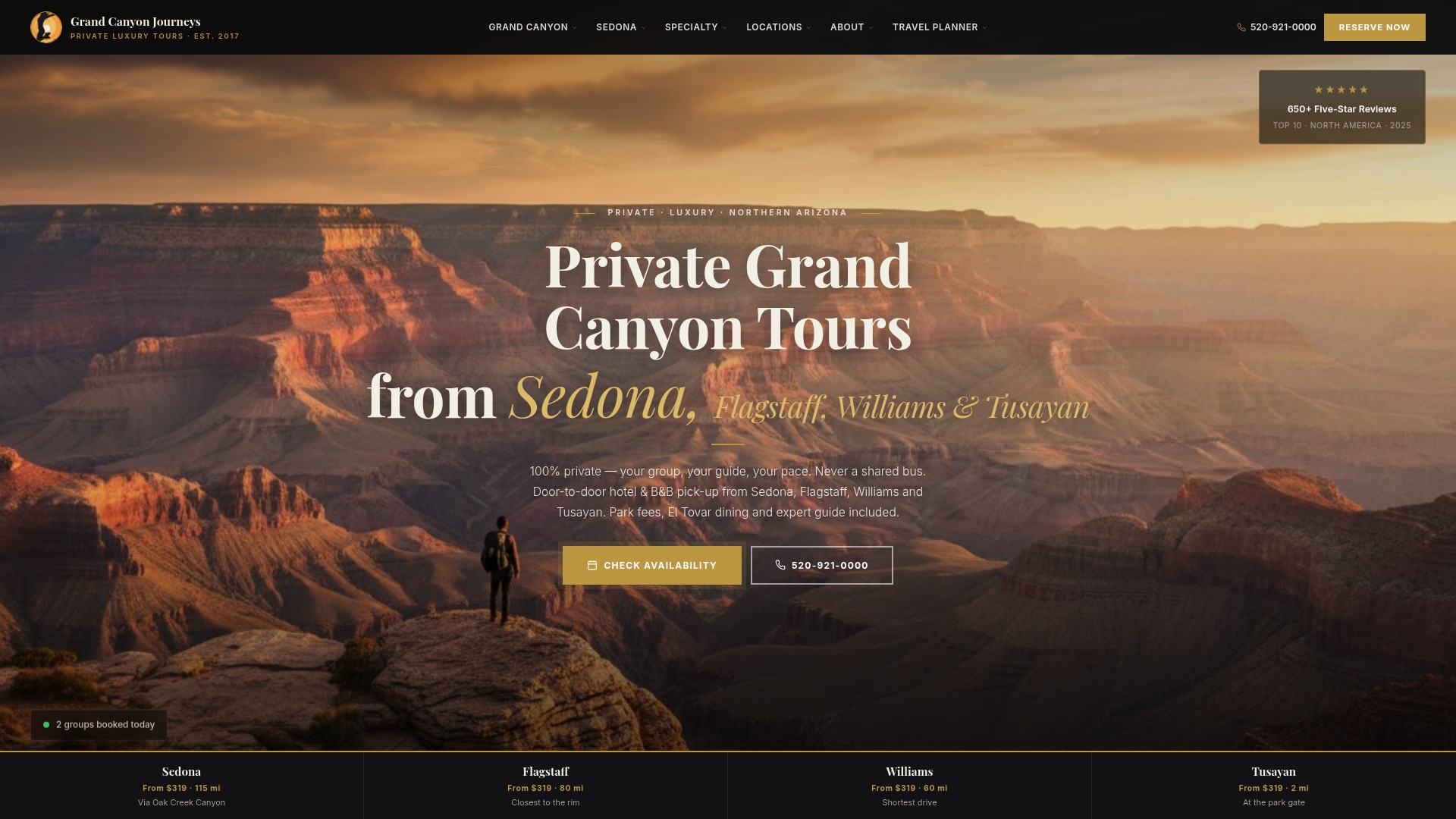
Grandcanyonjourneys handles all of it from door to door. Based in Sedona, the team offers fully private South Rim day tours and guided below-rim hiking experiences in late-model luxury vehicles, with park entry, El Tovar dining, and expert guidance included. No parking lines, no shuttle waits, no logistics to manage. Just the canyon. Check availability and book your private Grand Canyon tour directly at grandcanyonjourneys.com.
Useful sources for planning your visit
Before you finalize dates, fees, and permits, verify current information directly with the managing authorities. Rules and prices change seasonally.
- Grand Canyon National Park — NPS Official FAQs: Authoritative source for park rules, backcountry permit applications, entrance fees, and seasonal road conditions.
- Grand Canyon West (Hualapai Tribe): Official Hualapai operator page for West Rim admission, Skywalk fees, and tribal land policies
- El Tovar Hotel — Grand Canyon Lodges: Booking and information for the South Rim's historic rim-side hotel and dining room.
- Grandcanyonjourneys — Private Tours and Travel Planner: Planning resources, itinerary guidance, and private tour booking for South Rim visits from Sedona, Flagstaff, and Williams.
For last-minute fee or policy updates, always check the NPS website and the Hualapai operator's official page directly. Third-party travel sites frequently carry outdated fee information, particularly for the West Rim's Skywalk pricing.