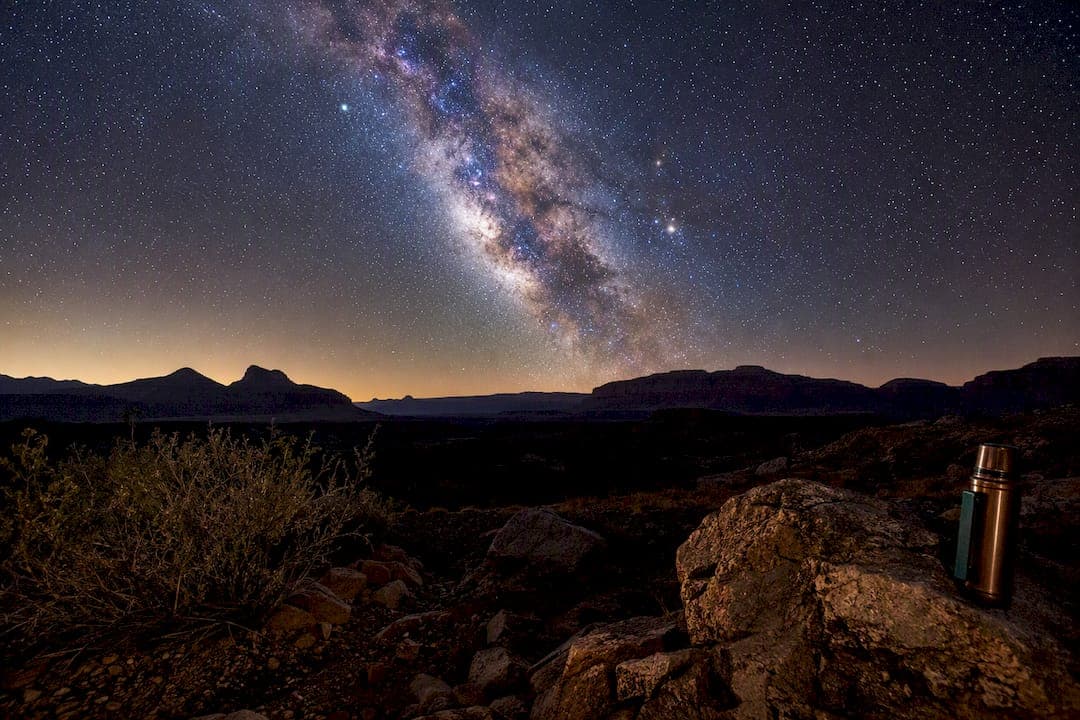
You can see the Milky Way across Arizona from dark-sky parks like Grand Canyon National Park and the Flagstaff area on clear, moonless nights. The galactic core is most visible from roughly mid-February through mid-October, peaking in June, July, and August. Sedona, Oracle State Park, and the Vermilion Cliffs region round out the state's best viewing spots, each offering a slightly different mix of darkness and foreground scenery.
TL;DR:
- The best months for Milky Way viewing in Arizona are late spring and early fall, with the galactic core visible from February 12 to October 18.
- Aiming for sites at least 40-50 miles from major cities like Phoenix or Tucson reduces skyglow and improves visibility.
- The ideal viewing window is during astronomical darkness, starting about 90 minutes after sunset and staying until 90 minutes before sunrise, depending on the season.
- Monitoring moon phases is critical, as a new moon or late-waning crescent provides the best contrast, especially during peak core visibility months.
- Guided tours and expert advice can help optimize trip timing, site choice, and safety, especially for those unfamiliar with local conditions or seeking a hassle-free experience.
Table of Contents
- Best Places to See the Milky Way in Arizona
- When Is the Milky Way Core Visible in Arizona?
- How to Plan Your Milky Way Viewing Trip
- Milky Way Photography Basics for Arizona
- Safety, Logistics, and Etiquette for Night Visits
- Grand Canyon Journeys' Local Take on Stargazing Trips
- Best Weather Conditions and Clear-Sky Months
- What's the Best Time of Night to See the Milky Way?
- Guided Tours and Local Resources for Milky Way Viewing
- The Overlooked Truth About Arizona's Dark Skies
- Ready to See It for Yourself?
- Sources
Best Places to See the Milky Way in Arizona
Arizona's Milky Way reputation isn't marketing hype. The state holds one of the highest concentrations of certified dark-sky places in the country, and that designation actually means something on the ground: fewer streetlights, stricter lighting codes, and darker horizons than almost anywhere else in the Southwest.
- Flagstaff and the Kaibab Plateau. Flagstaff was the world's first International Dark Sky City, and that status comes from decades of lighting ordinances the city still enforces. Drive a short distance onto the Kaibab Plateau and you're looking at some of the darkest skies within easy reach of a real town with hotels and restaurants.
- Grand Canyon National Park. The park carries its own International Dark Sky Park certification, and the National Park Service's night-sky program points visitors toward specific vantage points, including Mather Point, Desert View, and Cape Royal. The North Rim tends to work better for shots that put the canyon and the galactic core in the same frame, since the core sits to the south and the North Rim's geometry lines up more naturally for that composition.
- Sedona's remote viewpoints. Red rock formations make dramatic foregrounds, but Sedona proper has more ambient light than you'd expect. Head to the outskirts or a designated viewing area away from resort lighting for a real Milky Way view.
- Oracle State Park. North of Tucson, this park gives desert dwellers a dark-sky option without the multi-hour drive to Northern Arizona.
- Vermilion Cliffs and the surrounding plateaus. Remote, minimal traffic, and about as dark as Arizona gets. Long-exposure photographers who want zero skyglow in their frame head here.
A rough rule of thumb: try to get a significant distance from a major city core. That distance is usually enough to clear the worst of the skyglow that Phoenix and Tucson throw into the sky.
When Is the Milky Way Core Visible in Arizona?
The galactic core, the brightest and most photogenic part of the Milky Way, is visible in Northern Arizona from roughly February 12 through October 18. Outside that window, the core sits below the horizon or too close to the sun to see.
Timing shifts a lot depending on the month:
- February through April: the core rises only in the hours before dawn, so plan on a pre-dawn session.
- May through August: the core climbs into a full evening and overnight window. Mid-June gives you several hours of core visibility at Grand Canyon National Park, the longest stretch of the year.
- September and October: the window flips back to early evening, right after sunset, before the core dips out of sight for the season.
Moon phase matters just as much as the calendar. A bright moon washes out the fainter dust lanes of the core even on a perfectly clear night, so plan around the new moon or the days flanking it. Third-quarter and waning-crescent nights work too, since the moon rises late and stays out of the sky during prime viewing hours. Some Milky Way trip planners use computed "core window" calculators tied to a specific site and date rather than relying on rough seasonal guesses, which is worth doing if you're driving a few hours for one shot.
How to Plan Your Milky Way Viewing Trip
Getting a great Milky Way night in Arizona is less about luck and more about stacking the right conditions in your favor before you leave the house.
- Pick your date around the new moon and consult tips for stargazing at the gorge to improve your night sky experience. Cross-reference that with the season: if you're aiming for July through September, keep an eye on monsoon patterns, since afternoon storms can leave residual humidity and late-night cloud cover even when sunset looked clear.
- Check your distance from city light domes. Aim for that 40 to 50 mile buffer from Phoenix, Tucson, or any sizable town.
- Confirm site access. National and state parks have gate hours, permit rules, and sometimes reserved night-viewing areas. Check ahead so you're not turned away at 10 p.m.
- Pack smart. Warm layers (temperatures drop fast after dark, even in summer), water, a red-light headlamp, a tripod if you're shooting photos, offline maps or GPS, and a basic safety kit.
- Follow on-site etiquette. Stay on marked trails and viewpoints, keep white light off, and let someone know where you're headed and when you expect to be back.
Pro Tip: Give your eyes 20 to 30 minutes to fully adjust to the dark before judging how visible the Milky Way is. Checking your phone screen even once resets that adaptation, so switch it to red-light mode or leave it in your pocket.
Milky Way Photography Basics for Arizona
You don't need professional gear to get a usable Milky Way shot, but a few settings make the difference between a faint smudge and a photo worth printing.
- Aperture: go as wide as your lens allows, ideally f/2.8 or wider, to pull in as much light as possible.
- ISO: start around 3200 and adjust from there based on your camera's noise performance.
- Shutter speed: use the 500 Rule: divide 500 by your lens's focal length to get your maximum shutter speed before stars start to trail.
- Composition: point your camera toward the southern horizon, where the core sits, and frame it against something recognizable. A canyon rim, a saguaro silhouette, or a red-rock formation gives the shot scale and story.
- Gear: a stable tripod is non-negotiable at these shutter speeds. Bring a red-light headlamp so you can adjust settings without ruining your night vision, and pack extra batteries since cold desert air drains them fast.
If your frame comes out too bright or hazy, check the moon phase again. A bright moon or a distant city's light dome are the two most common reasons an otherwise well-shot photo looks washed out instead of crisp.
Safety, Logistics, and Etiquette for Night Visits
Arizona's high-elevation dark-sky sites get cold fast once the sun goes down, even in summer. Layer up and bring water regardless of the season.
- Watch your footing near canyon rims and cliff edges. Depth perception is unreliable in the dark, and railings aren't everywhere.
- Stay on marked viewpoints and trails after sunset. Wildlife and unstable terrain are real risks off the beaten path.
- Use red light only, and avoid shining white light, headlights, or phone flashlights toward other visitors. Dark-sky etiquette is part of what keeps these places dark in the first place.
- Confirm park permits, parking rules, and ranger program schedules before you go. Some sites run guided night programs that are worth building your evening around.
Grand Canyon Journeys' Local Take on Stargazing Trips
Knowing the right dark-sky spot is only half the equation. Getting there safely, at the right time, with a foreground that actually works for the shot you want, is the other half. That's where a private guided option earns its keep: a guide who knows the local roads, the timing of the core window, and which pullouts avoid stray light saves you from a wasted drive.
Grand Canyon Journeys is a Northern Arizona private tour operator running trips out of Sedona, Flagstaff, and Williams, including a Sedona stargazing tour built around dark, remote viewpoints away from town lighting. For travelers stitching stargazing into a broader Grand Canyon trip, the Arizona stargazing guide breaks down site-by-site logistics in more depth.
Best Weather Conditions and Clear-Sky Months
Arizona's high desert climate is exactly why it's a national stargazing destination. Low humidity and frequent clear nights are the norm across most of the state outside monsoon season.
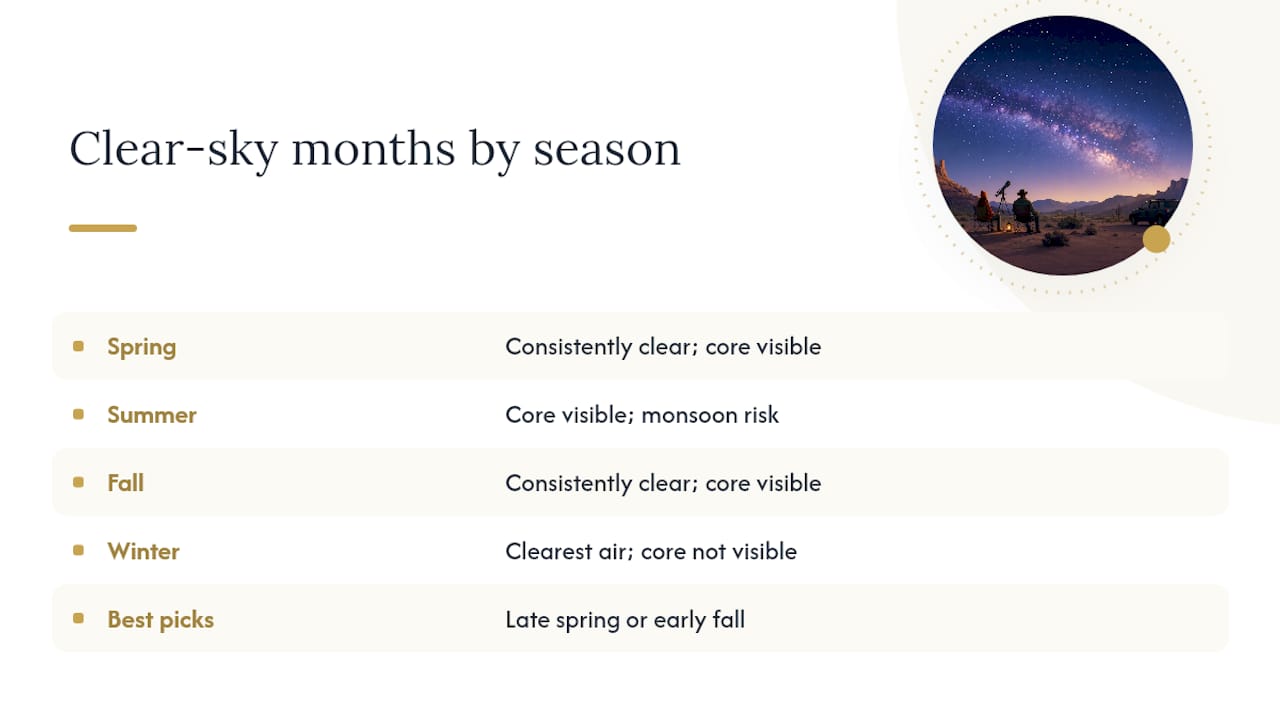
Spring (March through May) and fall (September through October) tend to deliver the most consistently clear, stable skies. Humidity is low, and storm systems are infrequent.
Summer (June through August) overlaps with the best core-viewing window, but it also overlaps with monsoon season, which typically runs from July into September. Afternoon thunderstorms can clear out by nightfall, but they sometimes leave lingering humidity or scattered high clouds that reduce contrast even on nights that look clear at sunset. Checking a forecast two or three days out, not just the night before, gives you a better read on actual conditions.
Winter (November through February) often has the clearest air of the entire year, especially at higher elevations like Flagstaff and the Grand Canyon rims. The tradeoff is that the galactic core isn't visible for most of the winter months, so this season is better suited to general stargazing and planet viewing than a Milky Way core shot.
If you have flexibility, aim for late spring or early fall. You get long enough core windows, lower monsoon risk, and comfortable overnight temperatures at elevation.
What's the Best Time of Night to See the Milky Way?
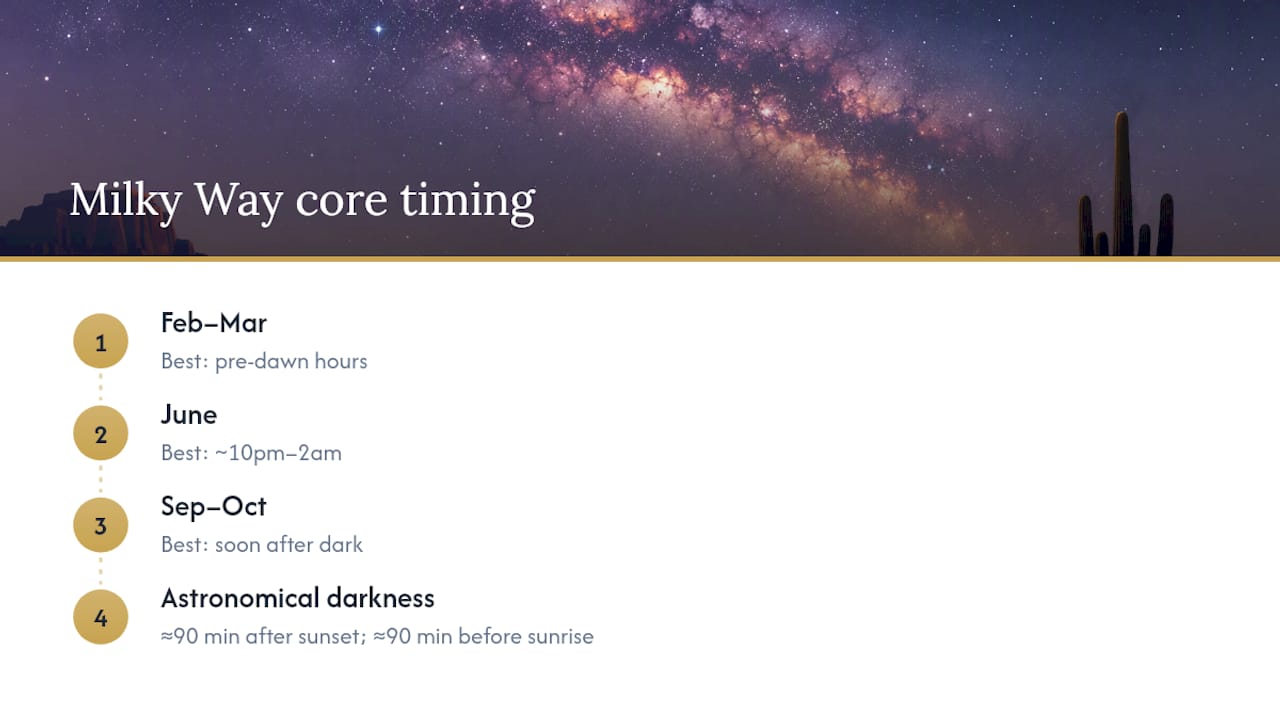
The single biggest factor isn't the clock. It's astronomical darkness, meaning the sun is at least 18 degrees below the horizon and true night has settled in. That typically starts around 90 minutes after sunset and ends about 90 minutes before sunrise, depending on the season and your latitude.
Within that window, the exact best hour shifts month to month because the core rises and sets at different times across the season. In February and March, your best shot is in the hours right before dawn. By June, the core is up for most of the night, so anywhere from about 10 p.m. to 2 a.m. tends to work well. By September and October, the window flips back toward the early evening, shortly after the sky goes fully dark.
Whatever the month, give yourself the full 20 to 30 minutes of dark adaptation before judging visibility. A lot of visitors give up on a spot after five minutes outside, convinced the sky is too hazy, when their eyes simply haven't adjusted yet. Moon phase still overrides everything else: even a perfect midnight core window looks washed out under a gibbous moon.
Guided Tours and Local Resources for Milky Way Viewing
Beyond a private tour, Arizona has some genuinely useful institutional resources for stargazers. Lowell Observatory in Flagstaff runs public programs tied directly to the city's dark-sky legacy, and it's worth building an evening around if you want a more structured astronomy experience alongside your own Milky Way viewing.
National and state parks also run ranger-led night-sky programs with telescope viewings, which are a good low-effort way to learn constellations and get expert context on what you're looking at. Grand Canyon National Park's night-sky program schedules these seasonally, so check ahead if you want to time your visit around one.
For a done-for-you evening, the Sedona stargazing tour from Grand Canyon Journeys pairs local guiding with a curated dark-sky location, which takes the guesswork out of finding a spot on your own. Travelers looking at a longer Grand Canyon itinerary can lean on the Grand Canyon travel planner to line up daytime touring with an evening under the stars.
The Overlooked Truth About Arizona's Dark Skies
Most advice on Milky Way viewing treats it like a checklist: find a dark spot, wait for a clear night, shoot at f/2.8. That's the easy 80%. The part conventional guides skip is that moon phase, not location, decides most trips. A well-scouted spot at Grand Canyon National Park on a full-moon night will underperform a mediocre pullout near Flagstaff during a new moon.
The second thing people underrate is elevation's effect on comfort, not just darkness. A 40 degree night at the South Rim in June feels nothing like a 40 degree night in Phoenix, and underdressed visitors cut trips short more often than clouds do.
If you take one thing from this guide, prioritize the calendar before the map. Pick your new-moon window first, then choose whichever certified dark-sky site fits that date and your travel time. Everything else, gear, composition, exact pullout, is easier to sort out once the timing is locked in.
— Chris
Ready to See It for Yourself?
Scouting the right pullout, timing the core window, and dressing for a 40 degree temperature swing after dark is a lot to coordinate solo, especially on a trip you're only taking once. Grand Canyon Journeys handles that logistics work for you: a private guide who already knows which Sedona viewpoints stay dark, when the core rises that specific week, and how to time the drive so you're not fumbling with a red headlamp on unfamiliar roads.
The Sedona stargazing tour is built for exactly this: a private, guided evening under some of Northern Arizona's darkest skies, with transportation and timing handled so you can focus on the view. If you're combining it with a daytime Grand Canyon visit, the Grand Canyon travel planner helps you line up both in one trip. Check available dates and get your evening on the calendar before the next new moon window closes.
Sources
- Night Skies - Grand Canyon National Park (U.S. National Park Service)
- Dark Skies | Visit Arizona
- Desert Astrophotography: Milky Way Photography Guide for Arizona | HikeDesert
- Lowell Observatory