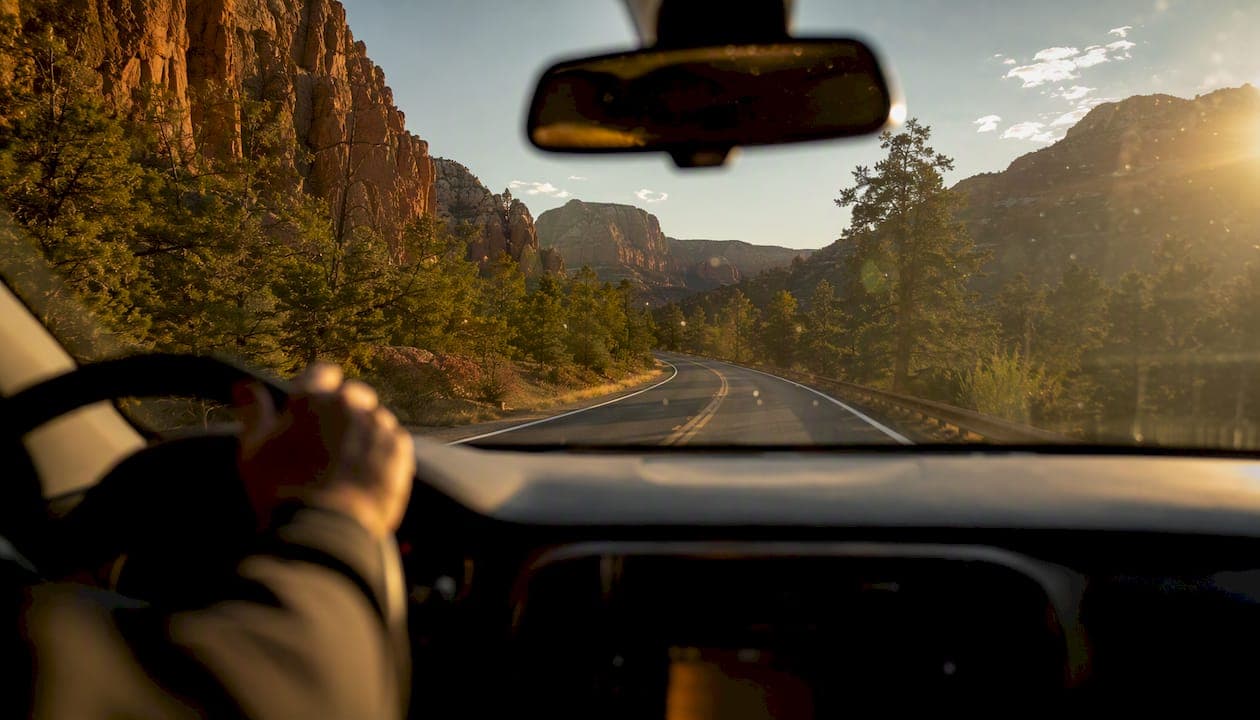
The Sedona to Grand Canyon drive covers roughly 109 miles and takes about 2 hours and 15 minutes without stops, using the most popular route: Highway 89A through Oak Creek Canyon to Flagstaff, then north on US-180 to the South Rim. That's fast enough to make a day trip genuinely workable, provided you leave Sedona by 7:00 or 7:30 AM and keep your stops focused.
A day trip is feasible, but only if you're honest about the math. Two-plus hours each way means you're spending nearly five hours in the car before you've walked a single trail. Plan for two to four hours at the South Rim, and you're looking at a full day. The National Park Service manages multiple viewpoints, shuttles, and visitor facilities at the rim, so once you arrive, you won't run out of things to see. The question is how much of Oak Creek Canyon you want to absorb on the way up.
Key Takeaways
The fastest scenic route from Sedona to the Grand Canyon South Rim covers 109 miles in roughly 2 hours 15 minutes, making a day trip feasible with an early start and focused stops.
| Point | Details |
|---|---|
| Best scenic route | Highway 89A through Oak Creek Canyon is the fastest and most scenic option for standard vehicles in clear weather. |
| RV and winter alternative | I-17 north to Flagstaff adds 15–20 minutes but is safer for large vehicles and after winter storms. |
| Arrive early | South Rim parking fills by 9:00 AM in peak season; leave Sedona by 7:00–7:30 AM for a day trip. |
| Pack for elevation | The South Rim sits at roughly 7,000 feet; bring layers even in summer, and check conditions before departure. |
| Private tour option | Grandcanyonjourneys offers door-to-door private Grand Canyon day tours from Sedona with guides, park entry, and El Tovar lunch included. |
Table of Contents
- What's the best route for the Sedona to Grand Canyon drive?
- Segment-by-segment drive times from Sedona to the South Rim
- Must-see stops between Sedona and the Grand Canyon
- Sample itineraries for a one-day and overnight trip
- Road conditions, elevation, and safety tips for the drive
- What to expect at the South Rim: entrance, parking, and shuttles
- What to pack and when to leave
- Self-drive vs. a private tour: an honest take
- Skip the driving stress with a private Grand Canyon day tour
- Sources
What's the best route for the Sedona to Grand Canyon drive?
Two routes dominate, and the right one depends on your vehicle, the season, and how much scenery you want.
Highway 89A through Oak Creek Canyon is the scenic choice and the faster of the two. It's a two-lane road that climbs through one of Arizona's most dramatic canyons, with red rock walls giving way to ponderosa pines as you gain elevation into Flagstaff. From there, US-180 takes you northwest to Valle, where AZ-64 runs straight into the park's South Entrance. The road is winding and narrow in stretches, which is exactly what makes it beautiful and exactly what makes it wrong for large RVs.
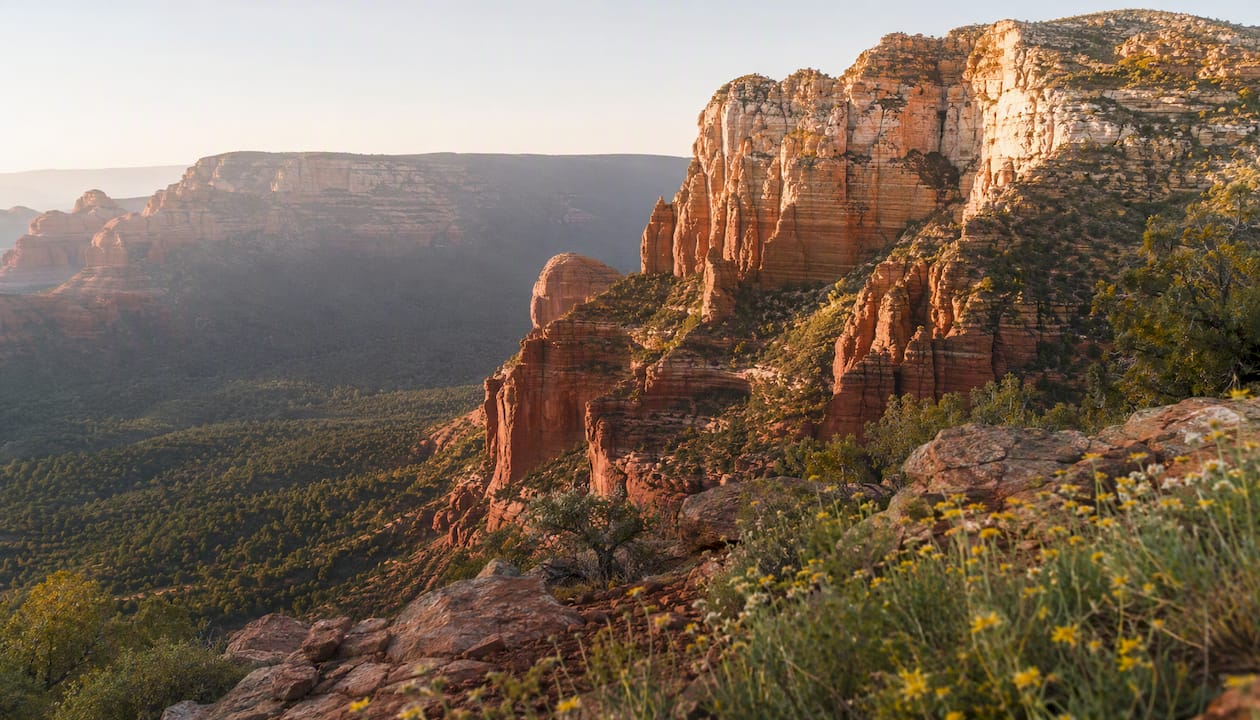
The I-17 corridor runs south from Sedona on AZ-179 to Interstate 17, then north to Flagstaff. It adds roughly 15–20 minutes to the total drive but trades canyon curves for a wider, straighter highway. From Flagstaff, you follow the same US-180 north. This route is the better call in winter when Highway 89A can close temporarily after heavy snow, and it's the only sensible option if you're driving a motorhome or a vehicle towing a trailer.
Which route fits your situation:
- Choose Highway 89A if you're in a standard car or SUV, the weather is clear, and you want the full scenic experience through Oak Creek Canyon.
- Choose I-17 if you're driving a large RV, traveling in winter or after a storm, or if anyone in your group is prone to motion sickness on winding roads.
- Highway 89A in summer can get congested through the canyon, especially on weekends. An early start (before 8:00 AM) keeps you ahead of the traffic.
- I-17 in winter is more reliably open and better maintained during snow events than the mountain highway.
Pro Tip: Check Az511 and the Grand Canyon NPS webcams the morning you leave. Highway 89A can close with little notice after overnight snow, and knowing before you back out of the driveway saves a 45-minute detour.
Segment-by-segment drive times from Sedona to the South Rim
These times reflect normal driving conditions without stops. Add time generously for photo pulls, short hikes, or any detour.
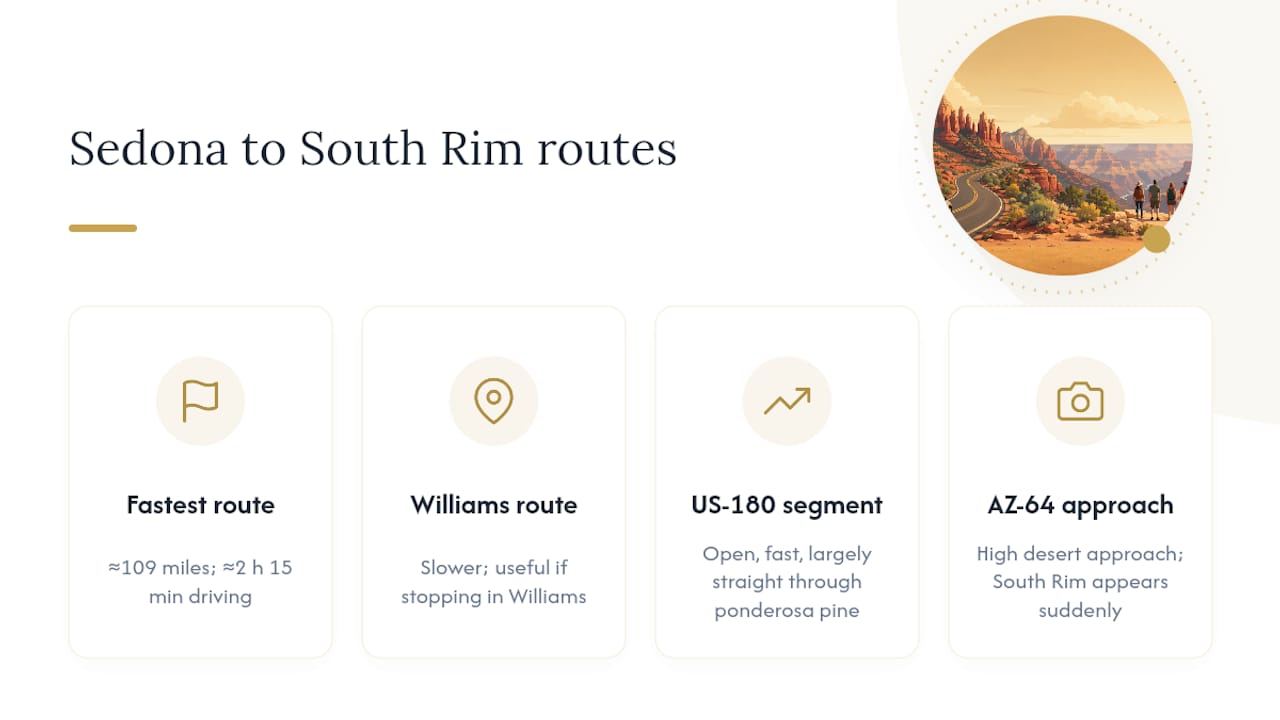
The fastest complete route is 89A + US-180 + AZ-64, totaling roughly 109 miles and about 2 hours 15 minutes of driving time. The Williams option via I-40 is slower and mainly useful if you're stopping in Williams for fuel or a meal, or if you're approaching from the west.
One practical note: the Flagstaff-to-Valle stretch on US-180 is open, fast, and largely straight through ponderosa pine forest. It's not dramatic, but it moves quickly. Save your attention for the canyon approach on AZ-64, where the landscape shifts to high desert and the South Rim suddenly appears.
Must-see stops between Sedona and the Grand Canyon
Every stop below adds time to your day. Budget accordingly, and be selective if you're doing a day trip.
-
Midgley Bridge (5–10 minutes): Right on Highway 89A just north of Sedona, this bridge spans Wilson Canyon with a quick pullout and a view back toward the red rocks. It's a 30-second walk from the car and worth the stop.
-
Slide Rock State Park (45–90 minutes): A natural rock water slide carved by Oak Creek, about 7 miles north of Sedona. Best visited in warm months (May through September) when the water is inviting. Expect an entrance fee and a crowded parking lot on summer weekends. Skip it in winter.
-
Oak Creek Vista (15–20 minutes): A pullout near the top of the Oak Creek Canyon switchbacks with a sweeping view back down the canyon. There's usually a small Navajo arts market here on weekends. Easy parking, no hiking required.
-
West Fork Trail access (1–3 hours): One of Arizona's most celebrated canyon hikes, accessed from Coconino National Forest trailheads along 89A. The first two miles are flat and stunning. This is a day-trip killer in the best way, so only include it if you're staying overnight or have an early start.
-
Flagstaff historic downtown (30–45 minutes): A natural fuel-and-coffee stop. Route 66 runs through the center, and there are good breakfast spots near the train depot. Worth 30 minutes if you left early and want a proper meal before the canyon.
-
Sunset Crater Volcano National Monument (45–60 minutes): Part of a 34-mile scenic loop northeast of Flagstaff. Short, accessible trails through recent volcanic terrain. Pair it with Wupatki for a half-day detour, or do a quick 30-minute loop if you're pressed for time.
-
Wupatki National Monument (30–60 minutes): Ancient Sinagua pueblo ruins on the same loop as Sunset Crater. The main ruin is a short walk from the visitor center. Fascinating context for the landscape you've been driving through.
-
Desert View Watchtower (20–30 minutes): If you enter the park from the east via AZ-64, the Watchtower is your first major stop. It's a National Park Service landmark with panoramic views of the canyon and the Colorado River far below. A strong argument for the east entrance approach.
Sample itineraries for a one-day and overnight trip
One-day drive from Sedona to the Grand Canyon
6:30 AM: Depart Sedona via Highway 89A. The canyon is quieter this early, and you'll beat the tourist traffic through the switchbacks.
7:15 AM: Quick stop at Oak Creek Vista for the view back down the canyon (15 minutes).
8:00 AM: Arrive Flagstaff. Grab coffee and fuel. Keep it to 20–30 minutes.
9:00 AM: Arrive at the South Rim via US-180 and AZ-64. Head straight to Mather Point or Yavapai Geology Museum for your first canyon view.
9:00 AM–1:00 PM: Explore the rim. Walk the Rim Trail between viewpoints, take the free South Rim shuttle to Hermit's Rest, and eat lunch at the canyon.
1:00–2:00 PM: Drive back toward Flagstaff. Optional fuel stop in Valle.
3:00–4:00 PM: Back in Flagstaff. Optional stop for a late lunch or coffee.
5:00–5:30 PM: Return to Sedona via 89A or I-17.
Overnight trip (two days)
Day 1: Drive up via Highway 89A with a stop at Slide Rock (in season) and Oak Creek Vista. Arrive Flagstaff by noon. Spend the afternoon on the Sunset Crater and Wupatki loop. Overnight in Flagstaff or Williams. Williams is closer to the park and has good lodging options; RV travelers can check campsite availability near the South Rim in advance.
Day 2: Leave Williams or Flagstaff by 7:00 AM. Enter the park via the east entrance on AZ-64 and stop at Desert View Watchtower first. Spend the morning at the rim, walk a section of the Bright Angel Trail, and have lunch at El Tovar. Return to Sedona via I-17 in the afternoon.
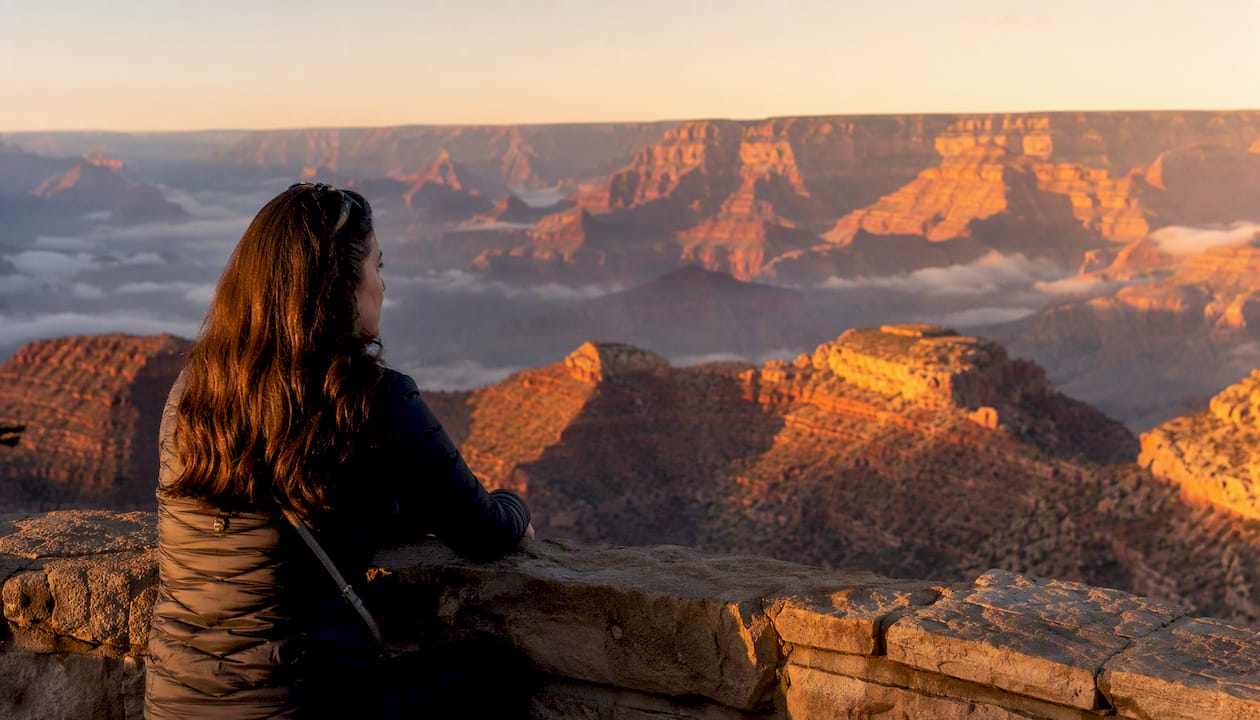
The overnight version is noticeably better. You get a sunrise at the rim, which is worth the extra night on its own.
Road conditions, elevation, and safety tips for the drive
Sedona sits at roughly 4,300 feet. The South Rim is around 7,000 feet. That 2,700-foot gain happens over about two hours of driving, and it matters more than most people expect.
In summer, you might leave Sedona in 95°F heat and arrive at the rim in 65°F with a stiff wind. In winter, Sedona can be mild and sunny while the rim has snow on the ground and temperatures in the 20s. The elevation change also means your engine works harder on the climb through Oak Creek Canyon, and your brakes take more stress on the descent if you're returning the same way.
Key safety considerations:
- Highway 89A in winter: The switchbacks above Oak Creek Canyon can ice over quickly. Check road conditions before you leave. If there's been overnight snow, the I-17 route is the safer choice.
- Summer weekend traffic: Oak Creek Canyon gets congested on Saturday and Sunday mornings from late May through Labor Day. Leaving before 8:00 AM or after 4:00 PM makes a real difference.
- Cell coverage: Expect gaps between Sedona and Flagstaff on 89A, and between Valle and the park entrance. Download offline maps before you leave.
- Wildlife: Deer are common on 89A at dawn and dusk. Elk are present near the rim. Slow down in low-light conditions.
- Large RVs: Highway 89A is not suitable for motorhomes or vehicles over about 30 feet. The switchbacks are tight and the lanes are narrow. Take I-17.
Pro Tip: Pack layers for the rim visit regardless of the season. A light jacket and a wind layer take up almost no space and make a real difference when you're standing at the edge of a 7,000-foot canyon in a stiff afternoon breeze.
What to expect at the South Rim: entrance, parking, and shuttles
The Grand Canyon charges a per-vehicle entrance fee. Fees and pass options change periodically, so verify the current amount on the National Park Service website before you go. An America the Beautiful annual pass covers entry and is worth buying if you visit more than two or three national parks in a year.
Parking and on-site logistics:
- Mather Point and Grand Canyon Village parking lots fill by 9:00 AM on peak summer days. Arriving before 9:00 AM is the single most effective way to avoid a long search for a spot.
- The park runs free shuttle buses along several routes within the South Rim. The Hermit's Rest Route and the Village Route cover most of the popular viewpoints. Check the South Rim shuttle guide for current routes and hours.
- Visitor centers are located at Canyon View Information Plaza near Mather Point and at Yavapai Geology Museum. Both have maps, ranger talks, and restrooms.
- If you enter from the east via Desert View, there's a smaller parking area and a gift shop at the Watchtower. It's less crowded than the Village and a good first stop if you want a quieter arrival.
What to pack and when to leave
Packing checklist:
- Layers: a light fleece or jacket plus a wind layer, regardless of the season
- Water: at least one liter per person for the drive; more if you plan to hike
- Sunscreen and sunglasses (the rim is exposed and the UV index is high at elevation)
- Snacks and a cooler if you're packing your own lunch
- Phone charger or portable battery pack
- Camera or a phone with extra storage
- Basic first-aid kit
- Downloaded offline maps (Google Maps or Maps.me work well)
- Park entrance pass or cash/card for the fee
- Confirmation of any restaurant reservations at the rim
Timing rules that actually matter:
Leave Sedona no later than 7:30 AM for a day trip. That gives you a buffer for a stop or two and still gets you to the rim before the parking lots fill. If you're planning to eat at El Tovar, make a reservation before you leave Sedona. Walk-in tables at peak season are rare.
Fill your gas tank in Sedona or Flagstaff. There is fuel available near the South Rim, but it's priced accordingly. Between Valle and the park entrance, there are no services.
Self-drive vs. a private tour: an honest take
Self-driving the Sedona to Grand Canyon route is genuinely rewarding. You stop when you want, linger at Oak Creek Vista for as long as the light is good, and arrive at the rim on your own terms. For photographers, road-trip enthusiasts, and anyone who finds the drive itself part of the experience, it's the right call.
That said, a lot of people underestimate what the logistics actually cost them. Navigating parking at the South Rim in peak season, managing the drive back after a full day at altitude, and trying to absorb the canyon's scale while also watching the road — it adds up. Families with young children, travelers who want expert interpretation at the rim, and anyone who'd rather not spend five hours behind the wheel on a vacation day often find that a guided private tour removes friction they didn't know they were carrying.
The traveler profile matters. Solo adventurers and couples who love road trips will almost always prefer self-driving. Travelers who want a curated, unhurried experience with someone else handling the logistics tend to get more out of a private tour. Neither is wrong. The honest question is whether the drive itself is part of what you came for, or whether the destination is.
Skip the driving stress with a private Grand Canyon day tour
For travelers who'd rather arrive at the South Rim refreshed instead of road-weary, Grandcanyonjourneys offers a fully private, door-to-door Grand Canyon day tour from Sedona that handles every detail: pickup at your Sedona accommodation, climate-controlled luxury vehicles, expert guides who know the canyon's geology and history, and a sit-down lunch at the historic El Tovar dining room overlooking the rim.
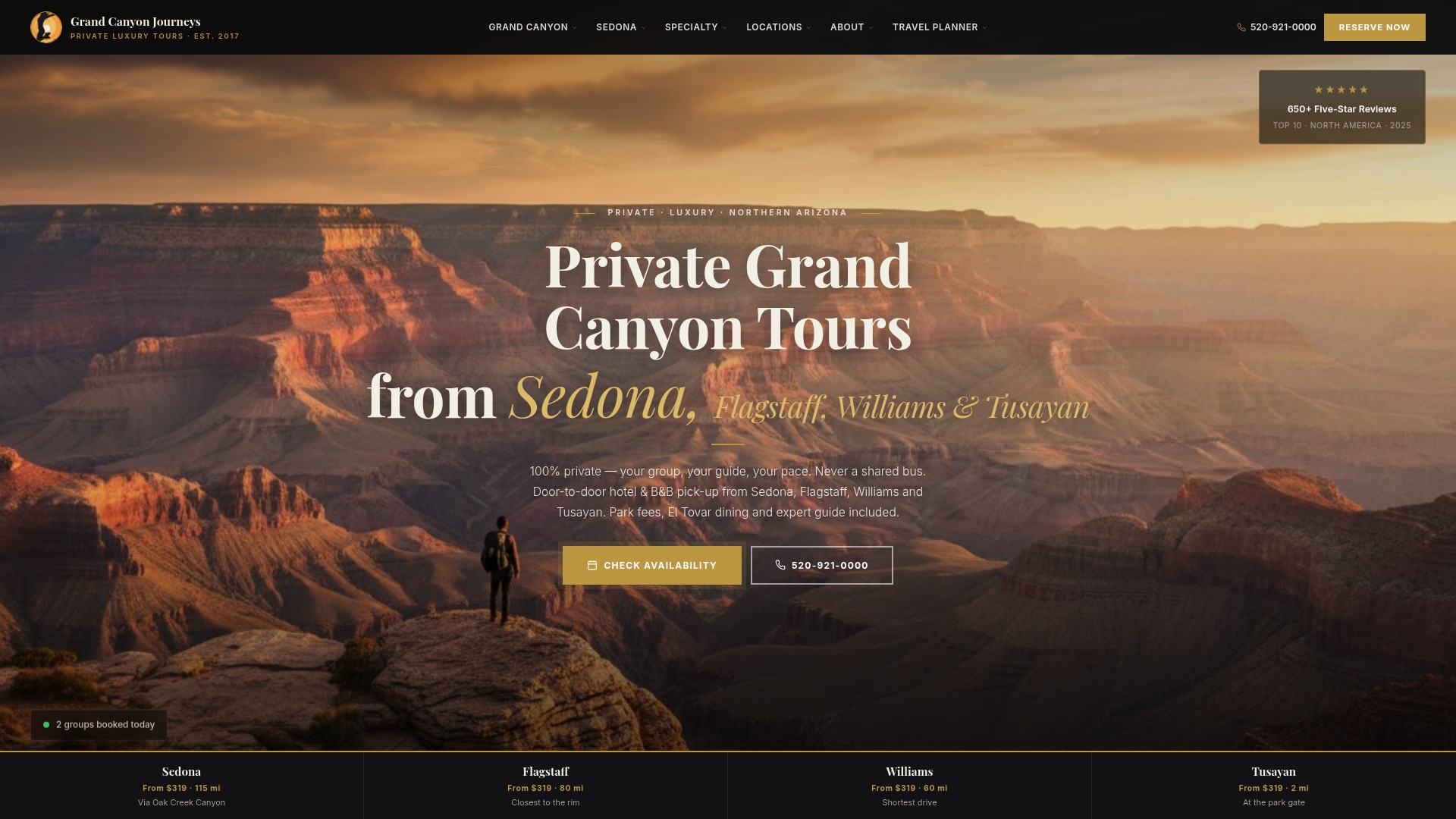
There's no parking to find, no navigation to manage, and no driving fatigue on the return. Park entry is included. The itinerary is built around your group's pace, not a bus schedule. For families, couples, and small groups who want the Grand Canyon experience without the logistical overhead, it's a straightforward upgrade over self-driving. Browse available dates and reserve your spot directly through Grandcanyonjourneys.
Sources
Check these the evening before and the morning of your departure, especially in winter or during monsoon season (July through September).
- Road Trip from Sedona to the Grand Canyon | Enterprise Rent-A-Car
- Desert View Watchtower | National Park Service
- Coconino National Forest recreation area page | USDA Forest Service
- Sunset Crater Volcano National Monument | National Park Service