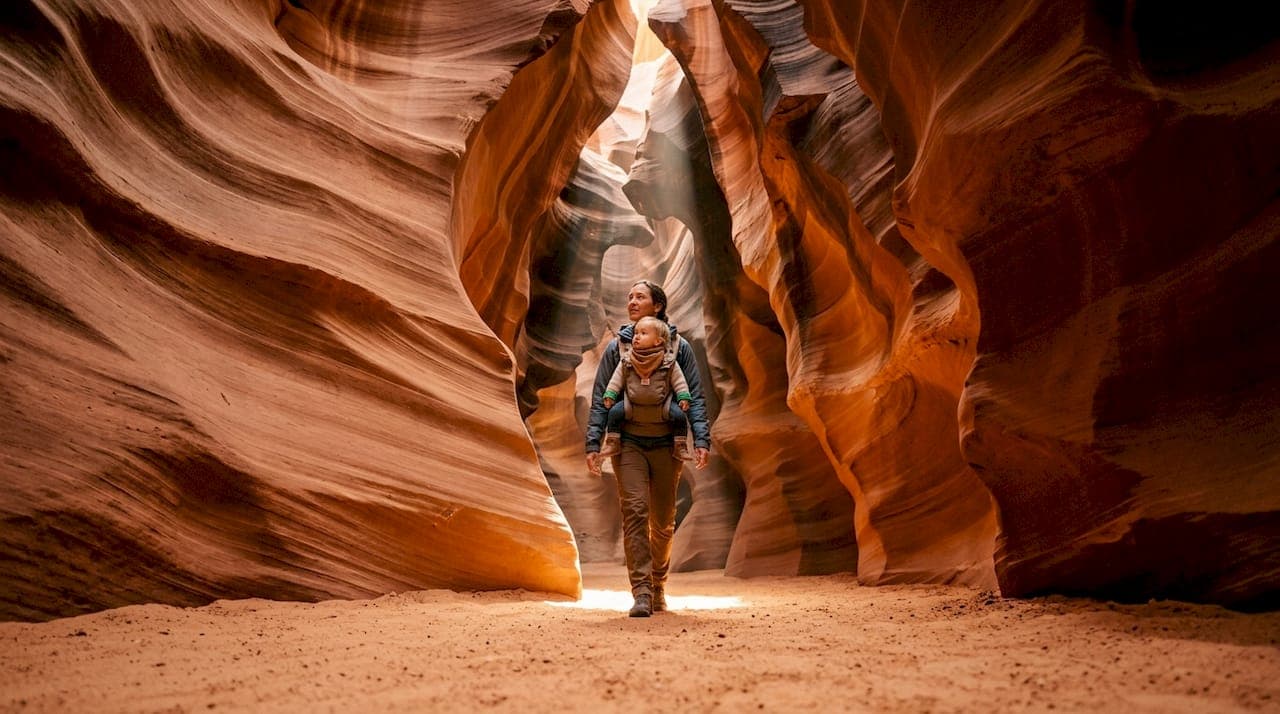
For infants and toddlers, book Upper Antelope Canyon and plan to carry your child the whole way in a soft front-pack carrier. Preschoolers ages 3 to 4 usually do fine in Upper or Canyon X, though some Canyon X operators set a 4+ minimum for the 4x4 shuttle ride. Once kids hit 5 or so, any section works, including Lower, if they're steady on ladders. Every visit requires a Navajo-authorized guided tour, no strollers, and a quick check of the operator's age policy before you pay.
TL;DR:
- Upper Antelope Canyon is ideal for infants and toddlers due to its flat sand floor and no ladders, but it becomes crowded during peak midday hours.
- Canyon X offers a quieter experience with a 4x4 shuttle and no stairs, making it suitable for children past infancy and less affected by crowds.
- Kids aged 5 and up can typically handle any section, provided they are comfortable on ladders and follow guide instructions, but safety policies vary by operator.
- Tours last 60 to 90 minutes, and early morning or late afternoon slots are recommended to avoid peak crowds and heat, especially for families with young children.
- Strollers are not allowed, and a soft front carrier is essential for infants and toddlers, alongside planning for hydration, proper footwear, and bathroom stops.
Table of Contents
- Which Canyon Section Works Best for Kids?
- What to Expect During the Tour
- Safety Rules, Accessibility, and Carrier Policies
- Booking, Timing, and Cost Expectations
- Packing Checklist for a Family Trip
- How Grand Canyon Journeys Approaches Family Logistics
- Handling a Medical Issue or Emergency With Kids in the Canyon
- Managing Altitude, Heat, and Dehydration for Kids
- Prioritizing Safety and Memory Over the Perfect Photo
- A Private Family Tour Removes the Guesswork
- Sources
- FAQ
Which Canyon Section Works Best for Kids?
Upper Antelope Canyon has a flat sand floor and no ladders, which makes it the easiest entry point for families with infants, toddlers, or anyone using a carrier. The trade-off is crowding: Upper draws the biggest groups because it's where the famous light beams appear, usually late morning in summer. If your child needs breathing room more than a photo opportunity, that midday rush matters.
Lower Antelope Canyon involves several sets of stairs and ladders bolted into narrow passages. Most operators set unofficial guidance around age 5 for this reason, and it's worth taking that seriously rather than treating it as a suggestion. A comparison of Upper and Lower Antelope breaks down the physical differences in more detail if you're weighing both.
Canyon X, also called Taadidiin, gets you there by 4x4 shuttle over a bumpy dirt road, then walks you through a quieter, less-crowded slot with smaller tour groups. Many parents find it the best middle ground once kids are past the infant stage, since the 4x4 ride itself often becomes a highlight for kids and there are no stairs to manage.
A few real-world scenarios help clarify the choice:
- Infant or toddler (0 to 2): Upper Antelope, carried the entire time. Skip Lower entirely.
- Preschooler (3 to 4): Upper or Canyon X, depending on the operator's minimum age for the shuttle.
- School-age (5 and up): Any section is typically fine if your child is comfortable on ladders and can follow instructions in tight spaces.
What to Expect During the Tour
A guided Antelope Canyon tour typically runs 60 to 90 minutes total, with the actual walk through the slot lasting somewhere around 30 to 45 minutes depending on the section and group pace. Canyon X adds shuttle time on both ends because of the unpaved access road.
- Shuttle logistics matter for younger kids. The 4x4 ride to Canyon X can be jarring on rough terrain, so motion-sensitive toddlers may do better in Upper, which you can walk to directly.
- Groups move as one unit. Guides set the pace, and there's no lagging behind to get a better shot. Kids need to understand they're staying with the group, especially in narrow sections where passing isn't easy.
- Hands stay free on stairs. In Lower and Canyon X, both hands are often needed for railings and ladder rungs, so cameras and phones need to be pocketed or slung, not held.
- There are no restrooms inside the canyon. Plan a bathroom stop at the staging area before the tour starts, and budget extra time for it with young kids.
Shade is minimal until you're inside the slot itself, so the wait in the parking or staging area can get hot fast in summer.
Safety Rules, Accessibility, and Carrier Policies
Antelope Canyon sits on Navajo Tribal Park land, and every visit runs through a Navajo-authorized guided tour operator. That's not a formality. Guides and Navajo Parks staff make the call on flash-flood risk, and tours get canceled or rerouted without much notice when conditions turn. If your guide says move, you move.
Strollers are not allowed anywhere in the canyon, and rigid backpack-frame carriers are generally discouraged too, since they don't fit through some of the tighter squeezes. A soft front-pack carrier is the standard recommendation for infants and toddlers, and you should plan to wear it for the full walk since there's nowhere to set a child down.
Closed-toe shoes are non-negotiable on sand, sandstone, and metal stairs. Guides typically position themselves near ladders and tight turns to help kids through, but supervision is still on the parent.
Pro Tip: If anyone in your group has mobility limits, ask the operator directly whether Upper Antelope's staging area and transfer vehicle can accommodate a wheelchair. Setups vary by operator, and confirming ahead saves a wasted trip.
Booking, Timing, and Cost Expectations
Book your tour 2 to 4 weeks ahead for most dates, and further out if you're traveling during peak season (spring through early fall) or want a private group. Antelope Canyon tours fill up fast, and family-sized private bookings go even quicker.
- Skip the 11 a.m. to 1 p.m. window if you can. That's when the light beams peak in Upper, and it's also when the canyon feels most crowded and claustrophobic for small kids.
- Early morning or late afternoon slots usually mean smaller groups and a calmer pace, which matters more for a 4 year old than a perfect photo does.
- Prices vary by operator and season, so confirm both the child rate and the minimum age policy before you pay. A tour listed as "family-friendly" doesn't always mean toddlers are welcome in every section.
- Smaller groups or private tours reduce a lot of the stress that comes from herding kids through a narrow space alongside 15 strangers.
Packing Checklist for a Family Trip
Pack light, but pack the right things. Water bottles, wide-brim hats, and closed-toe shoes cover the basics. Sunscreen matters even for a short walk, since the staging areas sit in full desert sun. A small first-aid kit with bandages and wipes is worth the extra ounce of weight, and if you're carrying an infant, the soft front-pack carrier is essential, not optional.
- Bring: water, hats, sunscreen, closed-toe shoes, a soft front carrier, a small first-aid kit.
- Leave behind: strollers, large backpacks, and messy or strong-smelling snacks that don't travel well inside the canyon.
- Brief kids beforehand: explain the "follow the guide" rule before you get out of the car, and save snacks for after the tour rather than mid-walk.
Choosing an off-peak time slot, as mentioned above, does more to keep kids comfortable than any item on this list.
How Grand Canyon Journeys Approaches Family Logistics
A locally owned Northern Arizona operator runs private Antelope Canyon and Horseshoe Bend tours, and family logistics come up constantly in trip planning conversations. Private bookings give guides room to slow down for a curious 4 year old or a nervous first-timer on a ladder, something a packed group tour can't offer.
Families do better when the pace bends around the kid, not the other way around. A smaller group means the guide has time to help a child through a ladder without holding up fifteen strangers behind them.
For permit details and section-by-section planning, the Antelope Canyon permits guide walks through how booking works before you commit to a date.
Handling a Medical Issue or Emergency With Kids in the Canyon
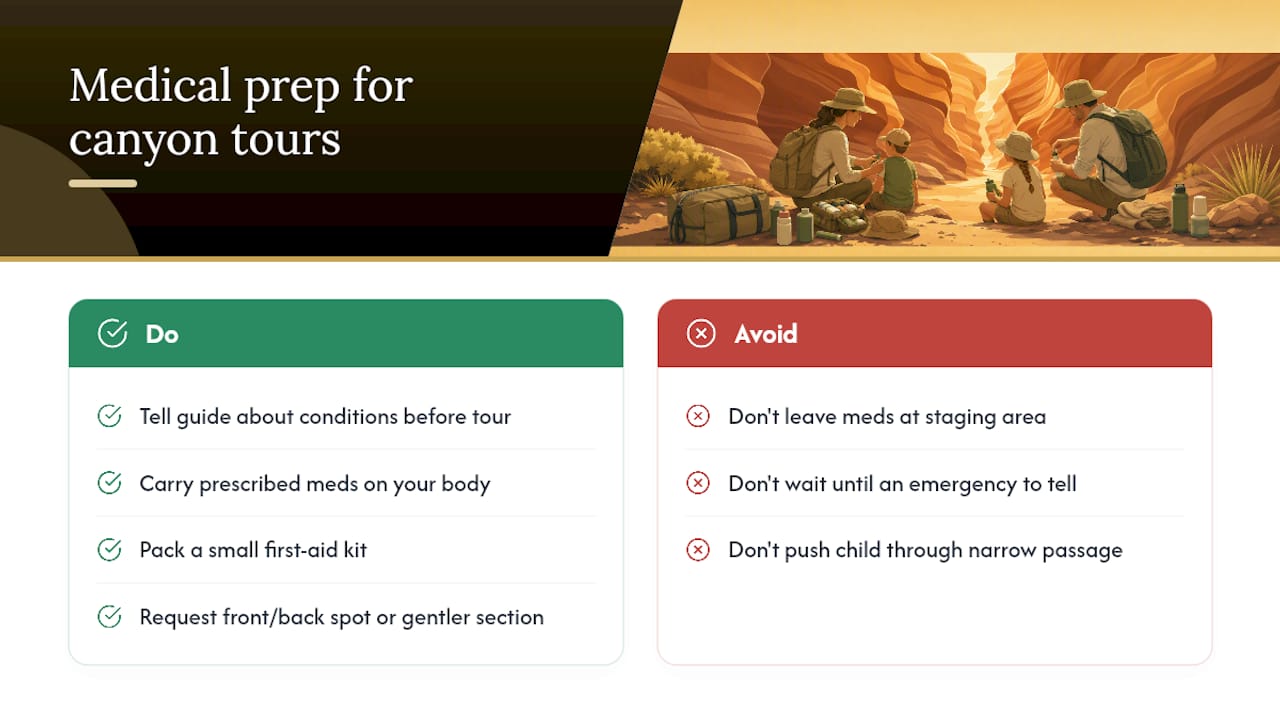
Guides carry basic first-aid supplies and are trained to respond to minor injuries, but the canyon's terrain limits how fast anyone can reach outside help. If your child has a known medical condition, such as asthma or a severe allergy, tell the guide before the tour starts, not after something happens.
Carry any prescribed medication (inhalers, EpiPens) on your body rather than in a bag left at the staging area, since there's no going back for it mid-tour. For minor scrapes or a stumble on the sand, a small first-aid kit covers most needs. For anything more serious, the guide will make the call on evacuating the group, since narrow passages make stretcher access difficult and slow.
If your child has a history of panic in tight or dark spaces, mention it when booking. Some operators can offer a spot near the front or back of the group, which gives more breathing room and an easier exit if needed. Canyon X and Upper tend to feel less closed-in than Lower's narrower stretches, so section choice itself is a form of prevention here. Trust your read on your own child over the itinerary. A tour that ends early because a kid needed a break beats one that pushes through a meltdown in a 3-foot-wide passage.
Managing Altitude, Heat, and Dehydration for Kids
Page, Arizona sits around 4,300 feet, which isn't extreme altitude, but it's high enough combined with desert heat to catch families off guard, especially kids who came from sea level a day earlier. Dehydration shows up faster in children than adults, and the warning signs (irritability, headache, dizziness) look a lot like ordinary toddler fussiness, which makes them easy to miss.
Start hydrating the morning of the tour, not right before it. A cup of water at breakfast and another in the car does more than a single bottle chugged at the trailhead. Bring more water than feels necessary. There's no shade or water source inside the canyon itself, and the staging area sun exposure adds up while you wait.
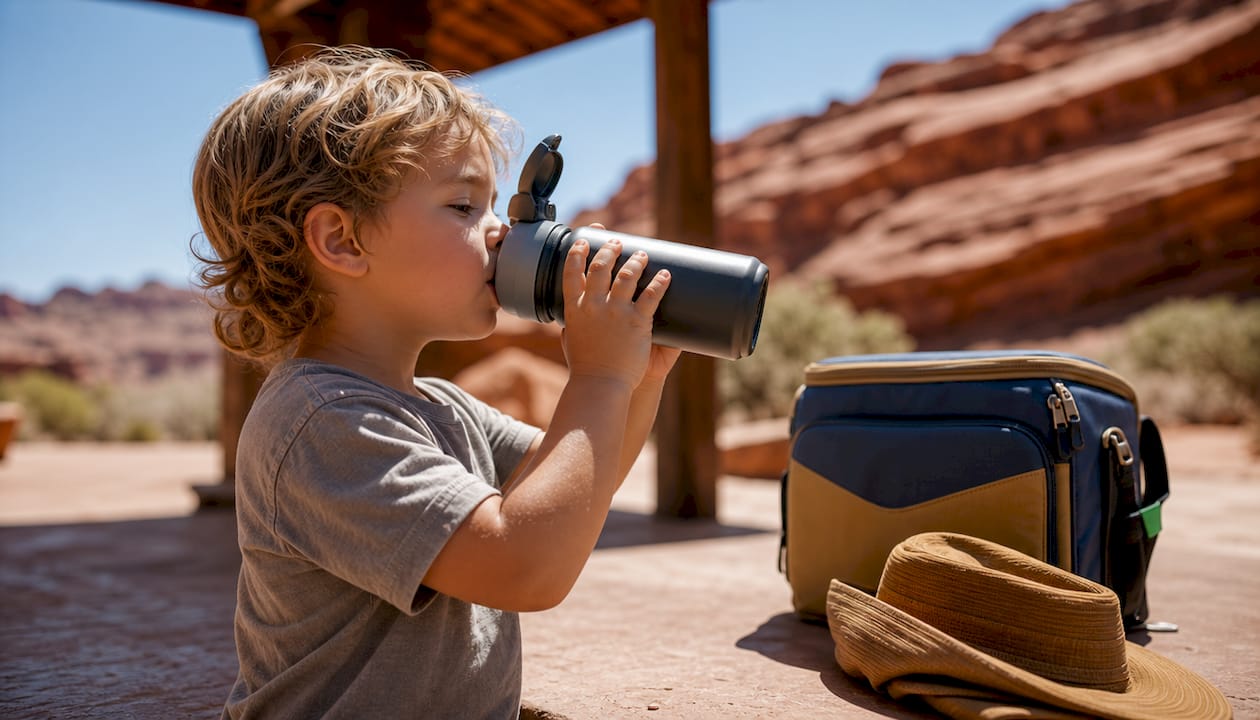
Watch for flushed skin, unusual quietness, or a child refusing to walk. Those are common heat-stress signals in kids, not just tiredness or boredom. If you notice them, tell the guide immediately. Most tours can pause briefly for water or shade even mid-walk, and guides deal with this regularly during summer months. Scheduling your visit for early morning or late afternoon, as covered earlier, cuts a lot of this risk before it starts simply by avoiding peak heat.
Prioritizing Safety and Memory Over the Perfect Photo
Pick the canyon your kid can actually handle, not the one with the best light or the lowest price. Lower looks great in photos, but a stressed 4 year old on a ladder isn't a memory anyone wants. Pair whatever section you choose with something low-effort afterward, like the Horseshoe Bend viewpoint or a shaded picnic, and the day rounds out a lot better than it would chasing a specific window of light.
— Chris
A Private Family Tour Removes the Guesswork
Grand Canyon Journeys runs the Antelope Canyon & Horseshoe Bend tour as a private, door-to-door experience from Sedona, which means no sharing a group with strangers who are moving at a different pace than your kids. Pickup comes to your hotel or B&B, the vehicle and pace flex around your family's needs, and your guide already knows each operator's age minimums and carrier rules before you arrive at the staging area.
That local knowledge matters more than it sounds. Instead of guessing whether Canyon X will accept your 4 year old or whether Lower's ladders suit your family, a private guide walks you into the right section from the start. If you're ready to check dates, visit the Antelope Canyon tour page to review logistics, then reach out to confirm carrier and car-seat details before booking your date.
Sources
- Antelope Canyon with Kids & Families: Age Limits, Safety (2026) | Slot Canyon Guide
- Guided tour operators | Navajo Nation Parks & Recreation
- Tips for visiting Antelope Canyon with your family - The Points Guy
FAQ
What Is the Age Limit for Kids at Antelope Canyon?
There's no single park-wide age limit. Each operator sets its own minimum, and Upper Antelope generally accepts infants carried in a soft front-pack, while Lower and Canyon X often set higher minimums around age 4 or 5 due to ladders and shuttle rides.
Is Antelope Canyon a Tourist Trap?
No. It's a genuine natural landmark on Navajo Tribal Park land, and the guided-tour requirement exists for real safety reasons tied to flash-flood risk, not just to sell tickets. The crowds during peak light-beam hours can feel commercial, but booking an off-peak slot or a private tour changes that experience considerably.
Is Upper Antelope Canyon Suitable for Toddlers?
Yes, Upper is generally the best choice for toddlers because the floor is flat sand with no ladders or stairs. Parents should still plan to carry toddlers the entire way in a soft front-pack carrier, since strollers aren't permitted and there's nowhere inside to set a child down.
What Happened During the Antelope Canyon Flash Flood?
Antelope Canyon has a history of serious flash floods, which is exactly why Navajo-authorized guides and Navajo Parks monitor weather closely and cancel or reroute tours when conditions turn risky. This is also the reason self-guided entry isn't allowed. Guides are trained to recognize warning signs and move groups out quickly if needed.