Below 90°F on your trailhead thermometer, normal caution applies. Between 100°F and 104°F, keep hikes short and start before sunrise. At 105°F and above, the Arizona Department of Health Services and Arizona State Parks both say get indoors, not on exposed desert floor trails. If a National Weather Service Excessive Heat Warning is active, the safest move is an early-morning start at higher elevation or a guided route chosen by someone who checks these numbers for a living.
TL;DR:
- Hikes on exposed desert trails are unsafe at 100°F and above due to radiant solar load, with higher elevations offering safer options at the same temperature.
- Official advisories trigger at 105°F for general caution and 110°F or higher for extreme danger, with closures on popular trails during excessive heat warnings.
- Shade and elevation significantly reduce thermal stress, making a shaded higher-elevation trail at 95°F safer than a sun-exposed canyon floor reading 92°F.
- Proper hydration involves drinking on a schedule, adding electrolytes, and starting hikes early based on elevation, with shorter trips recommended above 3,000 feet.
- Guided hikes that plan around early starts, shade, elevation, and hydration mitigate heat risks better than solo excursions in Arizona’s intense summer conditions.
Table of Contents
- Arizona Heat Index Hiking Thresholds You Need to Know
- Why Arizona Heat Hits Harder Than the Number Suggests
- Check These Advisories Before You Lace Up
- Your Arizona Hiking Safety Checklist
- Heat Exhaustion vs. Heat Stroke: What to Do on the Trail
- Choosing Trails and Start Times by Elevation
- How Guides Actually Make the Call on Hot Days
- A Heat-Aware Alternative to Hiking Solo in Arizona Summer
- Sources
Arizona Heat Index Hiking Thresholds You Need to Know
The heat index on your phone is a starting point, not a green light. Arizona State Parks draws a hard line at 90°F for strenuous outdoor activity and another at 105°F, where the advice shifts from "be careful" to "go inside."
Here's how to translate those numbers into actual trail decisions:
- Below 90°F: Normal precautions. Carry water, watch the clock, hike as planned.
- 90°F to 99°F: Heightened caution. Shorten your route, add rest breaks, avoid the noon window.
- 100°F to 104°F: Limit hikes to very short outings, ideally finished before 9:00 a.m.
- 105°F and above: Avoid exposed canyon-floor and desert trails entirely. Seek air conditioning.
Heat-Index Reality Check: A 100°F day with direct desert sun and low humidity can feel and behave like a 110°F+ event on your body, which is why guides treat the 100°F mark as a real turning point, not a suggestion.
Why Arizona Heat Hits Harder Than the Number Suggests
Standard heat-index charts are built around humidity and shade. Arizona rarely offers either. Direct desert sun adds what guides call "solar load," a radiant heat multiplier that can push the felt temperature well past what a phone app reports, since Arizona's dry climate and intense sun exposure make the humidity-based heat index an incomplete measure of real thermal stress on an exposed trail.
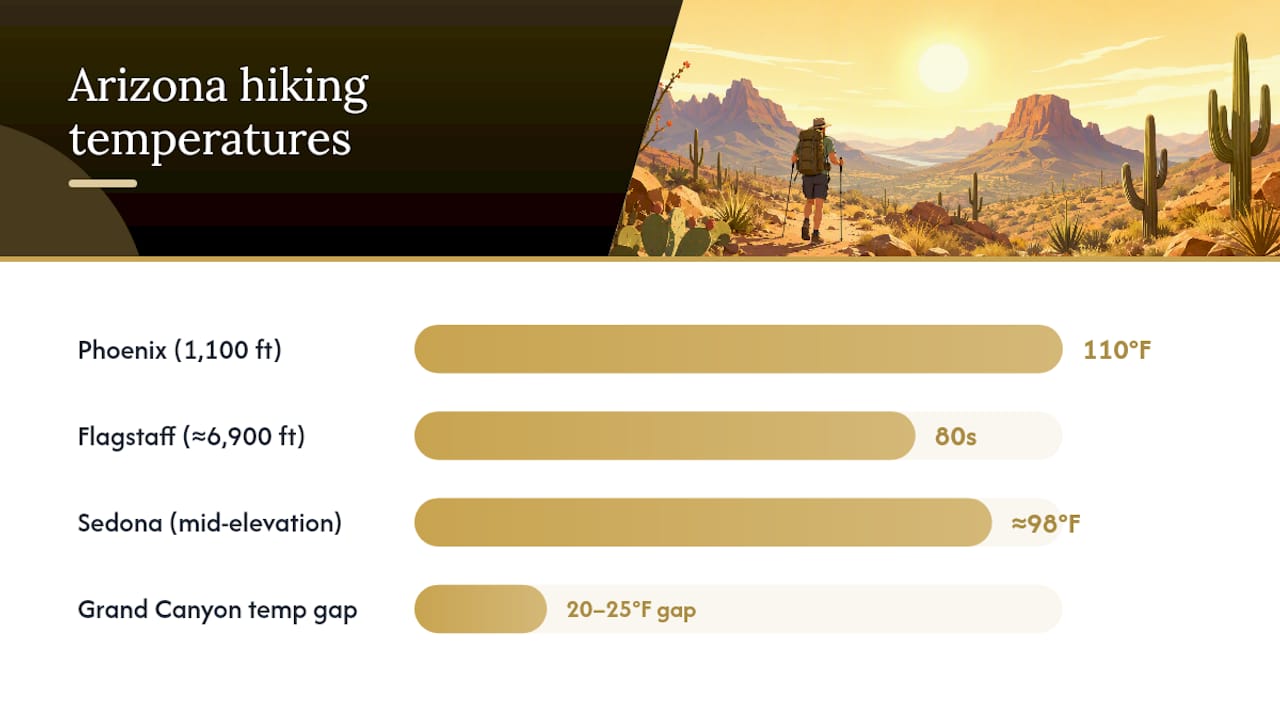
Elevation changes the math too. Phoenix at 1,100 feet can hit 110°F in July while Flagstaff, sitting above 6,900 feet, stays in the comfortable 80s. Sedona splits the difference, and the Grand Canyon's North Rim runs cooler still than the inner canyon floor, where temperatures routinely run 20 to 25 degrees hotter than the rim.
Pro Tip: Don't trust the number alone. Trust the shade. A shaded, higher-elevation trail at 95°F often beats a sun-blasted canyon floor reading 92°F on the thermometer.
Check These Advisories Before You Lace Up
Two official alerts matter most in Arizona. A Heat Advisory typically triggers around 105°F to 109°F daytime highs; an Excessive Heat Warning kicks in at 110°F or higher, or when heat index values climb even further, and signals conditions dangerous for anyone outdoors without shade or water access.
Local trail rules add another layer. Phoenix's Trail Heat Safety Program restricts or closes specific summit trails, including popular Camelback and Piestewa Peak routes, during Excessive Heat Warnings, and the program has measurably cut mountain rescues on the days those closures apply.
Before any summer hike, check:
- The National Weather Service forecast page for your specific route's zone
- The AZDHS heat-index chart for the day's projected values
- The relevant city or county trail-closure page for your trailhead
If a closure or warning is active, treat it as your answer, not a suggestion to work around.
Your Arizona Hiking Safety Checklist
Getting the gear and pacing right matters as much as watching the thermometer. Here's the order of operations that actually reduces risk on the trail:
- Drink on a schedule, not by thirst. AZDHS guidance is explicit that waiting until you feel thirsty means you're already behind. The National Park Service recommends roughly one quart of water per hour on hot, dry days.
- Add electrolytes, not just water. Long, hot efforts on plain water alone can lead to salt depletion; carry an electrolyte mix alongside your water supply.
- Dress for solar load. Light-colored, breathable long sleeves, a wide-brim hat, and SPF beat a tank top every time in direct desert sun.
- Pack margin water. Bring more than you think you'll drink, plus a way to signal for help if something goes wrong.
- Respect acclimatization. REI's guidance puts heat adaptation at 10 to 14 days. If you just landed from a cooler climate, plan shorter, lower-effort hikes for your first several days.
Pro Tip: Set a phone alarm every 20 minutes as a drinking cue on hot days. Thirst is a poor early-warning system in dry desert air.
Heat Exhaustion vs. Heat Stroke: What to Do on the Trail
Heat cramps show up first: muscle spasms, usually in the legs, while you're still sweating normally. Heat exhaustion follows, with heavy sweating, weakness, nausea, and a headache, but the person stays alert. Heat stroke is the emergency: confusion, hot and dry (or clammy) skin, a body temperature that can climb past 103°F, and sometimes loss of consciousness.
The Turning Point: If sweating has stopped or confusion appears, that's heat stroke, and it's a call-911 situation, not a rest-and-hydrate one.
For heat exhaustion, stop exertion immediately, move to shade, and sip water with electrolytes. For heat stroke, cool the person by any means available, wet cloth, shade, fanning, while someone calls for help. When you call 911 in a remote area, give your trail name, mile marker or nearest landmark, and the specific symptoms you're seeing; that detail speeds up the response far more than "we need help."
Choosing Trails and Start Times by Elevation
Match your start time and route to elevation, not just the calendar. Desert-hiking guides recommend a 5:00 to 7:30 a.m. window for low desert-floor trails, with later, more flexible starts as elevation climbs.
- Below 3,000 feet: Start by 6:00 a.m., finish before 10:00 a.m. in summer.
- 3,000 to 5,000 feet: Slightly more flexibility, but still an early finish on 100°F+ days.
- 5,000 to 7,000 feet: Comfortable through much of the day; Sedona and similar elevations fall here.
- Above 7,000 feet: Flagstaff and the North Rim rarely require the same urgency.
Monsoon season, roughly July through September, adds afternoon thunderstorm and flash-flood risk on top of the heat, per Harvard Health's wilderness-safety guidance. Leave your itinerary with someone, set a firm turnaround time, and if the forecast is borderline, a guided hike with someone tracking conditions in real time removes the guesswork.
How Guides Actually Make the Call on Hot Days
Most advice about Arizona heat gets the direction right and the margin wrong. People treat 100°F as the danger line when the real risk curve on an exposed canyon trail starts bending hard closer to 90°F, especially with no shade and a pack that's heavier than it needs to be.
What's underappreciated is how much logistics, not willpower, determines outcomes. A guide who times departure to reach the trailhead before first light, stages a cooled vehicle at the turnaround, and carries electrolyte solution as standard kit is solving the heat problem before it ever becomes a medical one. That's the model our Wilderness First Responder-certified guides follow on guided hikes below the rim: early pickup, air-conditioned staging, and a route chosen for shade and elevation rather than convenience.
The gap between "technically legal to hike" and "actually smart to hike" is wider in Arizona than almost anywhere else in the country. Respect that gap and the desert is genuinely rewarding. Ignore it and the same trail that felt manageable at 8:00 a.m. can turn into a rescue call by 11:00.
— Chris
A Heat-Aware Alternative to Hiking Solo in Arizona Summer
Grandcanyonjourneys is the alternative to solo desert hiking when the forecast turns risky: a WFR-certified guide plans your start time, route, and hydration protocol around the day's actual heat index, not a guess.
Every guided outing runs on the same logic covered above. Pickup happens before sunrise in a climate-controlled vehicle, routes get chosen for elevation and shade rather than convenience, and pre-cooled electrolyte solutions are standard kit in case anyone in the group starts feeling the heat. That's the operational difference between reading a safety checklist and having someone execute it for you on the trail.
If you're planning a summer trip and want the numbers handled for you, check available dates for a private guided hike below the rim or explore Grand Canyon tours from Sedona built around heat-safe timing.
This article is general information, not a substitute for advice from a qualified doctor. Consult a qualified healthcare professional about your own circumstances before acting on anything here.
Sources
- Summer Heat Safety Tips for Outdoor Recreation in Arizona
- Heat safety information — Arizona Department of Health Services
- Phoenix Trail Heat Safety Program
- Hot weather hiking — REI Expert Advice
- Hiking safety information — Saguaro National Park (NPS)