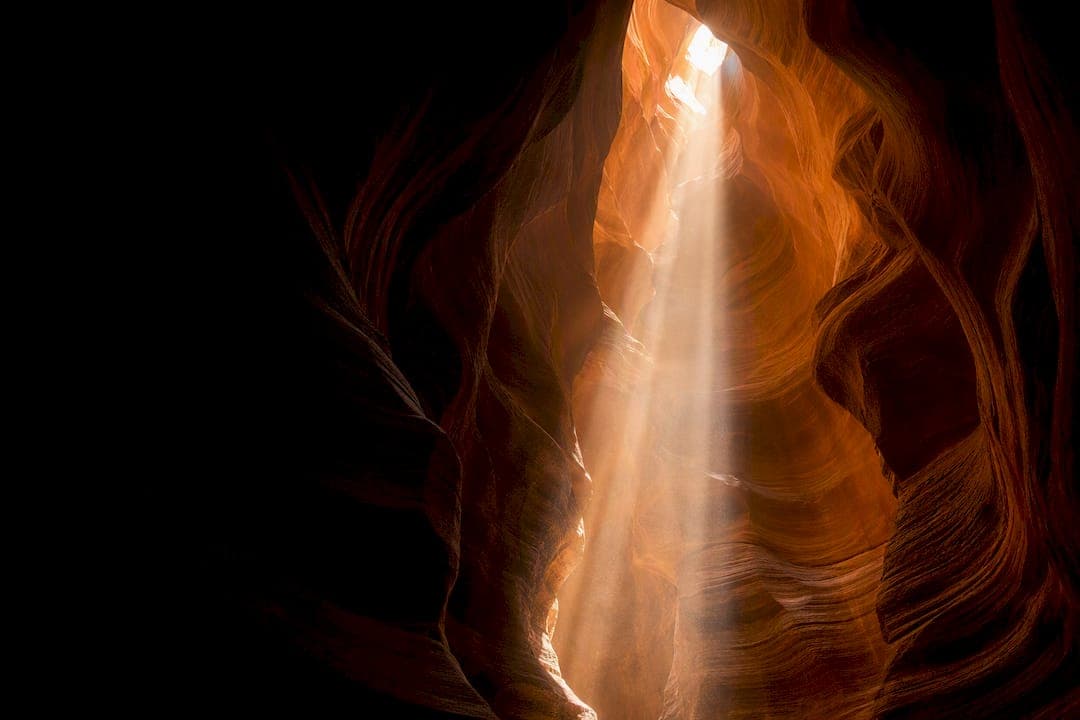
Late March through mid October is the beam season, and within that window, the period from late spring through summer delivers the strongest, most vertical light shafts. Aim for midday, roughly 10 AM to 1:30 PM, with the sweet spot between 11 AM and 1 PM in Upper Antelope Canyon. Peak months mean peak crowds and desert heat; shoulder-season dates trade a little beam intensity for breathing room and milder temperatures.
TL;DR:
- Peak beam conditions occur between 11 AM and 1 PM during May to August, but crowds and heat are highest in this period.
- Visiting in shoulder seasons like late March to May or September to October offers milder temperatures, fewer tourists, and still good lighting for photography.
- Booking a midday tour months in advance is essential, especially during summer weekends, and private guides offer more schedule flexibility.
- Inside the canyon, camera settings should favor high ISO and fast shutter speeds for handheld shots, with white balance adjustments to capture warm tones accurately.
- Monsoon season from June to September poses flooding risks, so travelers must monitor weather closely and be prepared for possible cancellations.
Table of Contents
- Best Time Antelope Canyon Visitors Should Target by Month
- What Time of Day Gives You the Light Beams
- Upper vs. Lower Antelope Canyon: Which Fits Your Photography Goals
- Booking Strategy: How to Beat the Crowds and Still Catch the Beams
- Camera Settings and Gear Tips for Slot Canyon Conditions
- Weather, Monsoons, and Closure Risk
- Does the Moon Affect Light and Timing Inside Antelope Canyon?
- A Local Guide's Take on Timing Your Antelope Canyon Visit
- Planning a Private Antelope Canyon Departure
- Sources
Best Time Antelope Canyon Visitors Should Target by Month
Beam probability tracks the sun's angle, which is why the calendar matters as much as the clock. From late March through mid-October, the sun climbs high enough to send direct shafts down into Upper Antelope's narrow openings, and May through August produces the strongest, most defined beams of the year.
That said, summer is a trade-off. Page, Arizona regularly hits triple digits in July and August, and the canyon fills with tour groups shooting the same 90-minute window. Shoulder months soften both problems.
- March to May: Beams begin appearing by late March, temperatures stay comfortable, and crowds are noticeably thinner than summer.
- June to August: Peak beam intensity and peak crowds, plus monsoon season starting in June, which can trigger closures.
- September to October: Beams taper off by mid-October, but the light turns warmer and crowds thin out again, making this a favorite window for photographers.
- November to February: No beams, but the canyon empties out, walk-in wait times drop, and the walls still glow with reflected color from ambient light.
Winter visitors give up the shaft photography but gain something else: room to actually compose a shot without three other people in the frame. If moody, warm-toned wall photography interests you more than the viral beam shot, Antelope Canyon stays open year-round and rewards the quieter months.
What Time of Day Gives You the Light Beams
The beams aren't magic. They're a function of the sun sitting nearly overhead, narrow enough to thread its light through a slot in the canyon roof. Here's how the day typically breaks down for Upper Antelope:
- Early morning (before 10 AM): Soft, indirect light bounces off the walls, producing warm gradients but no vertical shafts. Good for wide shots of texture and color.
- Midday (10 AM to 1:30 PM): The prime window for dramatic overhead light, with beam intensity peaking between roughly 11 AM and 1 PM depending on the season and exact canyon section.
- Afternoon (after 1:30 PM): The sun drops in angle again, shafts fade, but reflected light off the sandstone can still produce rich color for another hour or two.
Tour operators build their schedules around this window on purpose. Photography-focused slots during peak months get booked into that 11 AM to 1 PM stretch specifically because that's when the sun lines up with the canyon's openings. If you book a morning or late-afternoon slot instead, you'll still get beautiful photos, just softer and without the signature shaft.
Upper vs. Lower Antelope Canyon: Which Fits Your Photography Goals
Upper Antelope is the canyon most people picture when they think of Antelope Canyon: wide, flat-floored, and home to the iconic vertical light beams that show up on postcards and Instagram feeds. It's also the most crowded section during the midday window, since everyone's chasing the same shot at the same time.
Lower Antelope trades the beam spectacle for something photographers often underrate: variety. The winding, narrower passage produces deeper shadows, twisting rock shapes, and usable light across more of the day, not just a 90-minute stretch. It requires navigating stairs and ladders, so it's a poorer fit if mobility is a concern.
- Choose Upper if the beam shot is your priority and you're comfortable shooting in a crowd during peak hours.
- Choose Lower if you want compositional flexibility, deeper shadow work, and a bit more breathing room.
- Consider comparing Upper and Lower in more detail before booking if you're torn between the two.
- Look into a less-crowded alternative near Page if crowd density is your main concern regardless of beams.
Booking Strategy: How to Beat the Crowds and Still Catch the Beams
Antelope Canyon requires a Navajo-authorized guide for entry, no exceptions, and the best midday slots during peak season sell out well in advance. If you're targeting a specific summer date and a specific time window, book that slot months out, not weeks.
- Reserve peak-season midday tours as early as you can, ideally months ahead for July or August dates.
- Weekdays run noticeably lighter than weekends, especially Tuesday through Thursday.
- A private tour gives you more control over timing than a large shared group departure.
- Shoulder-season dates (April, September, October) often have more slot availability even close to your travel date.
- Staying overnight near Page rather than day-tripping in gives you flexibility if your tour time shifts or weather pushes a slot, with convenient options like the Grand Canyon South Rim KOA Holiday Campsites & Specs nearby.
Pro Tip: Availability shifts constantly as other travelers book and cancel. If your ideal date is full, check back a few days later, or ask about being flexible on the exact hour. A slot 30 minutes earlier or later in the window can still land you solid beam light.
For help locking in a slot without the guesswork, booking two to four weeks ahead with a private Navajo guide is a reasonable baseline, though peak summer weekends can require even more lead time.
Camera Settings and Gear Tips for Slot Canyon Conditions
Shooting inside a slot canyon means working with extreme contrast, low light in the shadows, and almost no room for a tripod setup anymore. Current photo tour rules favor handheld shooting over the tripod-heavy approach that used to define Antelope Canyon photography, so plan your settings accordingly.
- Set a custom white balance between roughly 5500K and 7000K, or shoot RAW, since auto white balance tends to cool down the sandstone's warm orange and red tones.
- For handheld shots, start around ISO 800 to 1600, a shutter speed of 1/60 or faster to avoid blur, and an aperture between f/4 and f/8 depending on available light.
- Brace against a canyon wall or use a monopod where allowed for extra stability in dim corners.
- Avoid changing lenses inside the canyon. The sand is fine, powdery, and gets into camera bodies fast.
- Carry a small brush or cloth and clean your gear immediately after the tour, before the sand has a chance to settle into seams and dials.
The midday window still gives you the most forgiving light for handheld shooting, since the overhead sun reduces the harsh shadow-to-highlight gap that makes early morning or late afternoon shots harder to expose correctly without a tripod.
Weather, Monsoons, and Closure Risk
Monsoon season runs roughly June through September, and it's the single biggest threat to a planned Antelope Canyon visit. Flash flooding inside a slot canyon is dangerous, and tours close without much notice when storms build anywhere upstream, even if the sky above Page looks clear.
Winter brings a different set of considerations: cold mornings, occasional snow, and the quietest crowd levels of the year.
- If your tour gets canceled for weather, contact your tour operator directly about rebooking or refund options rather than assuming either automatically.
- Wear closed-toe shoes with good traction; the sandy canyon floor can be uneven and slick in spots.
- Dress in layers during winter visits, since temperatures inside the canyon can feel colder than the trailhead.
- Check the forecast the morning of your tour, not just the night before, since monsoon storms can build quickly in summer afternoons.
Does the Moon Affect Light and Timing Inside Antelope Canyon?
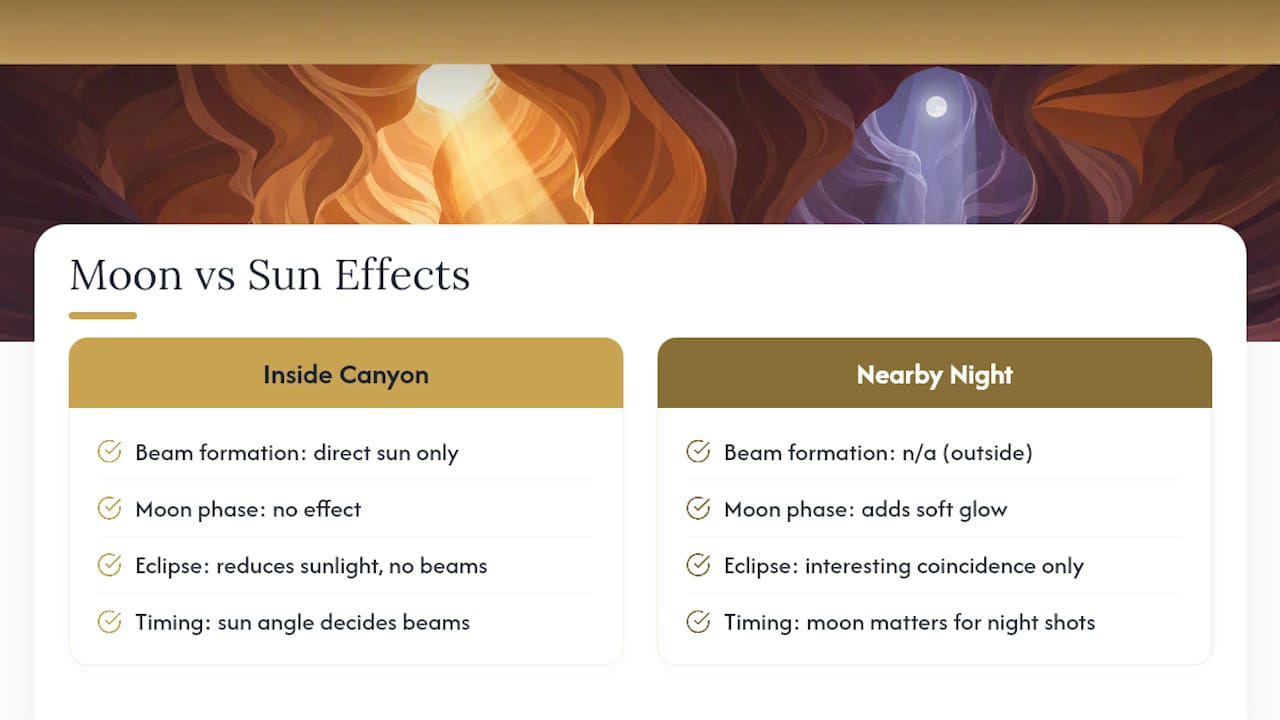
Moon phases don't affect the beams. Antelope Canyon's light shafts come from direct sunlight reaching a narrow opening at a steep angle, which is purely a daytime, sun-driven phenomenon. A full moon overhead at 1 PM has zero bearing on whether you get a beam.
Where moon phase and celestial timing actually matter is outside the canyon, on the front and back end of your trip. A bright moon the night before or after your tour can make evening photography around Page or nearby Horseshoe Bend more interesting, since moonlight adds a soft glow to long-exposure landscape shots. If you're stacking a slot canyon visit with a Horseshoe Bend stop, checking the lunar calendar for your travel dates can add a bonus shot to the trip even though it has nothing to do with the canyon itself.
Solar events get asked about occasionally, too, mostly because visitors assume an eclipse might create a dramatic beam effect. It won't. A partial or total solar eclipse actually reduces the direct sunlight reaching the canyon floor, which works against beam formation rather than enhancing it. If a rare celestial event happens to line up with your travel dates, treat it as a fun coincidence for the drive out, not a reason to change your booking strategy. The sun's daily angle, not the moon or a passing eclipse, is what decides whether you walk away with a beam photo.
A Local Guide's Take on Timing Your Antelope Canyon Visit
Private departures from Sedona, Flagstaff, or Williams solve a problem most day-trippers don't anticipate: the drive to Page eats into the exact window you're trying to hit. A guide who knows the route and the tour schedule can time your pickup so you're not rushing into the canyon sweaty and stressed right as the beams peak.
Every Antelope Canyon tour requires a Navajo-authorized guide by tribal law, and that guide's local knowledge, not just the permit, is what actually helps you find the best angle in a crowded 90-minute window. For help mapping the drive time and tour timing around your dates, the Grand Canyon travel planner is worth a look before you lock in a date.
— Chris
Planning a Private Antelope Canyon Departure
Grand Canyon Journeys is an option for travelers who prefer a more personalized approach than a rushed group tour or self-driven itinerary. A private Antelope Canyon and Horseshoe Bend tour departing from Sedona with door-to-door pickup means the drive time works around your desired midday slot, not the other way around, and you're traveling with a Navajo-authorized guide who knows the canyon's rhythms firsthand.
If you're still deciding between Upper and Lower, or trying to figure out how a slot canyon day fits alongside a Grand Canyon visit, the Grand Canyon travel planner is a useful starting point for building out dates and departure options. Reach out to check availability for your preferred beam-season window before the good slots disappear.
Sources
Timing and light-beam details draw on guidance from Digital Photography School, Marty Quinn Photography, Slot Canyon Guide, and Visit Arizona. For booking help, see Grand Canyon Journeys' Antelope Canyon page.
- 10 Tips for Photographing Antelope Canyons
- Antelope Canyon Photography Guide: Upper, Lower & Light Beams | Marty Quinn Photography
- Antelope Canyon Photo Tours & Photography Guide (2026) | Slot Canyon Guide
- A guide to visiting Antelope Canyon the right way | Visit Arizona