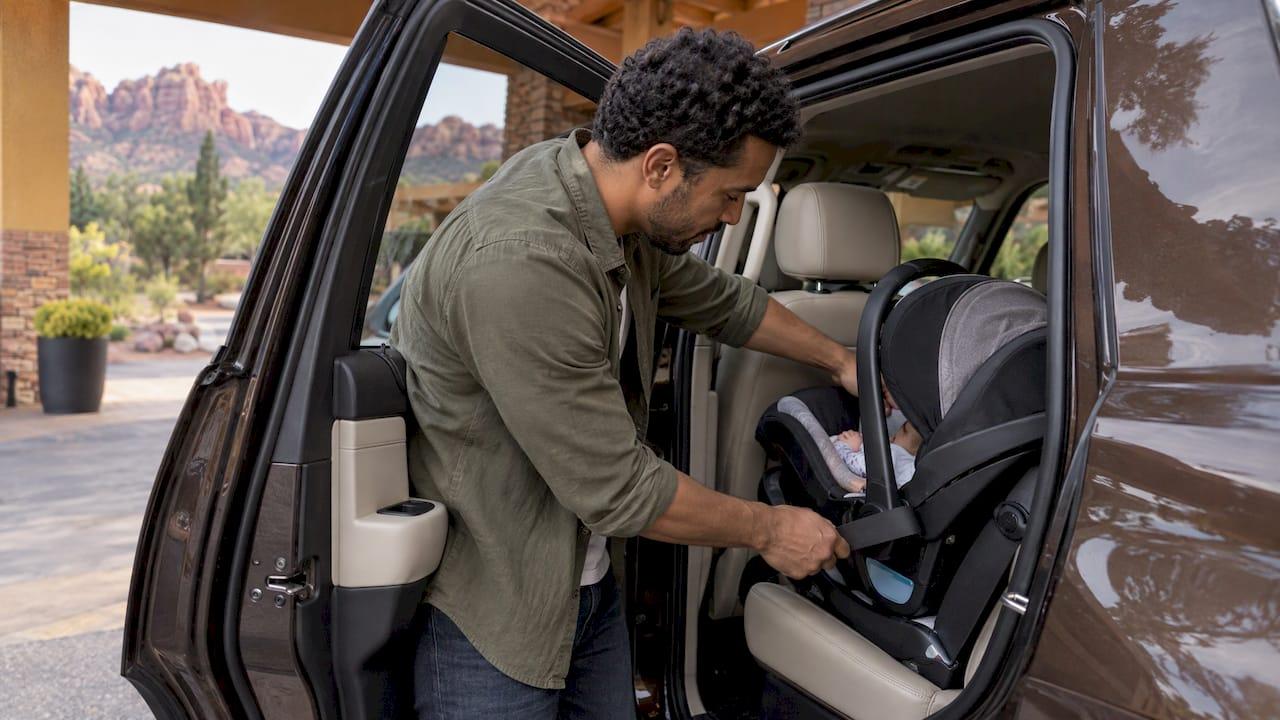
If you are touring Arizona with a child under eight, plan on a proper car seat or booster for every ride, including tour vehicles. Arizona's law sets the age and height thresholds, and the seat must meet federal standards and be installed the way the manufacturer says. The practical job is settling who supplies the seat, whether it fits the vehicle and how it gets from your airport to your hotel. Do that before you book, not at the curb on the morning of the tour.
This guide covers the Arizona rules, the gray areas around larger tour vehicles, seats bought outside the US, flying with a seat and the questions to put to a private tour operator.
TL;DR
- Arizona requires a child restraint for children under five, and for children aged five to seven who are no taller than 4 feet 9 inches.
- The statute lists exemptions for some vehicle types. Do not treat them as a reason to skip a seat for your child.
- A seat must be federally compliant, unexpired and installed per its manual. A seat from abroad may not carry the labels US rules look for.
- For flights, look for the "certified for use in motor vehicles and aircraft" label. Boosters are not approved for use during take-off and landing.
- Tell your tour operator your children's ages, heights and seat type before booking so the seating plan is settled in advance.
Table of Contents
- What Arizona law requires
- Beyond the legal minimum: when to move to a booster
- Do the rules change in larger tour vehicles?
- Fitting car seats in the vehicle: capacity matters
- Seats bought outside the US
- Is your seat still safe to use?
- Flying with a car seat to Arizona
- What to ask a private tour operator
- Our perspective
- Booking a private tour for your family
- FAQ
- Sources
What Arizona law requires
The rule sits in A.R.S. § 28-907. Children under five must be secured in a child restraint system. Children who are at least five but under eight, and no more than 4 feet 9 inches tall, must also be restrained in one. The Arizona Department of Transportation summarizes it the same way: younger than 8 and shorter than 4 feet 9 inches means a safety seat or booster.
A few points matter for visitors:
- Height counts as much as age. A tall six-year-old may be past the booster requirement. A small nine-year-old may still fit better in a booster, because the law is a minimum, not a recommendation.
- The seat must meet federal requirements and be used according to the manufacturer's instructions. The Arizona Legislature's issue brief on seat belt laws describes Arizona's child restraint law as primary enforcement, meaning an officer can stop a vehicle for the violation alone.
- Older children still need belts. The general seat belt statute, A.R.S. § 28-909, does not apply to a child covered by the child restraint law, so the two rules work together rather than overlapping.
If you are comparing states, the rules differ across the US. Treat the Arizona thresholds as what applies on your Arizona itinerary only.
Beyond the legal minimum: when to move to a booster
The law tells you the floor. Safety guidance goes further. NHTSA's car seat recommendations advise a booster once a child outgrows a forward-facing seat with a harness, and they describe what a good belt fit looks like: the lap belt lies snugly across the upper thighs, and the shoulder belt crosses the shoulder and chest, not the neck or stomach.
NHTSA also recommends keeping children in the back seat through age 12. That is useful on a tour day, when children often ask to sit up front with the guide for the view. The back row is the right place for them.
A simple check you can do in the lobby of your hotel:
- Does your child sit all the way back against the seat?
- Do their knees bend naturally at the edge of the seat?
- Does the lap belt sit low on the thighs?
- Does the shoulder belt stay on the shoulder and chest without slipping?
- Can they stay that way for the whole ride, including when they fall asleep?
If any answer is no, they still need a booster, regardless of the statutory age.
Do the rules change in larger tour vehicles?
This is the question that trips up families, and the answer needs care. The statute applies to vehicles designed for ten or fewer passengers that are required to have lap or lap/shoulder belts. It also lists exemptions, including recreational vehicles and certain commercial vehicles driven by a holder of a commercial driver license, plus a few emergency and limited-space situations.
Two practical conclusions follow:
- An exemption for the driver is not protection for your child. The crash forces on a six-year-old are the same in any vehicle. Planning around a restraint, whatever the vehicle class, is the safer assumption.
- Vehicle type affects installation. A midsize SUV, a luxury van and a full-size coach have different seat belt hardware, headrests and row layouts. A booster that works in one may sit awkwardly in another.
That is why private tours are easier for families than seats on a shared coach. With a private vehicle, the seating plan is built around your party. You can find the vehicles we run on our vehicles page.
Fitting car seats in the vehicle: capacity matters
Most problems come from row width, not law. Three child seats across one bench rarely fit, and a rear-facing infant seat takes far more legroom than you expect. If your group is two adults and three children with two harnessed seats and a booster, you need to know exactly which row each goes in and who sits where.
This is a seating-capacity question, and it helps to read up on SUV seating capacity before you commit to a vehicle size: a vehicle that seats five adults does not necessarily seat two adults and three car-seated children.
Bring these details to your operator:
- Each child's age, height and weight
- The type of seat: rear-facing infant, convertible, forward-facing harness or booster
- Whether the seat uses the vehicle's belt, LATCH or both
- Your total party size, including grandparents
NHTSA's guidance is clear that installation follows the seat manufacturer's instructions and the vehicle owner's manual. Ask for the vehicle type in advance so you can read that section of your seat manual ahead of time.
Seats bought outside the US
Many of our guests come from Canada and Europe, so this comes up often. Here is what the sources support, and where you should confirm for yourself.
Arizona's statute requires that child restraint systems meet federal performance, design and installation requirements. A seat approved under a European or other foreign standard is built to a different regulation, and it may not carry the US labeling. Airline guidance shows the same split: Southwest Airlines explains that a seat made outside the US needs foreign government approval and manufacture under UN standards to be accepted onboard. That is airline policy, not Arizona road law, but it shows how differently the two systems are labeled.
What to do:
- Check the label on your seat for its approval marking and read the manual for any statement about use in North America.
- Ask the seat manufacturer directly whether the model is approved for use in the United States.
- If the answer is unclear, consider renting or buying a US-approved seat at your destination, or ask your operator what can be arranged.
Canadian families should do the same check, since manufacturer labeling is what counts, and Canadian and US requirements are separate systems.
Is your seat still safe to use?
Age of the seat matters as much as origin. SafetyBeltSafe U.S.A. says caregivers should confirm the expiration date has not passed and that the seat has never been in a crash. Manufacturers usually set expiry at roughly 4 to 10 years from the date of manufacture. The date and model sit on a sticker on the side or back of the seat.
So a 2020 seat is not automatically fine or automatically expired. Check three things:
- The expiration date on the label or molded into the shell
- The manufacturer's recall list, using the exact model name and manufacture date
- The seat's history: no crash, no missing parts, intact harness
Do this at home, a week before you travel, so you have time to replace a seat if it fails.
Flying with a car seat to Arizona
Most visitors arrive at Phoenix Sky Harbor, Flagstaff or Las Vegas and then drive. The seat travels first on a plane.
The FAA's child safety guidance says to look for the label stating the restraint is certified for use in motor vehicles and aircraft. Baby carriers, booster seats and backless child restraints are not allowed during ground movement, take-off or landing. A car seat generally must go in a window seat, cannot be in an exit row and must not block another passenger's escape path. The FAA also notes that the CARES harness is certified as an alternative for children up to 40 inches tall and between 22 and 44 pounds.

Southwest states that it and the FAA strongly recommend a child restraint for children weighing 40 pounds or less, and that buying an adjacent seat for the child is the only way to guarantee one can be used onboard. Policies differ by airline, so confirm with yours.
Plan the ground leg too. Know how the seat gets from the baggage claim to your first vehicle, and whether it is already installed when your driver arrives.
What to ask a private tour operator
Send these questions in writing before booking. A good operator welcomes them.
- Which vehicle will carry us, and how many rows and belt positions does it have?
- Can we bring our own seats, and where will each one go?
- Can you accommodate a rear-facing seat in that vehicle?
- Is the pickup at our hotel or B&B, and can we leave seats installed between days?
- What is the pace of the itinerary for a child of this age?
The last point matters on a Grand Canyon day. Long drives, early starts and rim-side walks suit different ages differently. Our guide to Grand Canyon safety for kids covers which hikes make sense at which age, and our Grand Canyon with kids page covers planning in more depth. If your plans include Page, see Antelope Canyon with kids.
Drive times in Arizona vary with weather and construction, so build rest stops into the plan. Our Arizona driving guide has road conditions and tips.
Our perspective
Families ask us about car seats more than almost anything else, and it is the right question. A child's seat is the one piece of gear that cannot be improvised on the day.
Our tours are 100% private, with no shared buses and no strangers. That changes the car seat conversation. Because the vehicle is yours alone, we can plan seating around your children's ages and your seat types, instead of fitting you into whatever configuration is already there. Door-to-door pickup from your hotel or B&B means you are not carrying a seat across a parking lot to a meeting point.
Our advice is simple. Tell us the ages and heights of your children when you reserve. Tell us what seats you plan to use. We will talk through the vehicle and the day's pace with you before anyone arrives at the curb. Our guides speak English and German, which helps many European families who want to talk through details in their own language.
A long day at the canyon is a good day when the logistics are done and everyone is buckled in properly.
Chris
Booking a private tour for your family
A private tour lets you set the pace, the stops and the seating around your children. The Private Grand Canyon Day Tour starts from $319 per person, with the fees and dining included as described on the tour page. If you would rather finish the day at the rim in the evening light, there is the Grand Canyon Sunset Tour from $349 per person.
Staying near Sedona? See our Grand Canyon tours from Sedona with door-to-door pickup, or compare all ten itineraries on the private tours page. For help with routes, seasons and timing, use the Grand Canyon travel planner.
FAQ
At what age can a child use a booster seat in Arizona?
Arizona requires a child restraint for children under five, and for children aged five to seven who are 4 feet 9 inches or shorter. NHTSA recommends a booster once a child outgrows a forward-facing harness seat. Keep using the booster until the belt fits across the upper thighs and the shoulder.
Can I use a car seat I bought outside the US?
Arizona's law requires seats to meet federal standards, and a seat made to foreign standards may not carry the US labels. Ask the seat manufacturer whether your model is approved for US use. If the answer is unclear, arrange a US-approved seat for the trip.
Can I use a 2020 car seat?
Possibly. Check the expiration date, which is usually 4 to 10 years from manufacture, and look up the recall list using the model name and manufacture date from the sticker. Do not use a seat that has expired or been in a crash.
Can I bring my car seat on the plane?
Yes, if it is labeled as certified for use in motor vehicles and aircraft. It generally goes in a window seat and cannot block an exit path. Booster seats are not allowed during take-off and landing, so confirm your airline's policy before you fly.
Do children have to sit in the back of a tour vehicle?
Arizona has no minimum age for the front seat, but NHTSA recommends keeping children in the back through age 12. We suggest following that recommendation on any tour.
Sources
- Arizona Revised Statutes § 28-907, child restraint system
- Arizona Revised Statutes § 28-909, vehicle restraints
- Arizona Legislature issue brief, seat belt laws 2022
- Arizona DOT, Child Passenger Safety Week
- NHTSA car seat recommendations for children
- FAA child safety seat tips
- Southwest Airlines child restraint systems policy
- SUV seating capacity guide