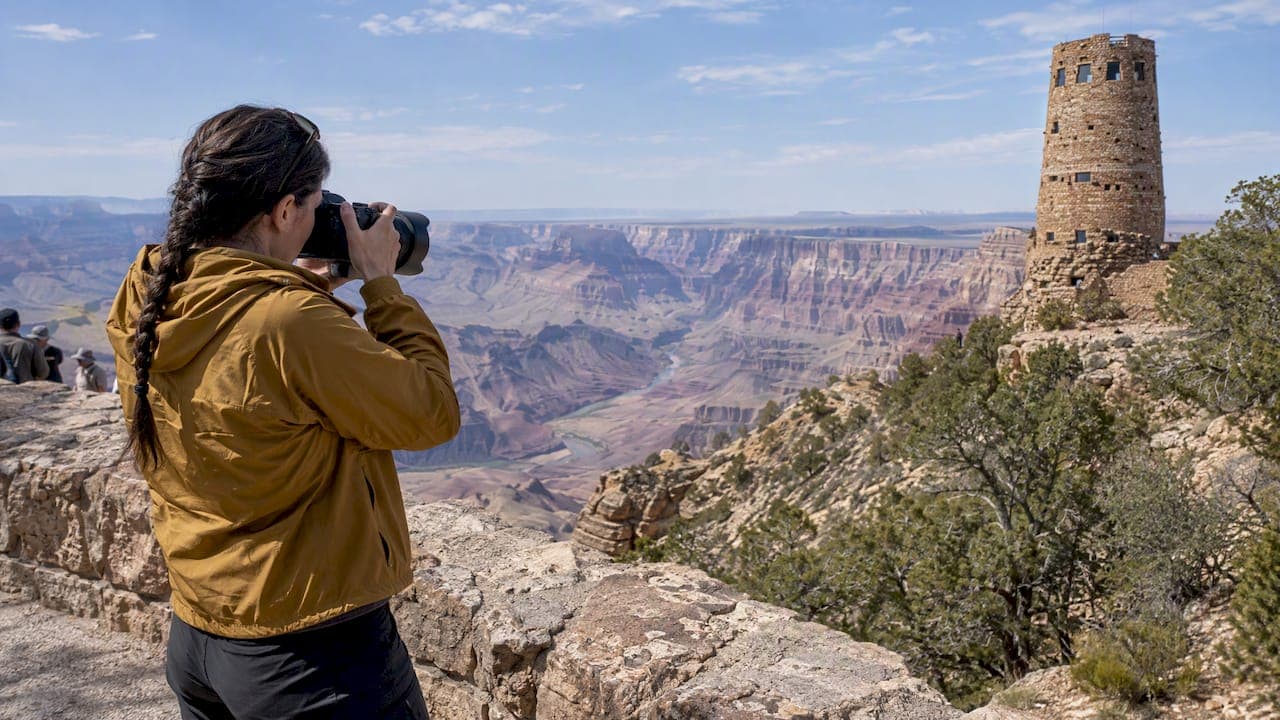
For sunrise, head to Yaki Point or Mather Point, where east-facing rims catch first light on Vishnu Temple and Wotans Throne. For sunset, Hopi Point, Mohave Point, and Pima Point along Hermit Road deliver the widest west-facing panoramas, with Desert View offering a quieter alternative with the Colorado River in frame. Each spot rewards a different kind of shot, and getting the access right matters as much as the light.
TL;DR:
- Yaki Point is reachable only by the Orange Route shuttle, while Desert View Drive stays open to private vehicles year round with marked turnout parking.
- The Red Route runs seasonally from roughly March 1 through November 30, so check shuttle schedules and last bus times before a Hermit Road sunset.
- Mather Point is the most crowded sunrise viewpoint, so arrive at least 20 minutes before first light to secure an unobstructed place at the railing.
- Drone flights are prohibited throughout the park, including takeoff and landing; aerial footage must come from outside its boundaries under applicable rules.
- Milky Way photography benefits from a fast wide angle lens near f/2.8, a tripod, and 15 to 20 second exposures under dark new moon skies.
Table of Contents
- Grand Canyon photo spots: a detailed guide to every viewpoint
- A workable sunrise-to-sunset photo itinerary
- Camera gear and technique for rim photography
- Shuttle rules, seasonality, and safety basics
- How private tours solve the timing problem
- Tips for astrophotography and night sky shooting
- Drone photography rules at the Grand Canyon
- What the conventional photo-spot advice gets wrong
- Book a private Grand Canyon photography tour
- FAQ
- Sources
Grand Canyon photo spots: a detailed guide to every viewpoint
Yaki Point works best for sunrise, especially if you want silhouettes rather than a lit-up panorama. The National Park Service recommends it specifically for capturing Vishnu Temple and Wotans Throne as dark shapes against a brightening sky. You cannot drive here: Yaki is shuttle-only, reached by the Orange Route in about nine minutes from the Visitor Center. Arrive early, since the viewpoint fills fast and the shuttle lot does not exist for private cars.
Mather Point sits a short walk from the Visitor Center and gives the classic wide canyon panorama that most people picture when they think of the Grand Canyon. It is also the most crowded sunrise spot on the South Rim, so claim a spot at the railing at least twenty minutes before first light if you want an unobstructed frame.
Hopi Point, on Hermit Road, is the sunset workhorse. Nine designated viewpoints line the 7-mile Hermit Road, and Hopi juts further into the canyon than most, giving a broad, unobstructed west-facing view. Expect company: tour buses stop here regularly, so frame around people rather than waiting for an empty rail.
Mohave Point, a few stops west, trades some of Hopi's crowd for a view that includes the Colorado River and visible rapids below. Compose with the river bend running diagonally through the lower third of the frame to give the shot depth that a flat horizon line lacks.
Pima Point sits further along Hermit Road and draws a thinner crowd. It is river-oriented like Mohave, and a longer lens here compresses the layered buttes behind the river into a tighter, more graphic composition.
Desert View Watchtower, 23 miles east of Grand Canyon Village on Desert View Drive, is the one spot that puts architecture, geology, and the river in a single frame. The drive is open to private vehicles with parking at turnouts, so no shuttle planning is required. A telephoto lens here, as National Geographic photographer Michael Schallau notes in his Grand Canyon photo guide, compresses overlapping ridgelines into a layered, almost painterly image.
Grandview Point, also on Desert View Drive, suits late morning through afternoon shooting when side light rakes across the exposed rock layers, making it a strong choice when sunrise and sunset slots are already booked elsewhere.
Lipan Point gives one of the best unobstructed views of the river's course through the inner canyon, though check current conditions before relying on it, since sections of the park occasionally see temporary closures.
A short walk below the rim on the South Kaibab Trail, O'Neill Butte and Cedar Ridge offer a different angle entirely: looking up at the canyon walls rather than across them. Toroweap, on the remote North Rim, produces dramatic sheer-cliff shots but demands high-clearance driving and advance planning, not an impromptu stop.
- Yaki Point: sunrise silhouettes, shuttle-only via the Orange Route.
- Mather Point: sunrise panorama, walkable from the Visitor Center.
- Hopi, Mohave, Pima Points: sunset panoramas along Hermit Road, decreasing in crowd size.
- Desert View and Grandview: vehicle-accessible, strong midday through sunset.
Pro Tip: Pick your viewpoint by the direction you want the light coming from first, not by name recognition: east-facing rims like Yaki and Mather for dawn, west-facing rims like Hopi and Mohave for dusk.
A workable sunrise-to-sunset photo itinerary
A single day can realistically cover sunrise, a midday stretch, and sunset without rushing, if you plan around the shuttles.
- Arrive at Yaki Point or Mather Point at least 30 minutes before sunrise, using the Orange Route shuttle for Yaki.
- Spend 9 to 11 AM along Desert View Drive, stopping at Grandview and Desert View Watchtower for side-lit geology shots.
- Rest midday, swap lenses, and review files while the light is flat and unflattering anyway.
- Head to Hermit Road by mid-afternoon on the Red Route shuttle, which runs seasonally, and post up at Hopi, Mohave, or Pima before sunset.
- If the Hermit Road shuttle is full or running behind, pivot to a Desert View sunset instead: the Colorado River view there remains appealing in low light.
Check the South Rim shuttle routes before you go, since last-bus times shift the whole plan.
Camera gear and technique for rim photography
A stable tripod matters more at the Grand Canyon than almost anywhere else, and following general ski photography tips for sharp action shots can help ensure you capture crisp images since the best light shows up before sunrise and after sunset when shutter speeds drop. Schallau's National Geographic guide recommends building compositions around a foreground element, a rock, a tree, a trail marker, rather than shooting the canyon as an empty wide panorama.
- Tripod, headlamp, and spare batteries: cold mornings drain batteries fast.
- A wide lens for panoramas and a telephoto for compression at Desert View.
- A polarizer to cut haze and an ND filter for long exposures at blue hour.
- Shoot RAW and bracket exposures, especially for sunrise silhouettes at Yaki.
Pro Tip: If you can see lightning within 8 to 10 miles, as Schallau notes after shooting a 30-second storm exposure, move to shelter immediately rather than finishing the frame.
Our Grand Canyon photography guide covers additional lens and filter recommendations by season.
Shuttle rules, seasonality, and safety basics
Access logistics decide whether a shot happens at all. The Orange (Kaibab) Route is the only way to Yaki Point, and the Red (Hermit Road) Route runs with seasonal restrictions roughly March 1 through November 30, per the Hermit Road shuttle page. Desert View Drive stays open to private vehicles year-round, with parking at marked turnouts. The North Rim operates on a shorter season, and roads to Cape Royal and Point Imperial close for winter.
- Carry water, warm layers, and a headlamp for pre-dawn walks.
- Confirm Lipan Point access before relying on it, since closures occur.
- Stay behind barriers: unprotected edges are the single biggest risk on the rim.
- Build in shuttle buffer time, since buses can run every 12 minutes but still fill up fast at peak times.
How private tours solve the timing problem
Chasing sunrise and sunset light means fighting shuttle schedules, parking limits, and seasonal road closures, all while trying to compose a shot. A private, guided itinerary removes that friction: a driver handles the Desert View Drive legs and timing, so you are not calculating shuttle windows between frames. Our Grand Canyon travel planner outlines departure options from Sedona, Flagstaff, Williams, and Tusayan for travelers coordinating a photography day around these logistics.
Tips for astrophotography and night sky shooting
The Grand Canyon's remoteness from major cities makes it a strong astrophotography location, particularly along Desert View Drive and at Lipan Point, where the sky opens wide over the inner canyon. A fast wide-angle lens, something in the f/2.8 range, lets you keep shutter speeds short enough to avoid star trails while still gathering enough light for the Milky Way.
Shoot in manual mode: set focus to infinity using a bright star or distant canyon feature in live view, then dial in an exposure around 15 to 20 seconds at a high ISO, adjusting based on your camera's noise performance. A sturdy tripod is not optional here, since any exposure this long on a handheld camera turns stars into streaks.

Bring a headlamp with a red-light mode to preserve your night vision and avoid ruining other photographers' long exposures nearby. New moon periods give the darkest skies and the most visible stars, while a bright moon can work in your favor if you want to light up the canyon walls as a silhouette backdrop. Dress warmer than you think you need to: rim temperatures drop fast after dark, even in summer, and standing still at a tripod for an hour feels colder than walking.
Drone photography rules at the Grand Canyon
Drone flights are not allowed anywhere within Grand Canyon National Park boundaries. This is a flat prohibition that covers takeoff, landing, and operation from within the park, regardless of the drone's size or your intent to fly briefly for a single shot. Rangers can and do issue citations for violations, and the rule exists partly to protect the quiet and visual experience other visitors expect, and partly for wildlife and air-tour safety.
If aerial footage matters to your project, the practical workaround is flying from land outside the park boundary where regulations allow it, though your framing options will be far more limited than flying over the rim itself. Ground-based alternatives, like a telephoto lens from Desert View Watchtower or a wide lens from Hopi Point, can approximate some of the layered, elevated feel that drone footage offers without the legal risk. Always check current park regulations directly before any trip, since rules around drones and other restricted equipment can change.

What the conventional photo-spot advice gets wrong
Most lists of Grand Canyon photo spots read like a greatest-hits roundup: Hopi for sunset, Mather for sunrise, repeat. What they skip is that the viewpoint barely matters if you arrive at the wrong time or the shuttle you needed stopped running an hour earlier. The real decision is sequencing: which direction the light comes from, how long the shuttle ride takes, and what you do with the three dead hours of flat midday light in between.
The other thing overlooked is that quieter spots like Pima Point often beat the famous ones on image quality, simply because you get to set up without someone's elbow in your foreground. If your priority is a clean, considered composition rather than checking a landmark off a list, prioritize access and crowd size over name recognition. Scout your angle before the light shows up, not after.
— Chris
Book a private Grand Canyon photography tour
Coordinating shuttle timing, road access, and sunrise or sunset windows takes real planning, and a private tour hands that logistics work to someone else while you focus on composition. Our Private Grand Canyon Day Tour covers multiple South Rim viewpoints in one guided day, and our Grand Canyon Sunset Tour is built specifically around the golden-hour window at the rim.
Both depart with door-to-door pickup, so you can check availability and lock in a date that matches the light you want.
FAQ
What are the best viewpoints in the Grand Canyon's South Rim?
The strongest South Rim viewpoints are Yaki Point and Mather Point for sunrise, and Hopi Point, Mohave Point, and Pima Point along Hermit Road for sunset. Desert View Watchtower and Grandview Point add architecture, geology, and river views that work well through the middle of the day.
Can the America the Beautiful pass be used at the Grand Canyon?
Yes, the America the Beautiful pass covers entrance to Grand Canyon National Park, since it is accepted at all federal fee-charging sites including national parks. Check the National Park Service photography page for current entrance details before your trip.
What US state is famous for the Grand Canyon?
The Grand Canyon is in Arizona, carved by the Colorado River over millions of years. The South Rim, where most visitor services and the viewpoints discussed above are located, sits in northern Arizona near Williams, Flagstaff, and Tusayan.
Why is 90% of the Grand Canyon restricted to the public?
Most of the canyon's backcountry and inner gorge are difficult to reach without permits, technical hiking, or rafting, which limits general public access rather than any blanket restriction. Developed viewpoints along the rim, like those covered here, remain fully open and are where the vast majority of photography happens.
Can I fly a drone at the Grand Canyon for photos?
No, drone flights are prohibited throughout Grand Canyon National Park. Any aerial footage has to come from outside the park boundary, where separate airspace rules apply.
Sources
- photography - Grand Canyon National Park (U.S. National Park Service)
- How to take an amazing photo at Grand Canyon National Park — National Geographic