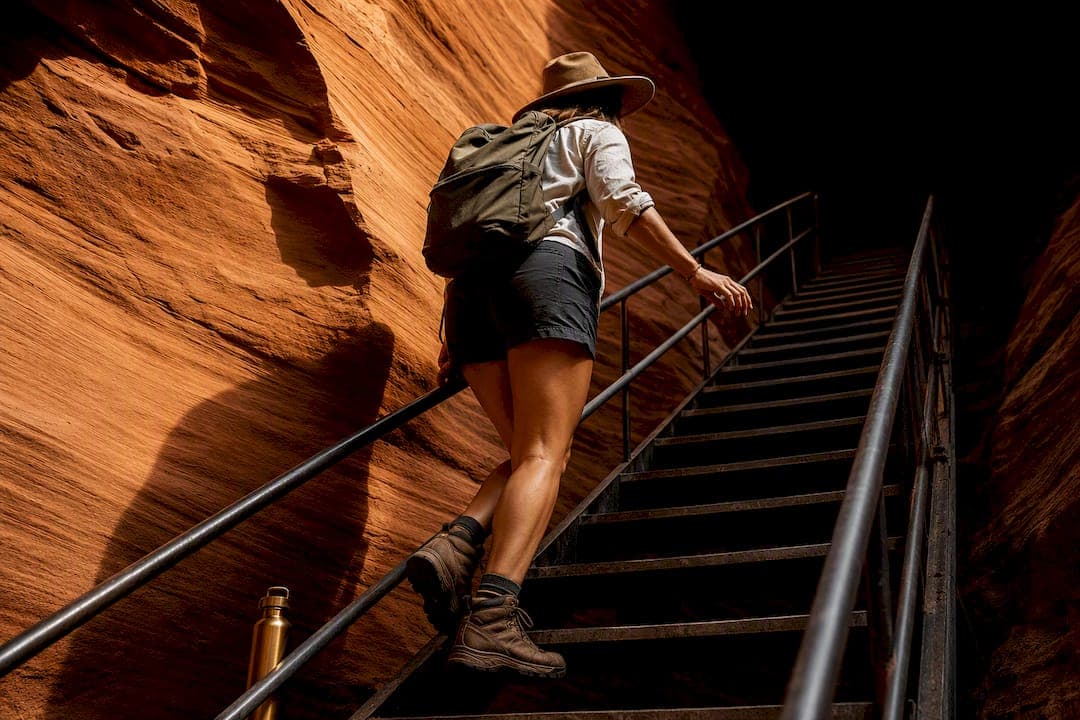
Lower Antelope Canyon uses metal staircases and short ladders bolted into the sandstone, and most visitor and operator reports describe about five stair or ladder sets with total counts ranging from roughly 70 to 130 steps. It's manageable if you climb stairs comfortably in daily life, but skip it if you cannot use stairs at all or are pregnant. One or two flights run noticeably steeper than the rest, and handrails are present throughout.
TL;DR:
- Most visitors encounter about five stair or ladder sections with a total of 70 to 130 steps, depending on how fixtures are counted and maintained.
- Steep ladder flights and confined spaces can feel more intense for those with knee, back issues, or mobility limitations, making Upper Antelope Canyon a safer alternative.
- Guided tours are mandatory on Navajo land, with strict rules such as no photography on stairs, both hands on rails, and removal of bulky backpacks for safety.
- Proper footwear, like closed-toe shoes with good tread, and dressing in light layers improve safety and comfort when navigating the steep and sandy stairs.
- Private tours allow for tailored pacing and mobility considerations, essential for families, travelers with health issues, or those uncertain about stair safety.
Table of Contents
- How many stairs and ladders are actually in the canyon
- How hard the climb feels and who should sit it out
- The safety rules you'll follow on the stairs
- Gear and technique that make the stairs easier
- Choosing Lower or Upper if stairs worry you
- Why the stair debate matters more than trip reports suggest
- How a private tour helps you prepare for the stairs
- Sources
- FAQ
How many stairs and ladders are actually in the canyon
The exact number depends on who's counting and when. Tour guides, trip bloggers, and forum posters often disagree because some count individual rungs, others count flights, and the canyon's fixtures get repaired or replaced periodically. That's why reports settle on approximate ranges rather than one fixed figure.
What's consistent across accounts:
- Visitors typically pass through around five distinct stair or ladder sections on the route through the slot.
- Total step counts land somewhere between roughly 70 and about 130, depending on the source and how sections are tallied.
- The entrance features a marked initial descent, commonly described as about 75 feet down, which sets the tone for the rest of the walk.
- The steepest single flight tends to draw the most comments from visitors, since the angle is sharper than anything else on the route.
Construction is straightforward and durable: metal treads bolted directly into rock, ladder-style rungs on the tightest sections, and continuous handrails. Family trip reports describe these fixtures as secure, with rails present at every ladder, which matters if you're bringing kids or older relatives along.
How hard the climb feels and who should sit it out
Most people who show up with reasonable mobility find the stairs manageable, if occasionally a little tight. The canyon narrows in places, and a steep ladder in a confined space can feel more intense than the same climb out in the open. That perception gap, tight walls plus metal rungs, is part of why difficulty reports vary so much between visitors.
Where real caution matters:
- Lower Antelope Canyon isn't suitable for anyone with significant mobility limitations, and pregnant visitors are strongly discouraged from attempting it.
- Recent knee or back injuries make the steeper flights genuinely risky, not just uncomfortable.
- A fear of heights or tight spaces can turn a five-minute ladder section into a stressful one, even though the canyon stays open to the sky in most stretches.
Ask yourself three questions before booking: can you climb a flight of stairs at home without pain, have you had recent knee or back trouble, and does confined space bother you? A clear "no" to the first or a "yes" to the last two is a real signal to reconsider Lower.
The safety rules you'll follow on the stairs
Every visitor enters through a guided tour, not on their own, because the Navajo Nation Parks & Recreation department requires licensed operators and charges an entry fee for access. That single rule shapes everything else about how the stairs are managed on the ground.
Guides typically enforce a short list of rules on the steeper sections:
- No photography while you're on the stairs or ladders, both for your safety and to keep the line moving.
- Keep both hands on the rail through the steepest flights rather than holding a phone or water bottle.
- Wait your turn at narrow pinch points instead of trying to pass another group.
- Leave bulky backpacks in the vehicle since they catch on rock walls in the tighter passages.
Guided access is required for every visitor, with no independent entry permitted on Navajo Nation land, according to the official operator listing. Guides are also trained to move groups quickly during flash flood season, when conditions can change fast.
Gear and technique that make the stairs easier
Small choices before you leave the hotel make a bigger difference than most people expect. This isn't a technical hike, but the wrong shoes or a full water bottle in one hand can turn an easy flight into a nervous one.

Pro Tip: Wear closed-toe shoes with real tread, not sandals, since the metal stairs get sandy and slick from foot traffic all day.
A few more things worth planning ahead:
- Dress in light layers since temperatures inside the slot can differ sharply from the parking area.
- Skip flip-flops, sandals, or heeled shoes entirely. They're the main cause of slips reported on the steeper flights.
- On the steepest rungs, some guides suggest facing the ladder and stepping down as you would on a fixed ladder rather than walking down forward.
- Keep both hands free on tight sections rather than juggling a camera or bag.
Families with young kids should ask their operator about carriers before the tour. Structured child carriers generally work fine on the wider stair sections, but a very young child on a caregiver's back adds real risk on the steepest ladder, so some parents choose to wait a year or two before bringing toddlers through Lower.
Choosing Lower or Upper if stairs worry you
If the stair counts above make you uneasy, Upper Antelope Canyon is the easier alternative. Guides and trip reports consistently point people who can't manage stairs toward Upper, since it's entered at ground level with a flat, sandy walking path the entire way.
- Upper Antelope Canyon (known in Navajo as Tse'bighanilini) has no stairs or ladders at all, just level walking, making it the better pick for mobility issues or claustrophobia concerns.
- Lower Antelope Canyon (Hasdez' Twazi') involves the stair and ladder sections covered above but offers a longer, narrower slot experience that many photographers prefer.
- The practical rule: if climbing stairs at home already gives you trouble, choose Upper and skip the debate entirely.
We cover this decision in more depth in our comparison of Upper and Lower Antelope Canyon tours, including which one fits different group compositions.
Why the stair debate matters more than trip reports suggest
The internet's obsession with exact step counts misses the real question. It doesn't matter whether Lower has 70 steps or 130. What matters is whether you can comfortably climb a few flights in a confined space while a guide moves your group along on a schedule. Visitors who focus on the number instead of their own stair tolerance tend to be the ones who show up unprepared.
The most honest self-test isn't reading another blog post, it's noticing how you feel walking up your own stairs at home on a normal day. If that's fine, Lower Antelope Canyon will be fine too. If it's not, no amount of research changes that answer, and Upper is the smarter choice.
— Chris
How a private tour helps you prepare for the stairs
A private Antelope Canyon and Horseshoe Bend tour gives you room to ask these questions before you're standing at the top of the first ladder, not after. Because the group is just your own party, a guide can walk through mobility concerns, pacing, and whether a child carrier makes sense for your specific kids rather than giving a generic answer to a bus full of strangers.
Grand Canyon Journeys runs a private Antelope Canyon & Horseshoe Bend tour from Sedona, Flagstaff, and Williams, with door-to-door pickup and a flexible pace instead of a fixed departure time shared with other groups. If someone in your party has knee issues or you're traveling with young kids, mentioning it when you book means your guide can plan around it on the day rather than improvising at the canyon entrance. Check availability for the Antelope Canyon & Horseshoe Bend tour to start planning your visit.

Sources
For entry rules and authorized guides, start with the Navajo Nation Parks operator listing. Mobility guidance appears in this breakdown of which canyon section suits limited mobility, while step counts and construction details come from operator trip reports and family-focused accounts. For gear planning, this adventure packing checklist covers footwear and desert conditions.
- Guided tour operators: Antelope Canyon
- Which section of Antelope Canyon is best for anyone with mobility issues?
- Lower Antelope Canyon With Kids: What You Need to Know
FAQ
What happened in the 1997 Antelope Canyon tragedy?
Flash floods have historically struck Lower Antelope Canyon, and such incidents are a major reason Navajo Nation Parks now requires guided tours with trained staff monitoring weather conditions. Guides today watch forecasts closely and can evacuate groups quickly if conditions change.
How many stairs are in Lower Antelope Canyon?
There's no single official count, but most reports describe about five stair or ladder sections with totals ranging from roughly 70 to 130 steps. The variation comes from different ways of counting rungs versus flights and from occasional maintenance updates to the fixtures.
Where is the secret Antelope Canyon?
There's no hidden or secret section of Antelope Canyon beyond the two publicly toured areas, Upper and Lower. Both require a guided tour booked through an authorized Navajo Nation Parks operator, and no other access points are open to visitors.
Is Antelope Canyon a tourist trap?
Most visitors describe the canyon as genuinely impressive rather than overhyped, since the narrow sandstone walls and light beams deliver an experience photos rarely capture fully. The required entry fee and guided-tour rule can feel restrictive, but they exist because Navajo Nation Parks manages the land and its safety risks directly.
Do I need to be very fit to climb the Antelope Canyon stairs?
No, but you should be comfortable climbing a few flights of stairs without pain, since Lower Antelope Canyon isn't recommended for visitors with significant mobility limitations. If stairs are a concern, Upper Antelope Canyon offers the same slot canyon scenery on flat, level ground.