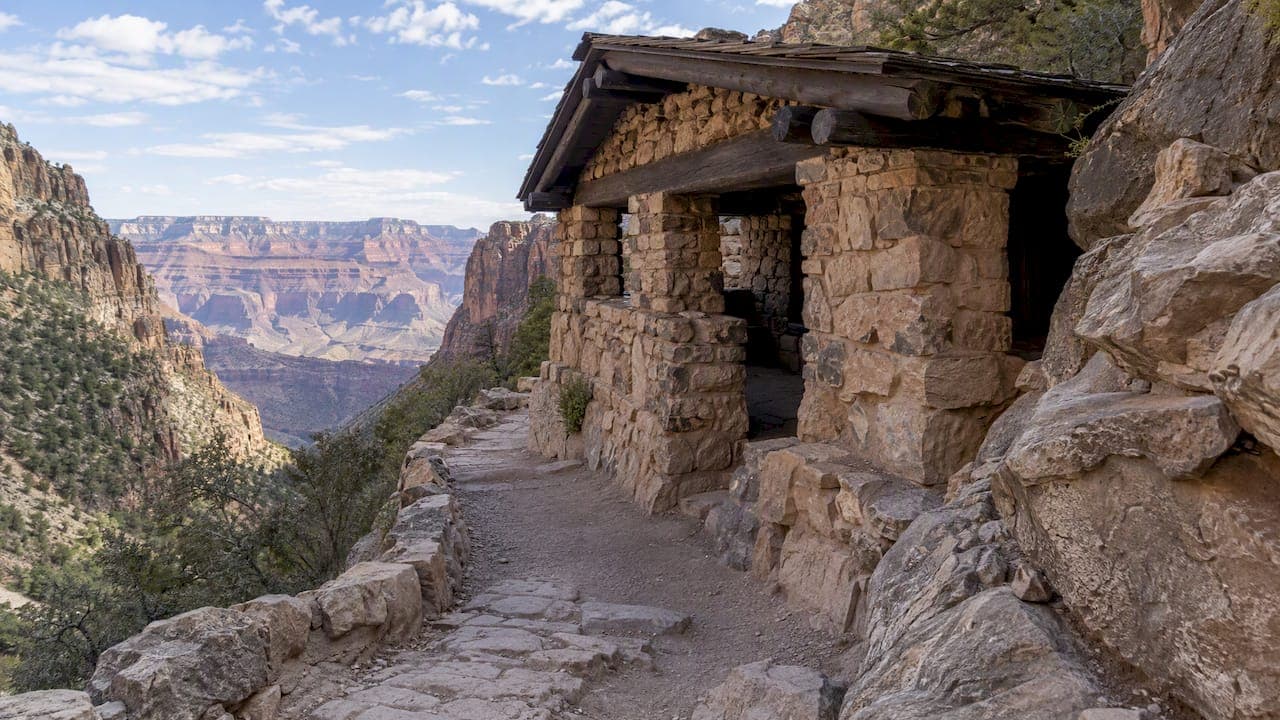
The Bright Angel rest houses are small, historic covered shelters spaced along the Bright Angel Trail below the South Rim. The best known stops are the Mile-and-a-Half and Three-Mile Resthouses, Havasupai Gardens (formerly Indian Garden), the River Resthouse, and the Bright Angel Campground area near Phantom Ranch. Amenities at each have changed since the August 2026 flash flood, so check current National Park Service guidance before you hike.
TL;DR:
- The first resthouses are 1.5 and 3 miles below the rim; Havasupai Gardens is 4.5 miles down, and the river is about 7.7 miles away.
- Upper resthouse taps typically run from May through early October, but failures can stop service; carry a treatment method and enough water to hike out.
- The August 2026 flood damaged lower corridor bridges, water lines, Bright Angel Campground, and Phantom Ranch, with some closures lacking reopening dates.
- Start before sunrise in warm months, allow twice your descent time for the climb out, and turn back if water is unavailable.
Table of Contents
- 1. Locations, Distances, and Elevations Along the Trail
- 2. What Amenities Each Resthouse Normally Offers
- 3. CCC-Era Construction and Ancient Use of the Corridor
- 4. What the Shelters Look Like and How Hikers Use Them
- 5. Current Closures and Conditions After the August 2026 Flash Flood
- 6. How to Plan Rest Breaks and Use the Resthouses Safely
- 7. Why Local Guides Rely on Resthouse Knowledge
- Private Guided Options for a Better-Informed Bright Angel Visit
- FAQ
- Sources
1. Locations, Distances, and Elevations Along the Trail
- Havasupai Gardens (Indian Garden): about 4.5 miles from the rim, a longtime hub for water and shade.
- River Resthouse: roughly 7.7 miles down, close to the Colorado River.
- Bright Angel Campground and Phantom Ranch area: around 9.5 miles from the trailhead, at the bottom of the corridor.
Each stop adds up to a steady, predictable rhythm: a shelter every mile and a half or so for the first stretch, then longer gaps as the trail flattens out near the river. That spacing matters most on the way back up, when the climb from the river to the rim reverses that entire 4,380-foot drop.
2. What Amenities Each Resthouse Normally Offers
Under normal operating conditions, the Bright Angel corridor has one of the better-supported water systems of any trail in Grand Canyon National Park, though availability is seasonal at the upper stops. From early May to early October, treated drinking water is typically turned on at the Mile-and-a-Half and Three-Mile Resthouses, while Havasupai Gardens and Bright Angel Campground normally carry water year-round when the pipeline and pump system are functioning, per the NPS Bright Angel Trail guide.
- Mile-and-a-Half and Three-Mile Resthouses: seasonal water (roughly May through October), vault toilets, shaded seating.
- Havasupai Gardens: toilets, picnic areas, and water most of the year under normal conditions.
- Bright Angel Campground and Phantom Ranch: toilets, water, and the corridor's emergency phone connected historically to the Transcanyon Line.
Even in a normal season, resthouse water is never a sure thing. The NPS explicitly warns that hikers should carry a backup water-treatment method, since pipeline breaks and pump failures can shut off a spigot with little notice. Treat every resthouse as a possible stop, never a guaranteed one, and pack enough water and a filter or treatment tablets to get yourself out regardless of what's running when you arrive.
3. CCC-Era Construction and Ancient Use of the Corridor

The resthouses hikers see today largely date to a 1930s rebuilding effort. Civilian Conservation Corps crews reconstructed the Bright Angel corridor in the late 1930s, building rustic stone and timber shelters at the Mile-and-a-Half, Three-Mile, Havasupai Gardens, and Pipe Creek locations, work that the ParkScience article on the corridor trail system documents as substantially complete by 1939. The design intentionally used native rock so the shelters would blend into the canyon walls rather than stand out against them.
The route itself is far older than its CCC architecture. Archaeological work near the Three-Mile Resthouse uncovered agave-roasting pits with carbon dates spanning 1460 to 1410 B.C., 800 to 780 B.C., and later use around A.D. 980 to 1030, evidence that people were traveling and camping along this same corridor thousands of years before any trail crew arrived.
The corridor trail system, including Bright Angel, is managed as a cultural landscape linking prehistoric use, CCC-era construction, and modern hiking infrastructure.
That layered history, prehistoric travel route, CCC engineering, and ongoing NPS management, is why the National Park Service treats the corridor as a cultural landscape rather than just a maintained trail.
4. What the Shelters Look Like and How Hikers Use Them
Each resthouse is modest by design: low stone walls, a timber or metal roof for shade, simple wood benches, and in most cases an adjacent vault toilet set back from the main shelter. None of them are large enough to shelter a big group comfortably, which keeps the footprint small against the canyon scenery.
- Hikers use the shelters mainly for short breaks: a few minutes of shade, a snack, a water refill when it's running.
- They double as fixed navigation points, since GPS can be unreliable in the inner canyon and a resthouse confirms exactly how far you've gone.
- Photo stops are common at Three-Mile and Havasupai Gardens, where the shade structures frame views back up toward the rim.
- Restroom use is the other big draw, since vault toilets at the resthouses are among the few below the rim until the river.
5. Current Closures and Conditions After the August 2026 Flash Flood
A flash flood on August 29, 2026, caused extensive damage to inner-canyon infrastructure, and the park has since expanded closures in the lower corridor. Phantom Ranch, Bright Angel Campground, and several bridges sustained damage, and water service was interrupted at multiple inner-canyon locations.
Several inner-canyon facilities remain closed with no estimated reopening date, according to the NPS news release on the expanded closures, which means the amenities described above may not reflect what's actually available right now.
- Bright Angel Campground and parts of the Phantom Ranch area are affected by the closures.
- Bridge access and water lines in the lower corridor sustained damage during the flood.
- Recovery work is ongoing, with no fixed timeline for restoring full service to every location.
Before you plan any hike into the corridor, check the NPS Key Hiking Messages page, which lists current closures and water-off advisories and is the most reliable live-status source the park publishes. Conditions below the rim can change faster than most trip-planning guides, including this one, can keep up with.
6. How to Plan Rest Breaks and Use the Resthouses Safely
Treat the resthouses as emergency shelters and navigation markers first, and as service stops second. That mindset keeps you from getting stuck if a spigot is dry or a toilet is closed for repair.
- Start early, ideally before sunrise in warmer months, to reach Three-Mile or Havasupai Gardens before the heat peaks.
- Pick a turnaround point based on fitness: newer hikers often do well stopping at Mile-and-a-Half, while more experienced hikers can target Three-Mile or Havasupai Gardens.
- Budget roughly double your downhill time for the climb back out, since the return trip reverses the same elevation change at a slower pace.
- Carry a backup water-treatment method regardless of the season, since seasonal taps can fail without warning.
- If you reach a closed section or an empty water tank, turn around rather than push toward the next resthouse on an assumption.
Pro Tip: Carry at least one liter of water per hour of expected hiking time in summer, and refill at every working spigot you pass rather than waiting until you're low.
Our Bright Angel day hike planning guide breaks down route timing and turnaround points in more detail if you're mapping out a specific itinerary.
7. Why Local Guides Rely on Resthouse Knowledge

Knowing exactly which resthouse has water on a given week, which vault toilet is functioning, and where the nearest emergency phone sits isn't something a trail map alone can tell you. We built our below-the-rim itineraries around that kind of current, on-the-ground knowledge, because conditions in the inner canyon change fast, especially during active recovery periods like the one following the August 2026 flood.
Guiding a group through the corridor means constantly checking which sections are open, pacing the group to match the slowest comfortable hiker, and having a backup plan ready if a water source or trail segment closes mid-hike. That kind of real-time logistics work is hard to replicate solo, particularly for visitors hiking the Bright Angel corridor for the first time. Our private Grand Canyon hiking tour and the planning notes in our Bright Angel day hike guide both reflect that same approach to trail safety.
— Chris
Private Guided Options for a Better-Informed Bright Angel Visit
We offer private, guided access to the Grand Canyon that takes the guesswork out of trip planning around closures, water status, and trail timing. Instead of cross-checking NPS advisories yourself the night before a hike, you get a local guide who already knows the current conditions and builds your day around them.
- Our Grand Canyon Hiking Tour includes a below-the-rim hiking itinerary led by a local guide who tracks real-time trail and water conditions.
- Our Private Grand Canyon Day Tour is a strong option if you'd rather see the canyon's highlights from the rim without descending the corridor.
- Every tour includes door-to-door pickup, a private vehicle, and all park fees, so you're not managing logistics on top of trail planning.
If you want a Bright Angel experience shaped by current, local knowledge rather than last year's trail report, our Grand Canyon Hiking Tour is the most direct next step to book.
FAQ
Which rim is the Bright Angel Trail on?
The Bright Angel Trail starts on the South Rim of Grand Canyon National Park and descends toward the Colorado River. It's one of the two main corridor trails on the South Rim, alongside the South Kaibab Trail.
Is the South Kaibab Trail harder than the Bright Angel Trail?
The South Kaibab Trail is generally considered more strenuous because it has little shade and no reliable water sources along its length, according to a comparison of the two routes. Bright Angel offers more shade and its series of resthouses, which makes it the more forgiving option in hot weather. Our South Kaibab versus Bright Angel guide breaks down the differences in more detail.
What age did humans settle in the Grand Canyon?
Archaeological evidence near the Three-Mile Resthouse, including agave-roasting pits dated as far back as 1460 to 1410 B.C., shows people were using the Bright Angel corridor thousands of years ago. Later use of the same sites continued into the medieval period, suggesting repeated, long-term travel through the canyon rather than a single settlement era.
Is Bright Angel Campground open?
Bright Angel Campground sustained damage during the August 29, 2026 flash flood, and the National Park Service has expanded inner-canyon closures in the area with no estimated reopening date for some facilities. Check the NPS Key Hiking Messages page for the current status before planning an overnight trip.