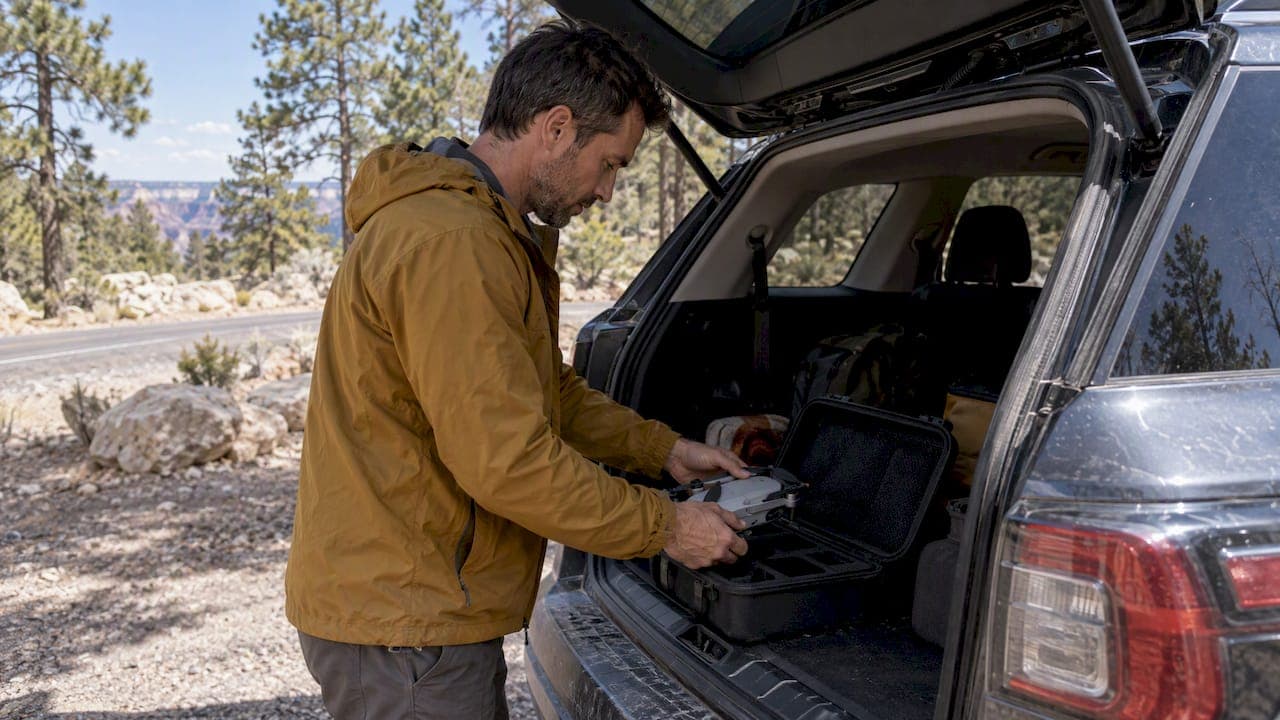
No, you may not launch, land, or operate a drone anywhere inside Grand Canyon National Park. The Grand Canyon Superintendent's Compendium and National Park Service policy prohibit it outright, with no exception for hobbyists, photographers, or licensed FAA pilots. Violating this rule is a federal misdemeanor, and rangers do issue citations.
TL;DR:
- Rangers may issue citations, require court appearances, or confiscate drones; a federal misdemeanor carries a maximum six months in jail and a $5,000 fine.
- FAA recreational tests and Part 107 certification do not override the National Park Service’s separate authority over activities on park land.
- Inside the park, approvals are generally limited to research, resource management, or emergency work, with each request reviewed for wildlife and visitor impacts.
- Nearby BLM or Arizona state lands may allow flights, but check parcel rules and posted signs, and use boundary maps to avoid accidental entry.
Table of Contents
- What the law and park policy actually say
- Penalties, enforcement and real-world consequences
- FAA vs. NPS: why an FAA license doesn't change anything here
- Permits, exceptions and approved operations inside the park
- Lawful alternatives for aerial photography and video near the canyon
- Why the park protects natural quiet, and how to show good stewardship anywhere
- How we help you capture the canyon without a drone
- Ready to photograph the canyon the legal way
- FAQ
- Sources
What the law and park policy actually say
The prohibition on drones at Grand Canyon isn't a suggestion or a courtesy posted at the trailhead. It's a formal regulation built into the park's Laws & Policies page, which states plainly that it is strictly prohibited to launch, land, or operate drones or any other uncrewed, remotely piloted aircraft within park boundaries. That authority comes from 36 CFR 1.5(a)(2), the federal regulation that lets a park superintendent close areas or restrict activities to protect resources and visitors.
In 2014, the National Park Service issued policy memorandum 14-05, directing superintendents across the entire park system to use that same 36 CFR authority to ban drone launches, landings, and operations within their parks. Grand Canyon's Superintendent's Compendium formalized that directive locally, and the park's own filming and photography guidance reinforces it with an explicit "No Drone Zone" designation that applies to anyone carrying a camera-equipped aircraft, whether for personal use or commercial purposes.
If you want to verify the current rule before you travel, three places confirm it:
- The park's official Laws & Policies page, which cites the 36 CFR authority directly.
- The Filming, Photography and News Gathering page, which spells out the drone ban for anyone doing visual work in the park.
- The current year's Superintendent's Compendium, posted on the park website, which can add or adjust site-specific restrictions.
None of these sources carve out an allowance for personal use, scenic photography, or short flights near the rim. The ban covers the entire park, rim to river.
Penalties, enforcement and real-world consequences
Flying a drone inside Grand Canyon isn't a warning-and-move-on violation. The NPS guidance on uncrewed aircraft classifies a drone violation as a federal misdemeanor, carrying a maximum penalty of six months in jail and a $5,000 fine, the same guidance confirms. Most first-time visitors caught flying near a viewpoint won't see the maximum, but the charge is real, it goes on your record, and rangers decide case by case how hard to come down.
Enforcement is discretionary, which means a ranger weighs the circumstances before deciding what to do. Typical responses include:
- A citation with a mandatory court appearance or a fine paid by mail.
- Confiscation of the drone as evidence, especially if the flight interfered with other operations.
- Arrest in more serious cases, such as repeated violations or refusal to comply.
Some of the most aggressive enforcement happens when a drone interferes with emergency helicopter operations, which are common in a park with frequent search-and-rescue calls along the rim and below it. Rangers also act quickly when a drone harasses wildlife such as California condors, which nest on cliff faces, or when a flight disrupts other visitors trying to enjoy a quiet viewpoint. None of these scenarios require a formal complaint. A ranger who sees or hears a drone can act on sight.
FAA vs. NPS: why an FAA license doesn't change anything here
A lot of confusion around this topic comes from mixing up two separate systems of authority. The Federal Aviation Administration regulates the national airspace, meaning it sets the rules for how, where, and under what certification any aircraft, including drones, can fly. Recreational flyers have to pass a safety test and follow baseline rules like staying below 400 feet and keeping the aircraft in sight, while Part 107 commercial operators carry a certificate that allows more complex operations. Neither credential, according to the FAA's own guidance for recreational flyers, grants permission to fly where a land manager has banned it.
That's the second system: land-management authority. The National Park Service controls what happens on park land itself, separate from what happens in the airspace above it, and it uses 36 CFR to prohibit drone launches, landings, and operations regardless of your FAA certification status. Holding a Part 107 license lets you fly commercially in uncontrolled airspace elsewhere. It does nothing to override a park-specific ban.
Grand Canyon adds a third layer that makes the airspace even more sensitive: the Special Flight Rules Area, created under SFAR 50-2 and codified in 14 CFR Part 93, Subpart U. This SFRA applies to all aircraft, not just drones, and includes:
- Named flight-free zones such as Bright Angel, Shinumo, and Toroweap, where no aircraft may operate below certain altitudes.
- Minimum route altitudes that commercial air tours and other aircraft must maintain throughout the canyon.
- Rules enforced for both safety and the protection of tribal lands and visitor experience.
Even licensed air tour operators follow a detailed altitude and routing structure here, which tells you how seriously the FAA and NPS treat this particular stretch of airspace.
Permits, exceptions and approved operations inside the park
There is a narrow path to legal drone use inside Grand Canyon, but it's built for research, resource management, and emergency response, not visitor photography. Park staff and authorized partners sometimes use uncrewed aircraft for wildlife surveys, wildfire monitoring, or search-and-rescue support under a formal agreement with the park.
Getting any kind of authorization generally follows this sequence:
- Identify the purpose: research, resource management, or an official park operation, since commercial and recreational photography requests are rarely approved.
- Contact the park's permits office listed on the Plan Your Visit permits and reservations page, which handles commercial use authorizations and special use permit inquiries.
- Prepare documentation covering the flight's purpose, timing, location, and equipment, since park staff evaluate every request individually against potential impacts to wildlife, wilderness character, and other visitors.
- Expect a review process that can include a Minimum Requirements Analysis, the same evaluation framework the park applies before approving other interventions, which weighs resource impact ahead of convenience.
If you're a visitor hoping to get a permit for a few personal drone shots, it's worth knowing upfront that approvals almost never go to individual travelers or commercial photo shoots. The bar exists for operational necessity, not aesthetics.
Lawful alternatives for aerial photography and video near the canyon
The good news is that a drone isn't the only way to get a dramatic shot of the canyon, and several legal options exist both inside and outside park boundaries. Commercial air tours operating under the SFRA rules already fly scenic routes by helicopter or small plane, giving passengers an aerial view without anyone breaking a single regulation. Outside the park, BLM and state trust lands in the surrounding region sometimes allow drone flights, though rules vary by parcel and change without much notice.
Options that keep you on the right side of the law include:
- Booking a helicopter or airplane sightseeing flight that operates within the designated SFRA routes.
- Checking BLM or Arizona State Land Department websites, along with on-site signage, before flying on land outside the park.
- Using GPS and park boundary maps carefully, since it's easy to drift into restricted airspace without realizing it.
- Hiring a photography-focused private tour that gets you to elevated, legal vantage points at the right time of day.
For ground-level shots that still look dramatic, our photographer's roadmap to Grand Canyon photo spots covers framing techniques and access points that produce strong images without any aircraft at all.
Pro Tip: Golden hour light at the rim often produces more striking depth and color in a photo than an aerial shot ever could, since the canyon's layered rock catches long shadows that flatten out at midday.

Why the park protects natural quiet, and how to show good stewardship anywhere
The drone ban isn't only about aviation safety. The NPS Natural Sounds program frames uncrewed aircraft as a visitor-experience and wildlife issue as much as an airspace one, since the noise and visual presence of a drone can disturb condors, raptors, and other species that nest on cliff faces, and can interrupt the quiet that draws many visitors to the rim in the first place. NPS guidance recommends that where UAS use is authorized at all, operators choose the quietest available aircraft and minimize both audible and visual impact.
That stewardship mindset travels well beyond Grand Canyon. If you're flying a drone legally anywhere else, a few habits make a real difference:
- Choose a quieter drone model and avoid low passes near cliffs, nests, or water sources.
- Stop flying immediately if wildlife changes behavior in response to your aircraft.
- Check for active emergency or search-and-rescue operations before launching in any wild area.
Our Grand Canyon travel planner and ongoing blog coverage are built around exactly this kind of planning, helping visitors understand park rules before they arrive rather than finding out the hard way.
How we help you capture the canyon without a drone
Getting a genuinely great photo of Grand Canyon doesn't require breaking a federal regulation. We build our private, guided tours around the viewpoints and timing that produce the best light and the clearest compositions, from sunrise overlooks to sunset ridgelines most day-trippers never reach. Because every tour is private, your guide can adjust the stops and pacing around the shots you actually want, instead of herding you through a group itinerary on someone else's schedule.
Our Grand Canyon photography guide and travel planner lay out the specific viewpoints, light conditions, and timing that work best for photography, all drawn from routes our guides already use with guests.
— Chris
Ready to photograph the canyon the legal way
We run private, guided tours with door-to-door pickup and no shared buses or strangers along for the ride. If you're chasing the kind of light that makes a canyon photo actually worth keeping, our Grand Canyon Sunset Tour is built around the exact window photographers wait for, from 349 USD per person.
For a broader first look at the canyon with flexible stops along the way, our Private Grand Canyon Day Tour starts from 319 USD per person and includes park fees and an expert local guide. Check our travel planner for logistics, then reach out to book the dates that work for your trip.
This article is general information, not a substitute for advice from a qualified lawyer. Consult a qualified legal professional about your own circumstances before acting on anything here.
FAQ
Can I fly a drone in Grand Canyon National Park?
No. The Grand Canyon Superintendent's Compendium prohibits launching, landing, or operating a drone anywhere within park boundaries, with no exception for personal or recreational use.
What happens if I fly a drone in a national park illegally?
A drone violation in a national park is a federal misdemeanor that can carry up to six months in jail and a $5,000 fine, though rangers typically use discretion based on the circumstances. Confiscation of the drone and a mandatory citation are common outcomes even short of the maximum penalty.
Does having an FAA drone license let me fly in the park?
No. The FAA regulates airspace safety and certification, but the National Park Service controls activities on park land under separate authority, so an FAA certificate, including Part 107, does not override a park's drone ban.
Are there any legal ways to fly a drone near the Grand Canyon?
Flights are sometimes possible on nearby BLM or Arizona State Trust land outside park boundaries, but rules vary by location and should be confirmed through the relevant land agency's website or posted signage before flying. Inside the park itself, drone use is limited to rare, case-by-case authorizations for research or official park operations.
What's a legal alternative to get aerial-style photos of the canyon?
Commercial air tours operating under the Grand Canyon's Special Flight Rules Area offer legal aerial views by helicopter or small plane, and a private ground tour timed for sunrise or sunset light can produce comparably striking images without an aircraft at all.