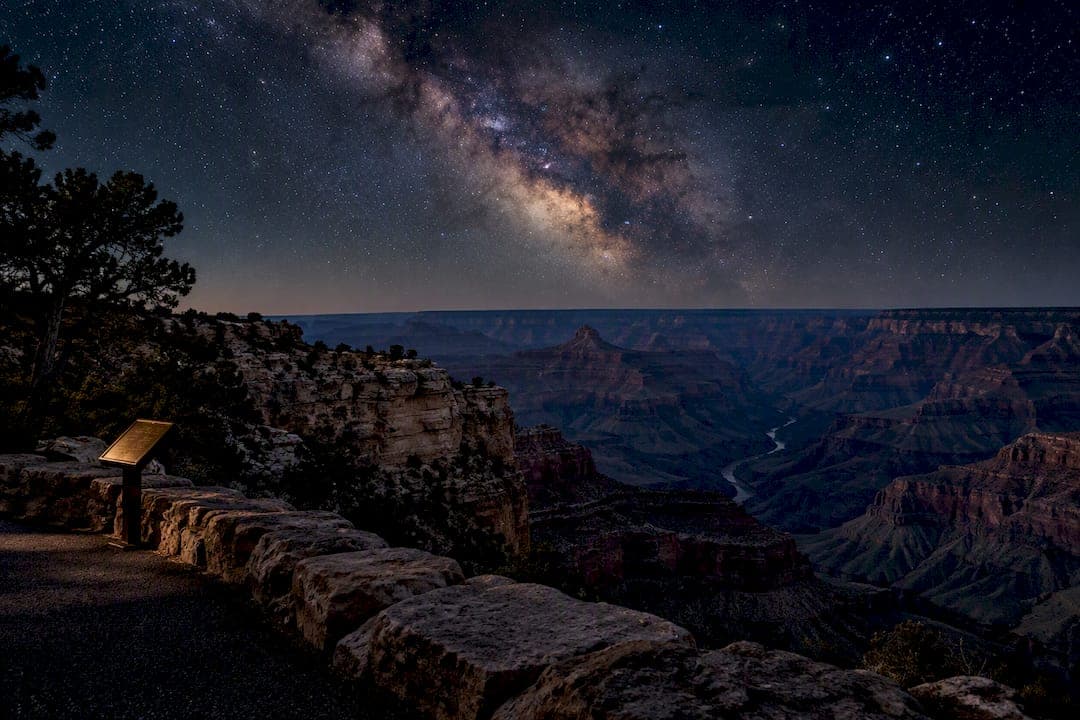
Yavapai Point and Mather Point deliver the easiest South Rim stargazing, while Cape Royal and Desert View Watchtower give photographers the best Milky Way framing. Go on a moonless or near-new-moon night, and stay put for at least 90 minutes after sunset. Check the National Park Service's night sky event calendar before you go, or let a private tour handle the timing and driving for you.
TL;DR:
- The best stargazing spots include Mather Point and Yavapai Point for convenience, with Desert View and Cape Royal offering darker skies for photography.
- The Grand Canyon Star Party is an ideal entry point for beginners, with peak viewing conditions after 9 p.m. on nights around the new moon.
- Optimal Milky Way viewing occurs at least 90 minutes after sunset during new moon phases, with summer months providing the best core visibility despite monsoon season risks.
- South Rim access is easier year-round with paved roads and shuttles, while North Rim visits require longer drives and limited after-dark amenities.
- Using a private guide can simplify logistics, avoid night-driving hazards, and allow better timing for moon phases and optimal conditions.
Table of Contents
- Where Are the Best Grand Canyon Stargazing Spots?
- What Is the Grand Canyon Star Party?
- When Is the Best Time to See the Milky Way at the Grand Canyon?
- How Do You Plan a Grand Canyon Stargazing Visit?
- What Gear and Technique Actually Help With Stargazing?
- What Are the Best Camera Settings for Grand Canyon Night Photography?
- How Dark Are the Skies at Grand Canyon National Park?
- A Note From Grandcanyonjourneys on Planning Your Visit
- An Editorial Take on Doing This Right
- Book a Private Tour and Skip the Night-Driving Guesswork
- Sources
- FAQ
Where Are the Best Grand Canyon Stargazing Spots?
Not every overlook offers the same experience after dark, and picking the right one depends on how far you're willing to drive and what you want to see. The National Park Service names Mather Point as the most convenient South Rim option, mostly because it sits a short walk from the Grand Canyon Visitor Center and has paved paths and lighting nearby for the walk back to your car.
Yavapai Point, just a few minutes west, trades a bit of that convenience for a slightly darker horizon and fewer crowds once the museum closes. Desert View, Lipan Point, and Moran Point sit farther east along Desert View Drive, and that extra distance from the main village lighting makes a real difference. These three overlooks are consistently darker than anything near Grand Canyon Village, and Desert View adds a bonus: the historic Watchtower, which works as a striking foreground silhouette against the night sky.
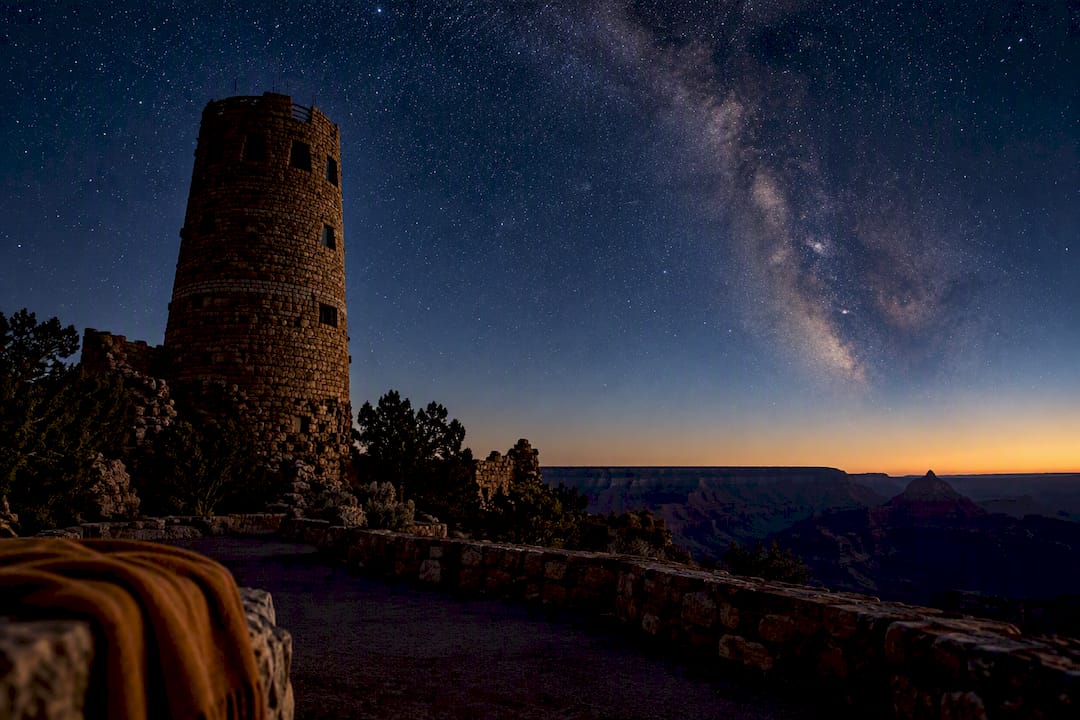
On the North Rim, Cape Royal and Bright Angel Point are the standout picks. Cape Royal juts out over the canyon and offers one of the widest unobstructed sky views in the park, which matters if you're chasing the galactic core. Bright Angel Point sits close to the Grand Canyon Lodge, so it's the North Rim's easiest option for casual viewing without a long walk.
A few practical notes worth knowing before you pick a spot:
- Mather Point and Yavapai Point have restrooms and shuttle access via the Village Route; Desert View, Lipan Point, and Moran Point are on the free shuttle only during peak season and reachable by car otherwise.
- North Rim overlooks require significantly more driving and have fewer amenities open after dark.
- For canyon-plus-sky photography, Desert View Watchtower and Cape Royal give the most dramatic foregrounds, while Mather and Yavapai Point are better for pure sky-watching without much foreground interest.
If you're deciding between rims for your whole trip, not just stargazing, this South Rim versus West Rim comparison breaks down the tradeoffs in daylight terms too.
What Is the Grand Canyon Star Party?
The Grand Canyon Star Party is the single best entry point if you've never done serious stargazing before. It's a free, ranger-and-volunteer-run event held annually on the South Rim, and in 2026 it ran June 6 through 13. Dates shift slightly each year around the new moon, so always verify the current schedule before you plan a trip around it.
Here's what a typical night at the event looks like:
- Evening constellation talks and beginner-friendly astronomy presentations start shortly after sunset.
- Volunteer astronomers set up dozens of telescopes in a designated viewing lot, and visitors can walk from scope to scope.
- Viewing conditions improve noticeably after 9 p.m., once twilight fully fades and eyes adjust.
- Rangers and volunteers answer questions and point out planets, star clusters, and galaxies in real time.
Bring a jacket even in June. Parking fills fast near the event site, so arrive early or use the shuttle. The event is wheelchair accessible, and volunteers are used to adjusting telescope height for different visitors. Because the Grand Canyon Conservancy reports roughly 250 astronomy programs reaching over 73,000 visitors in recent years, expect a crowd, especially on weekend nights. If you'd rather skip the group setting entirely, any of the darker overlooks work fine for a quieter, self-guided night.
When Is the Best Time to See the Milky Way at the Grand Canyon?
Moon phase decides more about your night than almost anything else. The Park Service recommends planning around the new moon or third-quarter phase, since a full or first-quarter moon washes out fainter stars and the Milky Way's dim band entirely. A star chart or a moon-phase app will tell you exactly which nights work best for whatever month you're visiting.
Timing your arrival matters just as much as picking the date:
- Arrive at your chosen overlook at least 90 minutes after sunset, once true darkness has settled in.
- Stay through at least 90 minutes before sunrise if you're doing an early-morning session instead.
- Budget 30 minutes of sitting in darkness before your eyes fully adapt. Checking your phone resets that clock.
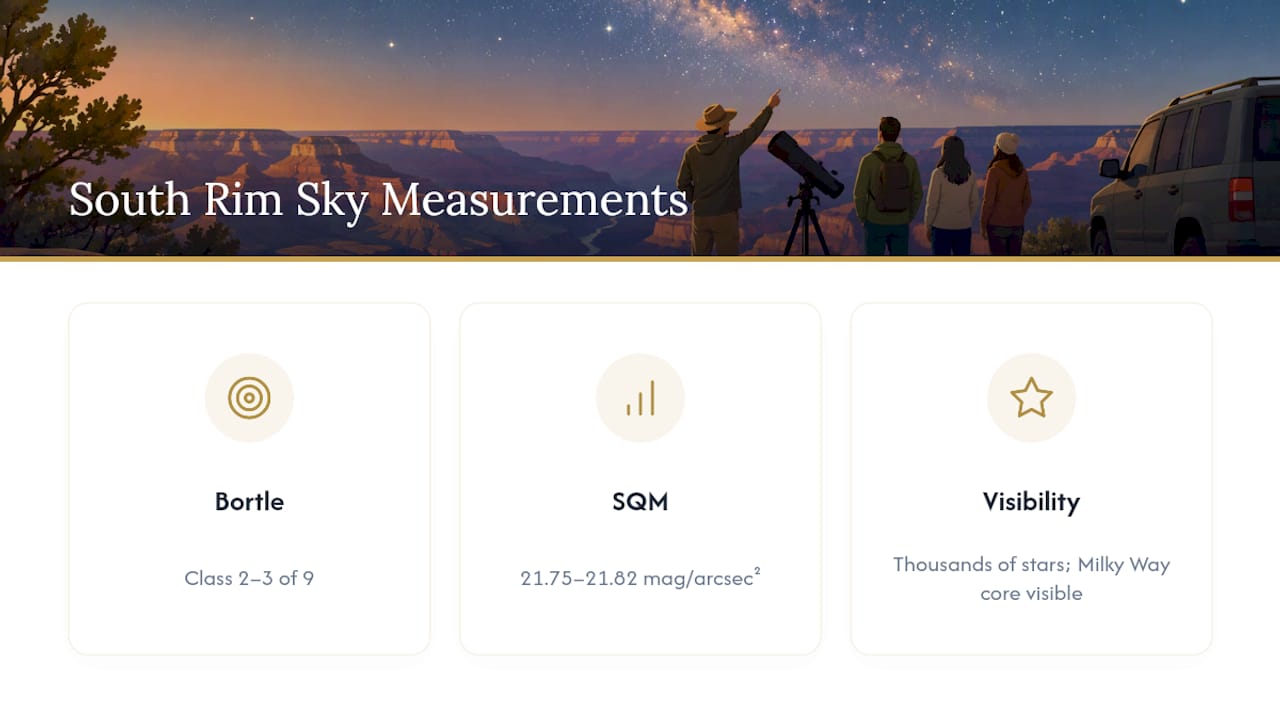
Statistic Callout: Field measurements cited in the park's dark sky certification put South Rim sky darkness at Bortle class 2 to 3, with sky quality meter readings around 21.75 to 21.82 magnitudes per square arcsecond at sample sites. That's dark enough to see the Milky Way's core with the naked eye on a clear, moonless night.
Summer months generally offer the best core visibility, but that's also monsoon season in Arizona. Sudden storms, smoke from regional wildfires, and high humidity can all cut visibility to zero with little warning, so check conditions the same day you plan to go, not just the week before.
How Do You Plan a Grand Canyon Stargazing Visit?
South Rim access stays open year round and is by far the simpler option: paved roads, a functioning shuttle system, and services running late into the evening during summer. The North Rim is a different story. Services were limited in 2026 following Dragon Bravo Fire impacts, and the drive between rims runs 209 miles, or about five hours. Check current NPS conditions pages before committing to a North Rim night, especially outside peak season when facilities close early or not at all.
On the South Rim, the Village Route shuttle covers Mather Point and the visitor center area, while the Kaibab Rim Route reaches Yavapai Point. Hermit Road closes to private vehicles for part of the year, so a shuttle or a private tour vehicle becomes your only option on that stretch after certain hours. Parking near Desert View fills up during the Star Party, so arrive with daylight to spare.
A short safety checklist before you head out after dark:
- Bring more water than you think you need. The desert air dries you out faster at night than the temperature suggests.
- Pack warm layers. Rim temperatures can drop 30 degrees or more after sunset even in summer.
- Use a red-light headlamp, never a white flashlight, once you're near a viewing area.
- Give yourself extra time walking on unfamiliar trails in the dark, and stay well back from unmarked cliff edges.
- Check the National Weather Service forecast for Grand Canyon Village before you leave your hotel.
Pro Tip: If you're staying in Flagstaff or Williams, build in an extra 45 minutes of drive time beyond what your map app estimates. Rim roads have wildlife crossings, and elk on the road at dusk are a real hazard, not a rare novelty.
For a full day-by-day framework that leaves room for an evening stargazing session, this South Rim itinerary guide is worth reading before you lock in your schedule.
What Gear and Technique Actually Help With Stargazing?
Your eyes are the most important piece of equipment you own, and they need time to work properly. Full dark adaptation takes about 30 minutes, and it resets the moment you glance at a bright phone screen or someone's headlights. NPS field advice on this is blunt: a red flashlight preserves night vision in a way white light simply can't. If you don't own one, stretching red cellophane over a regular flashlight lens does the same job for a couple of dollars.
A simple pack list covers almost everyone's needs:
- Red-light headlamp or flashlight (essential, not optional)
- Warm layers, even in summer, plus a blanket or folding chair
- Extra water and snacks
- A star chart or a phone app with a red night mode enabled
- Binoculars, if you have them. They reveal far more detail on the Milky Way and star clusters than most people expect.
Respect the telescope lots during organized events. Volunteers set delicate equipment up for hours, and a stray flashlight beam or a bumped tripod ruins someone else's view instantly. Follow ranger direction at crowded events, and keep voices low. Silence carries oddly far across the canyon rim at night.
What Are the Best Camera Settings for Grand Canyon Night Photography?
Composition comes before gear. Decide on your foreground first: Desert View Watchtower and Cape Royal both give you a recognizable silhouette against the sky, which turns a generic star photo into something that clearly says Grand Canyon. Since the galactic core sits toward the south, North Rim overlooks that face south across the canyon tend to line up core-and-canyon shots more naturally than most South Rim spots.
A workable starting setup for most cameras:
- Use the widest lens you own, ideally f/2.8 to f/4 for maximum light gathering.
- Set ISO between 1600 and 6400, adjusting based on how much noise your camera handles well.
- Expose for 15 to 25 seconds on a wide lens before star trails start showing; go shorter on longer focal lengths.
- Focus manually in the dark using a bright star or distant light, then tape the focus ring in place.
Pro Tip: Arrive while there's still enough light to compose your shot and lock your tripod. Fumbling with framing in total darkness wastes your best viewing window. A stable tripod and correct moon-phase timing will improve your photos more than any lens upgrade.
How Dark Are the Skies at Grand Canyon National Park?
Grand Canyon earned International Dark Sky Park certification in June 2019 after completing a lighting inventory and retrofitting fixtures throughout the park. That designation recognizes the park's preservation effort. It doesn't mean every overlook is equally dark, since horizon glow from nearby facilities and seasonal conditions still vary by location.
The numbers back up the reputation. Field data from the certification process measured Bortle class 2 to 3 skies at sample South Rim sites, among the darkest ratings on the nine-point scale used by astronomers. Sky quality meter readings there ran roughly 21.75 to 21.82 magnitudes per square arcsecond, a range that puts thousands of stars and the Milky Way's core easily within naked-eye reach on a clear night.
What that means practically: expect genuinely excellent skies almost anywhere in the park, but don't assume identical results everywhere. Weather, moonlight, and even distant wildfire smoke can knock a five-star night down to average without warning.
A Note From Grandcanyonjourneys on Planning Your Visit
Chris covers Grand Canyon travel planning for Grandcanyonjourneys, focusing on the logistics that trip up first-time visitors most.
The biggest friction point for stargazing visitors isn't finding a dark spot. It's the logistics around it: driving unfamiliar roads at night, timing arrival around sunset, and figuring out parking before a shuttle stops running. A private tour removes most of that guesswork.
What that looks like in practice:
- Door-to-door pickup means you're not driving back to a hotel on a dark rim road after your eyes have adjusted to night vision.
- A private guide can time your visit around moon phase and sunset rather than a fixed group schedule.
- Local guides know which overlooks are quiet on a given night and which ones will be packed for an event.
If you want a planning resource that covers transportation and timing together, the Grand Canyon travel planner is a good starting point before you book anything.
An Editorial Take on Doing This Right
Most stargazing advice online treats the Grand Canyon like any other dark sky destination: pick a spot, wait for dark, look up. That undersells how much the moon phase alone controls your outcome. A trip planned around a full moon, no matter how perfect the overlook, will disappoint. A trip planned around a new moon at a mediocre spot will still deliver a memorable sky.
The conventional wisdom also overweights gear. Readers fixate on telescopes and camera lenses when the real lever is timing and patience, specifically that 30 minute dark-adaptation window almost nobody actually waits out. Prioritize the calendar first, the location second, and the equipment last.
Where I'd push back hardest on typical advice: don't assume you'll navigate rim roads confidently after dark just because you drove them fine at noon. Elk, unlit shoulders, and unfamiliar turns change that equation fast. If night driving worries you at all, that's exactly the logistics problem a private guide solves.
— Chris
Book a Private Tour and Skip the Night-Driving Guesswork
Consider using a private tour service to avoid navigating rim roads, shuttle schedules, and sunset timing on your own.
Our Grand Canyon Sunset Tour is built for travelers who want to catch golden hour and stay through early darkness without worrying about the drive back. If your trip is centered further south, the Sedona Stargazing Tour offers a private astronomy experience under the same dark Arizona skies with an expert local guide handling timing and location. Both include the flexibility to adjust for moon phase and weather, something a fixed-departure group tour can't offer. Check tour dates and book directly through either page to lock in a night that actually matches the conditions.
FAQ
Where Is the Best Place to Stargaze at the Grand Canyon?
Mather Point and Yavapai Point offer the easiest South Rim access, while Desert View, Lipan Point, and Moran Point sit far enough from village lighting to feel noticeably darker. Cape Royal on the North Rim offers the widest open sky view in the park, though it requires a much longer drive to reach.
Why Is Most of the Grand Canyon Restricted at Night?
It isn't restricted so much as undeveloped. Most of the park has no roads, lighting, or facilities at all, which is exactly what makes its skies so dark. The developed overlooks along the rim represent a small fraction of the park's total area, and that's intentional for preserving the dark sky designation.
Where Is the Darkest Place in the USA for Stargazing?
Several U.S. national parks hold International Dark Sky Park status, and Grand Canyon is among them, with sample South Rim readings around Bortle class 2 to 3. No single "darkest place" ranking is official, but the Grand Canyon's certified sky quality readings put it firmly among the best in the country.
When Can You See the Milky Way at the Grand Canyon?
The Milky Way's core is most visible during summer months on moonless or near-new-moon nights, starting roughly 90 minutes after sunset. Check a moon-phase calendar and NPS conditions before you go, since monsoon storms and wildfire smoke can obscure the sky with little warning.
Does Grandcanyonjourneys Offer Stargazing Tours?
Grandcanyonjourneys offers a Sedona Stargazing Tour with private, guided astronomy viewing under dark Arizona skies. For Grand Canyon visits timed around sunset and early darkness, the Grand Canyon Sunset Tour is the better fit, and current pricing is listed on each tour page.