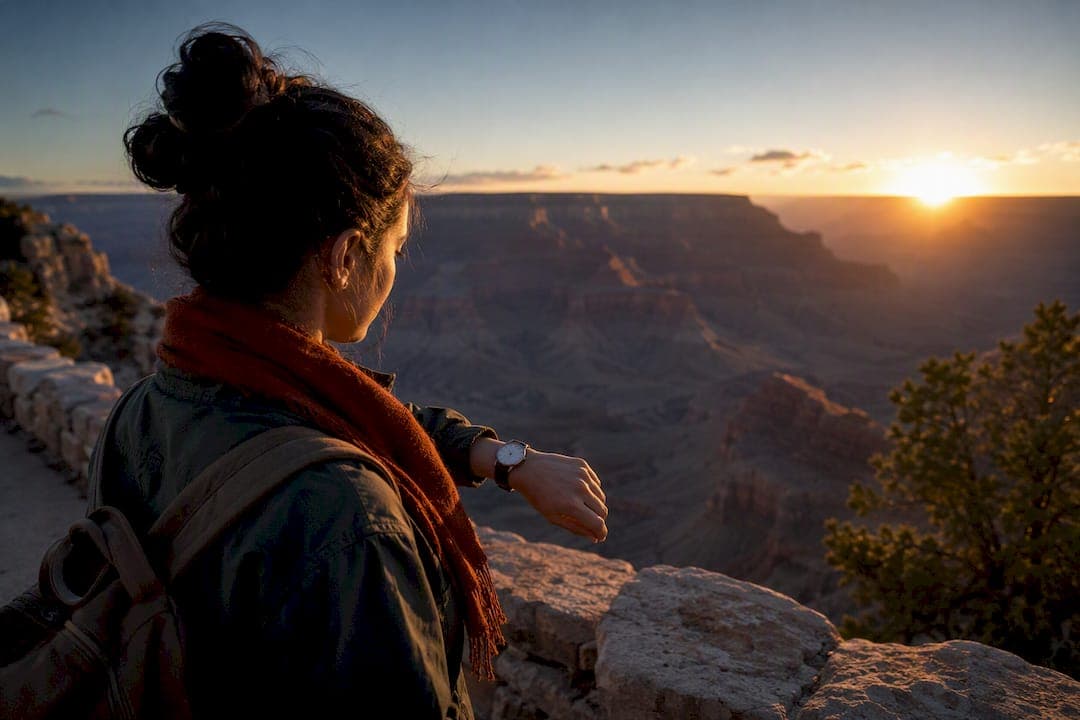
Grand Canyon National Park runs on Mountain Standard Time (UTC−7) all year, and Arizona does not observe Daylight Saving Time, so the clocks here never spring forward or fall back. The one exception is the Navajo Nation, which does follow DST. Before you book a shuttle, flight, or private tour, confirm the time is quoted in Arizona MST rather than a neighboring state's seasonal time.
TL;DR:
- Travelers near Navajo Nation and Hopi Reservation boundaries should verify local time with their service providers before booking activities to avoid scheduling issues.
- Most reservations and tours in the Grand Canyon are scheduled in Arizona MST, which remains fixed at UTC−7 year-round, simplifying planning for visitors.
- The Navajo Nation's observance of Daylight Saving Time can cause a one-hour time shift for areas within Arizona, affecting travel and activity timing.
- Arriving at viewpoints 30 to 60 minutes early and confirming each pickup time in Arizona MST helps prevent missed sunrises, sunsets, and transportation.
- Using official sources like the National Park Service sunrise/sunset tables and Time.gov ensures accurate local time confirmation before making arrangements.
Table of Contents
- What MST year-round actually means
- The Navajo Nation exception and border-crossing confusion
- Scheduling sunrise, sunset, drives, and pickups
- How to confirm the exact local time before you go
- What tour operators watch for on pickup day
- What actually matters here
- A time-aware way to see the Grand Canyon
- Where these facts come from
- Sources
- FAQ
What MST year-round actually means
Mountain Standard Time sits seven hours behind Coordinated Universal Time, written as UTC−7. Most of the country adjusts its clocks twice a year, but Arizona locked in standard time permanently under Arizona Revised Statute 1-242, which formally exempts the state from the seasonal shift. That single line of state law is why Grand Canyon time never lines up with Phoenix's neighbors during the summer months.
The federal side of the picture comes from the Uniform Time Act framework overseen by the U.S. Department of Transportation, which sets national time zone boundaries but lets individual states opt out of Daylight Saving Time entirely. Arizona used that option decades ago, largely because of the desert heat: shifting clocks forward in summer would push sunset later into the evening, adding an extra hour of blistering afternoon sun rather than saving anything.
The National Park Service confirms that Grand Canyon National Park stays on Mountain Standard Time year-round and does not observe the seasonal change. A few things follow from that fact:
- The park's clock never moves, even as most of the country changes twice a year.
- Arizona effectively matches Pacific Daylight Time in summer and Mountain Daylight Time the rest of the year, depending on which states are currently observing DST.
- Any pickup, tour, or reservation time quoted for the Grand Canyon is already in standard time, with no adjustment needed.
MST at the Grand Canyon is fixed at UTC−7 every day of the year, according to the National Park Service, which removes one variable that trips up travelers coming from states that do change their clocks.
The Navajo Nation exception and border-crossing confusion
Arizona's no-DST rule has one major carve-out. The Navajo Nation observes Daylight Saving Time even though it sits inside Arizona, which means parts of the northeastern part of the state run an hour ahead of the rest of Arizona for about eight months of the year. To add another layer, the Hopi Reservation, which is surrounded by Navajo Nation land, follows Arizona's standard time rule and skips DST entirely.
That patchwork creates what's sometimes called a time island effect, and it matters if your route touches these areas:
- Driving Route 264 through the Hopi Reservation and Navajo Nation can mean crossing a time boundary without ever leaving Arizona.
- Page, Arizona, sits near Navajo Nation land, so hotels, tours, and restaurants nearby may operate on either clock depending on which side of the boundary they're on.
- Antelope Canyon tours, many of which operate on or near Navajo Nation land, are a common source of missed reservations when visitors assume Arizona time applies everywhere.
Pro Tip: If your itinerary touches Page, Antelope Canyon, or any road crossing tribal land, ask the operator directly which clock they're using before you lock in a meeting time.
Scheduling sunrise, sunset, drives, and pickups
Time confusion causes more missed sunrises than bad alarms do. The National Park Service publishes daily sunrise and sunset tables for the park, and it recommends arriving well ahead of the actual event to claim a spot at popular viewpoints. A few practical habits keep your schedule intact:
- Check the official NPS sunrise/sunset table for your visit date rather than relying on a generic sunrise time from your phone's home screen.
- Arrive at least 30 to 60 minutes early at high-demand viewpoints like Mather Point or Hopi Point, since parking fills fast and the crowd builds well before the actual moment.
- Confirm your pickup or tour start time is stated in Arizona MST, especially if you booked through a service based in California, Utah, or another state that observes DST for part of the year.
- Treat flight and rental car pickup times as local airport time, and double-check that "local" matches Arizona MST rather than your departure city's zone.
Grand Canyon National Park's official guidance suggests arriving 30 to 90 minutes before sunrise or sunset events, which gives you time to park, walk to the rim, and settle in before the light show starts. Build in extra drive time between rims and viewpoints too. Roads here are long, shuttle windows are restrictive, and a 20-minute buffer on paper can vanish fast once you're behind a slow RV on a two-lane highway.
How to confirm the exact local time before you go
A few free tools remove any doubt about what time it actually is at the canyon:
- The NPS sunrise/sunset page gives official daily times for the park itself, which is the most reliable source for planning a viewpoint visit.
- Time.gov displays the current Mountain Standard Time for Arizona and is backed by the federal time standards that the Department of Transportation administers.
- Timeanddate.com or your phone's built-in world clock work fine for a quick check, but confirm against an official source before finalizing a booking.
When you're confirming a reservation with a hotel, shuttle, or tour company, ask a direct question: "Is this time listed in Arizona MST?" That single question resolves almost every mix-up before it becomes a missed pickup.
What tour operators watch for on pickup day
A reputable local tour operator typically confirms every meeting and pickup time in Arizona MST, since guests arrive from time zones across the country and sometimes overseas. Guides build in arrival buffers for sunrise and sunset tours specifically because parking, park shuttle windows, and foot traffic to the rim all eat into the schedule.
Planning a full day around exact timing is easier with a resource built for it. The Grand Canyon Travel Planner walks through logistics for visitors juggling multiple time-sensitive stops, and readers assembling a day-by-day route can also check a South Rim itinerary breakdown for how much time to allow between viewpoints.

What actually matters here
Most articles on this topic stop at "Arizona doesn't do Daylight Saving Time" and call it done. That misses the part that actually causes problems on the ground: the Navajo Nation exception and the Hopi Reservation's separate rule inside it. Travelers rarely get confused by Arizona statewide, they get confused by a 30-mile stretch of highway near Page or Tuba City where the clock quietly shifts.

The conventional advice to "just check what time zone Arizona is in" oversimplifies a state with two coexisting time rules operating on the same roads. If you're driving anywhere near the Navajo Nation or Hopi Reservation, the smarter habit is asking your specific service provider which clock they use rather than assuming a statewide rule covers every mile of your route.
Prioritize this: confirm local time directly with whoever is picking you up, feeding you, or guiding you, every single time your itinerary crosses a reservation boundary. Everything else, sunrise tables, UTC offsets, statute numbers, is background that supports that one habit.
— Chris
A time-aware way to see the Grand Canyon
Booking a private tour can remove the guesswork entirely, as some operators build every pickup and departure time around confirmed Arizona MST, often with door-to-door hotel or B&B pickup so you're not deciphering a shuttle schedule on your own.
For sunrise viewpoints or golden-hour photography, timing is everything, and a guide who already knows the shuttle windows and parking patterns saves you the guesswork a self-driven trip requires. Three starting points worth a look:
- The Private Grand Canyon Day Tour covers the highlights with a schedule built around your pickup time, not a bus timetable.
- The Grand Canyon Sunset Tour is timed to the evening light, with arrival planned against the same sunset tables the National Park Service publishes.
- The Grand Canyon Travel Planner helps you map out a full day, including which rim and which viewpoints fit your available hours.
Reach out to confirm your exact pickup time and mention if you're aiming for sunrise, sunset, or a stargazing session, since each one shifts the schedule differently.
Where these facts come from
- NPS sunrise/sunset tables
- Arizona Revised Statute 1-242
- U.S. DOT time zone guidance
- Time in Arizona overview
- Time.gov
Sources
- Sunrise/ Sunset Times and Moon Phases - Grand Canyon National Park (U.S. National Park Service)
- Arizona Revised Statutes §1-242
- Daylight Saving Time | U.S. Department of Transportation
- Time in Arizona — Wikipedia
FAQ
Which time zone is the Grand Canyon in?
The Grand Canyon sits in the Mountain Standard Time zone, which is UTC−7 year-round according to the National Park Service. Unlike most of the country, this offset never changes with the seasons.
Is Phoenix 2 or 3 hours behind Eastern time?
Phoenix runs on Mountain Standard Time all year, which puts it 3 hours behind Eastern Standard Time. During the months when the East Coast observes Daylight Saving Time, the gap narrows to 2 hours because Arizona's clock stays fixed while Eastern time shifts forward.
Does Arizona have two time zones?
Arizona effectively operates on two schedules rather than two official zones: most of the state stays on Mountain Standard Time year-round under Arizona Revised Statute 1-242, while the Navajo Nation observes Daylight Saving Time. The Hopi Reservation, surrounded by Navajo Nation land, follows Arizona's standard time rule instead.
Is Arizona on MST or PST right now?
Arizona stays on Mountain Standard Time (UTC−7) throughout the year, since the state does not observe Daylight Saving Time under its own statute. For part of the year this happens to match Pacific Daylight Time's clock reading, but the underlying zone is MST, not PST.
Does the Grand Canyon change its clocks for Daylight Saving Time?
No, Grand Canyon National Park stays on Mountain Standard Time every month of the year, confirmed by the National Park Service. The only nearby exception is the Navajo Nation, which does observe the seasonal change.