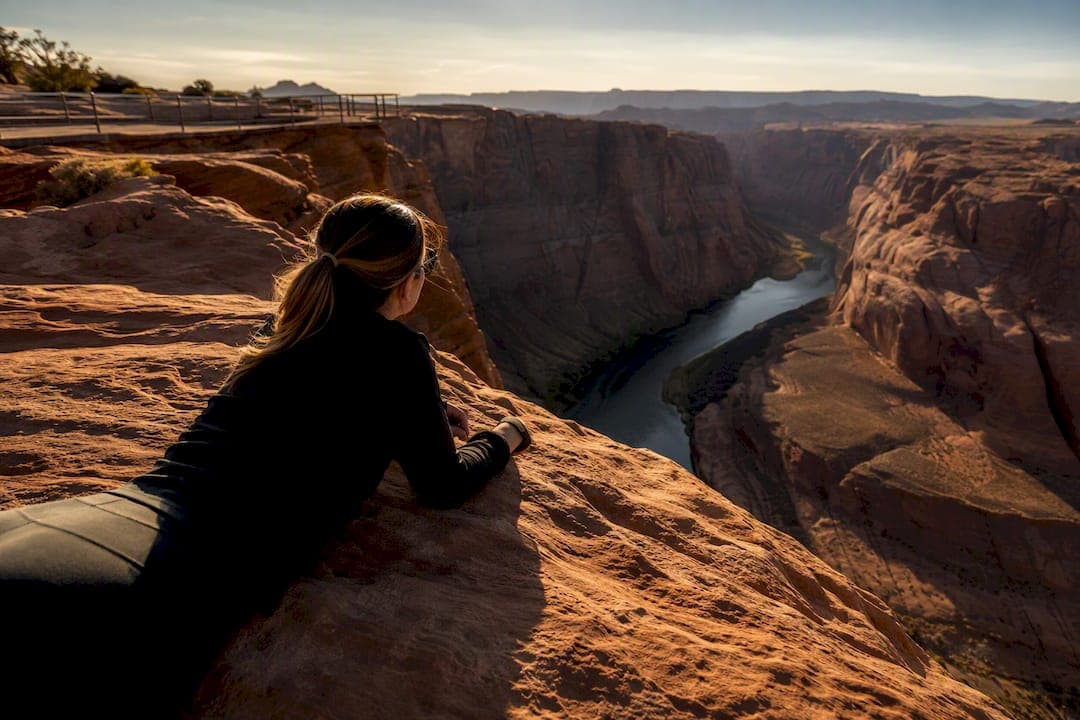
Horseshoe Bend is safe to visit when you plan around three things: timing, water, and the edge. The biggest hazards are a 1,000-foot drop with almost no guardrails, summer heat that regularly tops 100°F, and a parking lot that fills fast. Go at sunrise or in the last two hours before sunset, carry at least a liter of water per person, keep kids on the fenced platform, and check current parking fees before you drive out.
TL;DR:
- Visiting at sunrise or the last two hours before sunset reduces exposure to heat and crowds, especially in summer when temperatures often exceed 100°F.
- Stay on designated paths, keep children on the fenced platform, and avoid approaching unfenced edges to prevent falls from the 1,000-foot drop.
- Carry at least one liter of water per person, wear closed-toe shoes, and check parking fees in advance to avoid dehydration and parking issues.
- The accessible left trail to the fenced platform provides the safest viewpoint; the unguarded right edge presents a higher fall risk and requires caution.
- Booking a guided tour can improve safety, streamline logistics, and ensure visitors experience Horseshoe Bend with local knowledge about timing, parking, and rim safety.
Table of Contents
- How Safe Is Horseshoe Bend, Really?
- Your Pre-Visit Safety Checklist
- What Does the Trail Actually Look Like?
- How Do You Handle the Heat?
- How Close Should You Get to the Edge?
- What Should You Know About Parking and Driving?
- What About Storms and Emergencies?
- Should You Just Book a Guided Visit Instead?
- A Local Guide's Quick Takeaway
- Book a Private Tour That Handles Horseshoe Bend for You
- Check These Before You Go
- Sources
- FAQ
How Safe Is Horseshoe Bend, Really?
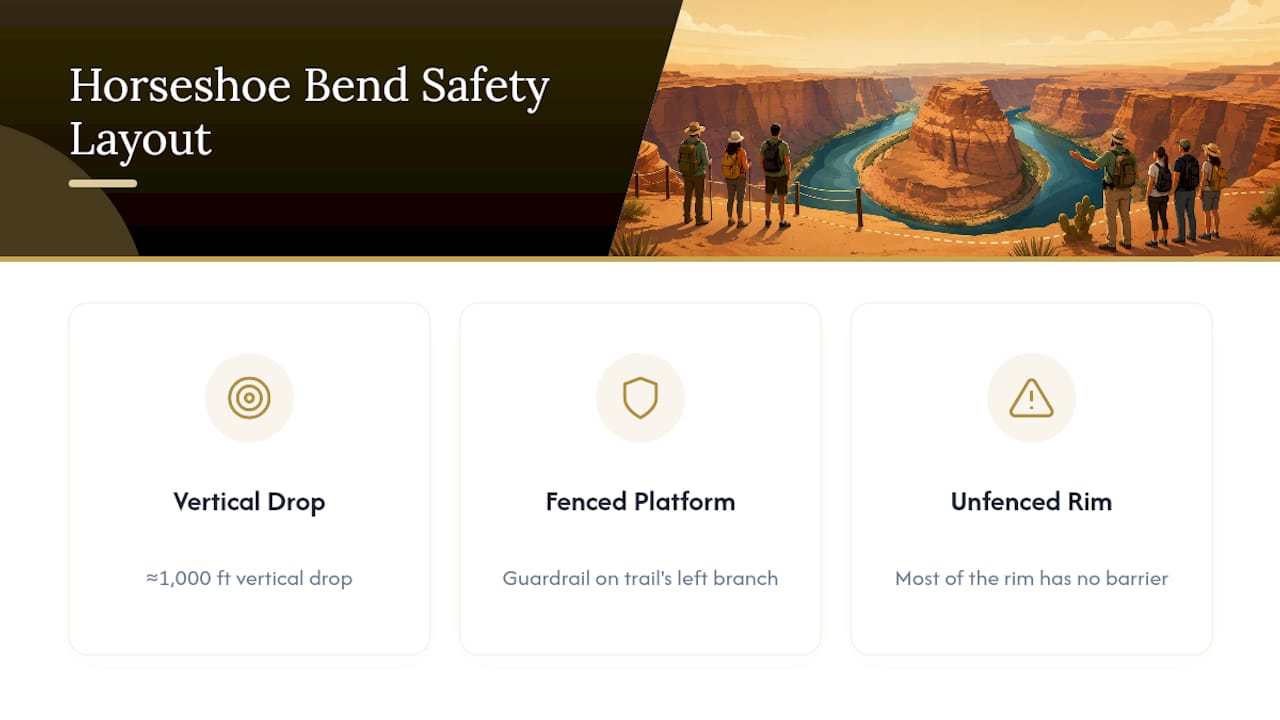
The overlook itself is not dangerous if you respect it, but it does not coddle you either. Most of the rim has no barrier at all. The National Park Service notes the drop runs roughly 1,000 feet straight down, and the only guardrail on the entire site sits at the fenced viewing platform on the trail's left branch. Everywhere else, you're standing on sandstone with nothing between you and the Colorado River far below.
That's not a reason to skip it. Thousands of visitors walk out, take their photos, and walk back without incident every week. The people who get hurt are almost always the ones who ignore the obvious: they get too close to a crumbling edge for a photo, they hike at 2 p.m. in July without water, or they let a toddler wander near the unfenced overlook while they're distracted. Horseshoe Bend safety comes down to basic discipline, not luck.
The standard playbook borrowed from Leave No Trace principles applies directly here: stay on the established path, don't create new routes to "better" viewpoints, and pack out everything you bring in. Those aren't just environmental courtesies. Sticking to the worn trail is also how you avoid the loose sand and unstable footing that cause most stumbles near the rim.
Your Pre-Visit Safety Checklist
Pack light but don't skip these. A rushed departure from your hotel in Page is how people end up at the trailhead without water on a 105°F afternoon.
- At least 1 liter of water per person, more in summer
- A hat, sunscreen, and closed-toe shoes (sandals slip on sand and loose rock)
- A basic first-aid kit: bandages, blister pads, any personal medication
- Cash or a card ready for the City of Page parking fee
- A charged phone and a rough idea of cell coverage in the area
- A plan to visit at sunrise or in the final two hours before sunset
If you're traveling with young kids or aren't confident managing the walk and the heat on your own, a private guided visit to Horseshoe Bend removes most of that logistics burden entirely.
Pro Tip: Screenshot the City of Page parking page before you leave your hotel. Cell service near the lot is inconsistent, and you don't want to be guessing about payment while your kids are melting in the back seat.
What Does the Trail Actually Look Like?
The walk out is shorter than most people expect, but the surface and the split at the end matter more than the distance.
- Distance and time. The route runs about 0.7 miles each way, or roughly 1.5 miles round-trip on a hardened, packed path. Budget 15 to 30 minutes each way plus time at the overlook.
- Two branches, two experiences. The left branch is the ADA-accessible route, ending at a raised, fenced platform. This is the only spot on site with a real guardrail. The right branch leads to the original overlook: unfenced, sandy, and where the real elevation exposure begins.
- Amenities are limited. You'll pass two shade structures along the trail, but there's no shade at the overlook itself. Restrooms and water fountains exist only back at the parking lot.
- Accessibility has real limits. Wheelchairs and strollers generally manage the left branch fine since it's packed and graded, but the final approach to the platform can still feel steep for manual chairs.
If you're bringing children or anyone unsteady on their feet, the left branch isn't a compromise. It's the better view for most people anyway.
How Do You Handle the Heat?
Page sits in the high desert, and Horseshoe Bend has zero shade at the overlook. That combination turns a "quick 20-minute walk" into a real heat risk if you go at the wrong time of day.
Summer afternoons here commonly exceed 100°F (38°C), and the exposed sandstone radiates heat back at you on top of the air temperature. Midday between roughly 11 a.m. and 4 p.m. from May through September is when heat illness risk climbs fastest.
- Carry a minimum of 1 liter of water per person for the round-trip walk, more for kids, seniors, or anyone on medication that affects heat tolerance
- Wear closed-toe shoes. Sand and rock at the overlook get hot enough to burn bare or sandaled feet by midday
- If you bring a dog, keep it on a leash no longer than 6 feet, check paw pads on the sand regularly, and never leave it in a parked car, even for a few minutes
- Skip midday visits entirely if you have young children; sunrise or the last two hours before sunset are both cooler and better for photos
Shoulder season (October through April) is far more forgiving, but mornings can still be cold enough that layering matters.
How Close Should You Get to the Edge?
This is where Horseshoe Bend safety actually gets tested, because the view rewards getting close and the terrain punishes it.
The vertical drop from the rim is close to 1,000 feet, and outside the fenced platform, there is nothing stopping a slip from becoming a fall. Sandstone edges can crumble without warning, especially after rain.
- Stay well back from any edge that isn't fenced, and never lean out for a "straight down" shot while standing
- If you want that classic overhead photo, sit or kneel several feet from the edge and extend your arm or phone, don't lean your body over
- Keep children within arm's reach at all times on the unfenced right branch; some parents use a short child harness for toddlers
- Secure cameras, phones, and gear with a strap or wrist loop before approaching any edge
Pro Tip: If you're shooting with a phone on a selfie stick, extend it while sitting down, not standing. A gust of wind at the wrong moment has pulled more than one visitor off balance right at the rim.
What Should You Know About Parking and Driving?
Getting to the overlook safely starts in the parking lot, and this is where a surprising number of visitors run into avoidable friction.
The City of Page manages the Horseshoe Bend parking lot and its fees directly, separately from any National Park Service pass you might already hold. Your America the Beautiful pass or Glen Canyon entrance receipt won't cover it. Check current parking details before you go so you're not caught off guard at the gate.
- Lot hours run sunrise to sunset; arriving outside that window means parking elsewhere or not going at all
- On busy weekends and holidays, the City may require shuttle use once the lot fills, so build in extra time
- After dark, US-89 has minimal lighting and frequent wildlife crossings, including deer and elk, so slow down noticeably on the drive back to Page
- If you're chasing sunset light, plan for the return drive to happen after dark and consider staying overnight in Page rather than pushing on that same evening
What About Storms and Emergencies?
Northern Arizona's monsoon season, roughly July through September, brings fast-building storms that catch unprepared hikers off guard.
- Watch the sky before you start. If cumulus clouds are stacking up by early afternoon, delay or skip the hike. There is no shelter anywhere at the rim.
- Know your nearest shelter. The ramada at the parking lot is the closest cover, about a 15-minute walk back from the overlook.
- If lightning starts while you're on the trail, turn around immediately and head for the parking lot rather than waiting it out at the rim.
- Recognize heat stroke early: confusion, stumbling, or collapse means you call 911 right away, move the person to shade, and cool them with water and wet cloths while help is on the way.
- Tell someone your plan. Cell coverage near Horseshoe Bend is inconsistent, so let someone know your expected return time before you head out.
Should You Just Book a Guided Visit Instead?
A private guide handles the parts of this trip that trip people up: timing the visit to dodge both heat and crowds, managing where to park, and keeping a close eye on kids near the unfenced sections.
That's a real advantage for first-time visitors, families with young children, or anyone uneasy about driving Highway 89 after dark. A local guide already knows which hour has the best light with the fewest people, and they're not guessing about lot hours or shuttle rules. Grand Canyon Journeys builds this kind of local knowledge into its Horseshoe Bend visits, including private pickup and small-group supervision, so you're not troubleshooting logistics on the fly. If comfort or safety is your main concern going in, a guided option is worth serious consideration over a solo drive.
A Local Guide's Quick Takeaway
The three things guides repeat to every guest, every single time: time your visit around the heat, carry more water than you think you need, and stay off the unfenced rim if you're not fully confident on your feet. Most close calls at Horseshoe Bend trace back to skipping one of those three. Guided logistics don't just add polish. They quietly remove the decisions that get people hurt.
— Chris
Book a Private Tour That Handles Horseshoe Bend for You
Grand Canyon Journeys is the alternative to figuring out parking fees, sunset timing, and highway driving on your own. Instead of juggling a rental car, a City of Page parking pass, and a drive back on US-89 after dark, you get a private vehicle, a local guide who already knows when the light and crowds are best, and someone watching the group near the rim so you can actually enjoy the view.
Private tours from Northern Arizona can build Horseshoe Bend into a full day alongside Antelope Canyon and other Page-area stops, with pickup handled door to door. If you're mapping out the trip, start with the Grand Canyon travel planner to see how the timing works, or go straight to the Antelope Canyon & Horseshoe Bend tour from Sedona to check availability for your dates.
Check These Before You Go
Fees, hours, and closures change without much notice, so confirm details directly with these sources shortly before your trip.
- NPS Horseshoe Bend page for trail and safety updates
- City of Page for current parking fees and lot hours
- Leave No Trace Center for Outdoor Ethics for on-site behavior guidance
- General travel safety habits worth applying to any outdoor day trip
Sources
- Horseshoe Bend - Glen Canyon National Recreation Area (U.S. National Park Service)
- City of Page
- Leave No Trace Center for Outdoor Ethics
FAQ
How deep is the water at Horseshoe Bend?
The Colorado River sits roughly 1,000 feet below the overlook rim, and the drop is close to vertical along most of the unfenced trail.
Is it safe to visit Horseshoe Bend right now?
Yes, with planning: visit at sunrise or late afternoon, carry water, and keep children and unsteady walkers on the fenced platform rather than the open right-branch overlook.
What is Horseshoe Bend famous for?
It's known for the dramatic horseshoe-shaped curve the Colorado River carves into the sandstone, viewed from a cliff edge roughly 1,000 feet above the water.
Which is better, Horseshoe Bend or Antelope Canyon?
They're different experiences rather than direct rivals: Horseshoe Bend is a short, free-standing overlook hike, while Antelope Canyon is a guided slot-canyon walk, and many visitors pair both in one day through a combined tour.
Do I need a guide to visit Horseshoe Bend safely?
No, a guide isn't required, but one helps significantly with heat timing, parking logistics, and rim supervision, especially for families or first-time desert visitors.