The best Sedona half day picks one zone and stays in it. Choose red rock trails and viewpoints, Oak Creek Canyon, or the village-and-chapel loop along Highway 179. Then start early and park once. Cross town several times and traffic and parking will eat a surprising share of your four or five hours.
Below are three tested-in-spirit plans, the real costs of passes and parking, and an honest look at when a private guide saves you more than it costs.
TL;DR
- Pick one zone per half day: Red Rock trails, Oak Creek Canyon, or the Highway 179 village loop. Local guidance favors this over crossing the city.
- Start early. Parking, not distance, is what breaks a short Sedona itinerary.
- Budget for passes: a Red Rock Pass is $5 per day per vehicle, and Slide Rock State Park charges $20 to $30 per vehicle depending on the season.
- The free city trailhead shuttles can replace parking at Cathedral Rock and Soldier Pass, but check that day's operating status.
- If you want no parking logistics at all, a private tour handles pickup and routing for you.
Table of Contents
- How much can you really see in half a day?
- Plan 1: Red rock views and an easy trail (Highway 179)
- Plan 2: Oak Creek Canyon and a swim (Highway 89A north)
- Plan 3: The no-hike village loop (Uptown and Tlaquepaque)
- Side-by-side: which half day fits you?
- Passes, fees and parking: the real cost of a half day
- Using the free trailhead shuttles
- A sample timeline for the Red Rock plan
- Our perspective: where half days go wrong
- Let someone else handle the parking
- If you have more than half a day
- Practical checklist before you leave the hotel
- FAQ
- Sources
How much can you really see in half a day?
A half day in Sedona means roughly four to five hours. That is enough for one good short hike or one scenic stop, plus a relaxed lunch or a walk through a village. It is not enough for "everything", and the plans that promise Cathedral Rock, Slide Rock, Tlaquepaque and a sunset drive in one morning are selling you a traffic jam.
The road layout explains why. Sedona's main attractions sit on two corridors: Highway 179 to the south, and Highway 89A running through Uptown and north into Oak Creek Canyon. Each has limited parking and heavy visitor traffic. Local sightseeing guidance suggests sticking to one zone instead of cutting across the city.
So the question is not what to see, but which zone fits you. Here are the three options.
Plan 1: Red rock views and an easy trail (Highway 179)
Best for first-time visitors who want the postcard Sedona without a strenuous hike.
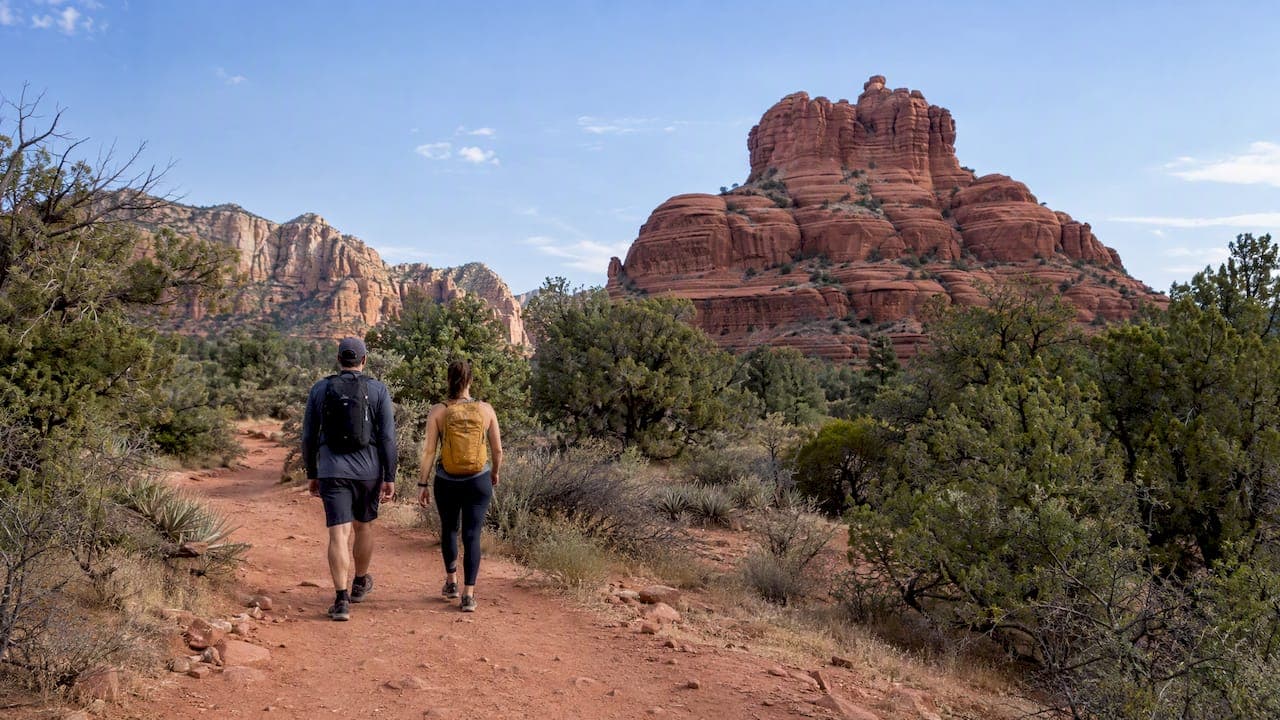
Start: Courthouse Vista or Bell Rock area. The Forest Service describes Courthouse Vista as the trailhead for the Courthouse Butte Loop, Bell Rock and the Bell Rock Pathway, so you can choose a short out-and-back or a longer loop on the spot. Arrive early. Lots fill up as the morning goes on.
Middle: a gentle walk. Walk as far as your energy allows toward the base of Bell Rock, then turn back. You do not need to climb it to get the views. Carry more water than you think you need, because the desert dries you out fast, and wear real shoes rather than sandals.
Finish: Chapel of the Holy Cross and lunch. Drive back north on 179 to the chapel, built into the red buttes. Then continue toward the village for a late lunch.
Pass needed: a Red Rock Pass at forest trailheads (details in the costs section below).
Plan 2: Oak Creek Canyon and a swim (Highway 89A north)
Best for families and for summer visits, when the red rock trails get hot by mid-morning.
Start: Slide Rock State Park. Admission is by vehicle only. Arizona State Parks states there are no walk-ins, drop-offs or bicycle entries, and that the vehicle fee is $30 from May through August 21 and $20 for the rest of the year, covering one to four adults, with $5 for each extra adult. Credit cards are strongly preferred over cash. Arrive near opening in summer, because the entry station can back up.
Middle: slide, wade, or just walk the creek. The natural rock chutes are the draw. Water shoes help with the slippery, uneven creekbed.
Finish: back to Uptown for lunch. Park once in a central lot and walk. See the parking section below.
Watch out for: sites in Oak Creek Canyon such as West Fork are run differently from standard forest trailheads. The Forest Service notes that the standard Red Rock Pass does not cover every site, and that some concessionaire-managed locations charge their own fees. Check before you go so you do not buy the wrong pass.

Plan 3: The no-hike village loop (Uptown and Tlaquepaque)
Best for travelers with limited mobility, hot-weather visits, or anyone who wants galleries and a long lunch more than a trailhead.
Start: Tlaquepaque Arts & Shopping Village for its galleries, courtyards and restaurants. The Sedona Chamber of Commerce points to this kind of village stop as ideal for a short visit when you use its "park once" approach.
Middle: Chapel of the Holy Cross. It is a short drive away and rewards a visit even if you only stay twenty minutes.
Finish: a scenic drive. Take a slow loop of the red rock roads in the afternoon light, ideally off-peak. We cover good options in our guide to Sedona scenic drives.
Side-by-side: which half day fits you?
| Plan 1: Red rocks | Plan 2: Oak Creek | Plan 3: Village loop | |
|---|---|---|---|
| Effort | Easy to moderate | Easy | Minimal |
| Best season | Fall to spring | Late spring to early fall | Year-round |
| Main cost | Red Rock Pass | State park vehicle fee | Parking, meals |
| Biggest risk | Full trailhead lots | Summer entry lines | Uptown traffic |
| Good with kids | Yes, short loops | Yes, very | Mixed |
Passes, fees and parking: the real cost of a half day
This is where most self-planned itineraries go wrong.
Red Rock Pass. Per the Forest Service's passes program, many popular Coconino National Forest trailheads require a pass: $5 per vehicle for a day, or $15 for a week. The America the Beautiful annual pass ($80) is accepted at many, but not all, of these sites.
Concession sites. Locations such as West Fork and Crescent Moon set their own fees, typically around $14 to $15 per vehicle according to the same source. Do not assume your Red Rock Pass covers them.
Uptown parking. The City of Sedona notes that Uptown has free public parking but also demand-based metered parking on Main Street, and enforcement is strict. Read its Uptown parking page before you leave your car, and then walk between shops rather than re-parking.
Pass planning for the wider trip. If a Grand Canyon day is also on your schedule, our national park passes guide explains how the federal pass can pay for itself.

Using the free trailhead shuttles
The City of Sedona runs free trailhead shuttles to busy spots including Cathedral Rock, Soldier Pass and Dry Creek Vista/Mescal. According to the city's transit page, they typically run Thursday through Sunday, with frequencies from 15 to 45 minutes depending on the route, and may expand to seven days a week at peak times. While they operate, the Soldier Pass and Cathedral Rock lots are closed to private vehicles.
Two practical points for a half day:
- Check status the same morning. The city says service, stops and frequency change with seasonal demand and conditions such as fire alerts.
- Add the park-and-ride leg to your clock. The rider guide recommends using the TransLoc app for real-time departures and heading to the free park-and-ride lot. That is easy, but it is a few more steps than pulling into a trailhead.
If you would rather skip all of this, our post on getting around Sedona without a rental car lays out the options.
A sample timeline for the Red Rock plan
Here is how Plan 1 can run on the clock. Adjust it for your season, since desert heat shifts everything.
- Early morning: Reach the trailhead before the lot fills. Display your pass.
- Next 90 minutes: Walk toward Bell Rock or the Courthouse Butte loop and turn back before it gets hot.
- Late morning: Drive to the Chapel of the Holy Cross.
- Midday: Lunch in the village, parked once.
- Early afternoon: Slow scenic drive, then return to your hotel to rest.
In summer, flip it: do the creek first and avoid exposed trails after mid-morning.
Our perspective: where half days go wrong
We are a locally owned Northern Arizona operator, and the same pattern shows up in the questions we hear from guests planning Sedona. People build a list of five stops, then spend a third of the time circling for parking or waiting in line on 89A. The sights are not the problem. The logistics are.
Our advice is simple. Choose one theme for the half day. Decide in advance who is driving and where you will park. Leave a little slack for a viewpoint you did not plan on. Sedona rewards lingering more than it rewards checklists.
This is also why our guests tend to book private rather than shared. A private tour means your own vehicle, door-to-door pickup from your hotel or B&B, a guide who knows the day's best route, and no fighting for a space at the trailhead. Your pace is yours, and nobody is waiting for the group. If you prefer to hear that from the guide's seat rather than from a travel blog, ask us about it when you book.
— Chris
Let someone else handle the parking
If you want the red rocks without the logistics, we offer private Sedona tours with door-to-door pickup. Our Sedona Highlights Tour starts from $189 per person and covers red rock sightseeing. Prefer to walk? The Sedona Highlights & Hike adds a guided hike from $269 per person, and Sedona Highlights & Wine pairs red rock views with Verde Valley wine from $289 per person. Browse everything on our Sedona tour page and tell us your dates and group size.
If you have more than half a day
Sedona is the base for longer outings too:
- A full day at the Grand Canyon. The South Rim is a long day from Sedona. Our guide to the South Rim day trip from Sedona covers the 9 to 11 hour roundtrip and what to expect. Our Private Grand Canyon Day Tour starts from $319 per person.
- Page and Antelope Canyon. See when to self-drive and when to hire a guide for the 11 hour Sedona to Page day.
- Traveling with children. Our Sedona family itinerary spreads one big morning and pool afternoons over one to four days, and our easy hikes list includes weekend parking tips.
- A broader overview. Our Sedona guide covers when to go and where to stay.
Practical checklist before you leave the hotel
- Water, a hat and sunscreen, even in cooler months.
- A Red Rock Pass or federal pass on the dashboard if you are using forest trailheads.
- A card for Slide Rock, since cards are strongly preferred there.
- Shuttle status checked that morning, if you plan to use it.
- A backup plan: if a lot is full, move to the next stop in the same zone rather than crossing town.
FAQ
How long is enough time in Sedona?
Half a day gives you a good taste: one trail or one viewpoint, plus a village stop. A full day lets you add a second zone. Two or three days let you hike, swim and explore without watching the clock.
What can you do with one day in Sedona?
Pair a morning in one zone with an afternoon in another, for example a red rock walk on Highway 179 followed by Uptown and a scenic drive. Keep driving between zones to a minimum. If you prefer not to plan it, a private guided day handles the route for you.
Do I need a Red Rock Pass for a half day?
For many Coconino National Forest trailheads, yes. A daily pass is $5 per vehicle and the America the Beautiful pass is accepted at many sites. Concession-run sites like West Fork charge separate fees, so check the Forest Service page first.
Is it easy to park in Sedona?
Not at peak times. Arrive early, use a central lot and walk, or use the free trailhead shuttles where they serve your hike. A private tour with hotel pickup removes the issue entirely.
Sources
- Red Rock & Coconino Passes Program, Coconino National Forest
- Courthouse Vista, Coconino National Forest
- Slide Rock State Park facility information, Arizona State Parks
- Transit improvements, City of Sedona
- Parking in Uptown, City of Sedona
- Sedona Rider Guide, Trailhead Shuttles (PDF)
- Self-Guided Driving Tour, Sedona.net
- Visit Sedona, Sedona Chamber of Commerce