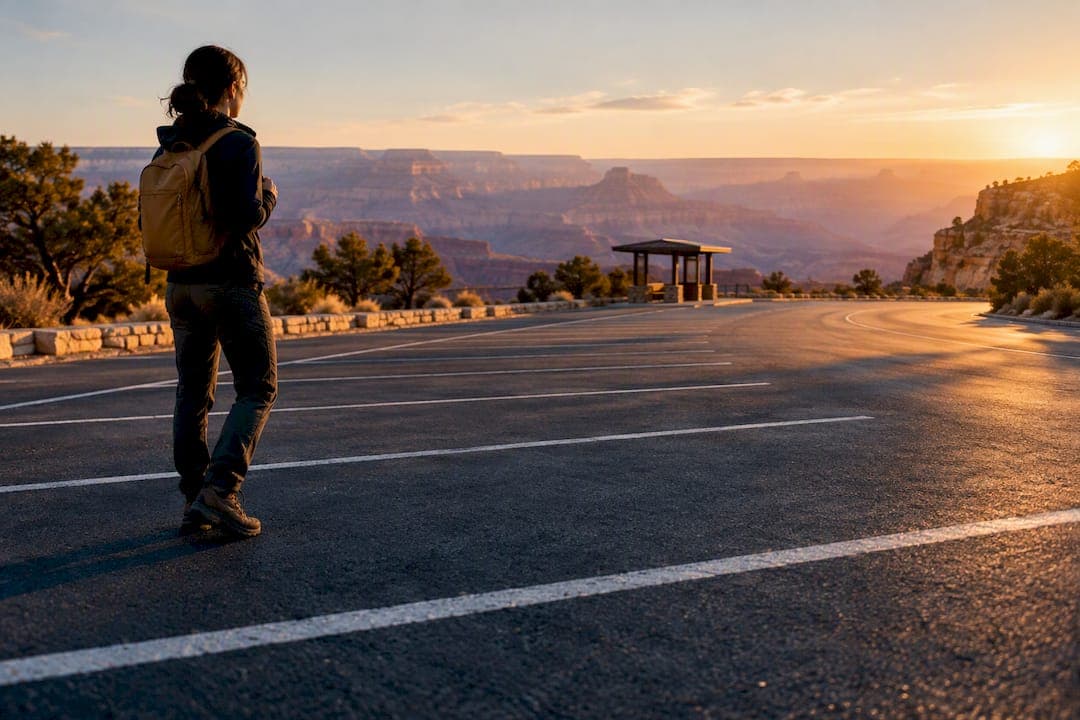
Your best bet for South Rim parking is the Visitor Center area (Lots 1 through 4), with Lot 1 reserved for RV pull-throughs and easy access to Mather Point. Market Plaza (Lots A and B) and Lot D work well as overflow. Arrive before 9:30 am on busy days, or skip the hunt entirely by using the Tusayan park-and-ride or booking a private tour with door-to-door pickup.
TL;DR:
- Arrive early before 9:30 am for the best chance of securing parking at the Visitor Center lots, especially Lot 1 and Lot B for RVs.
- RV spaces in Lot 1 typically fill by 10:00 am, while Market Plaza's Lot B fills early afternoon, making timing crucial for oversize vehicles.
- During peak season, parking outside the park at the Tusayan park-and-ride offers a reliable backup option, especially for RV owners or late arrivals.
- The park's shuttle system covers major areas, and some routes close to private vehicles from March to November, so plan to ride instead of drive on Hermit Road or South Kaibab Trail.
- Booking a private guided tour with door-to-door pickup can eliminate parking concerns altogether, ideal for visitors with limited time, RVs, or heavy gear.
Table of Contents
- South Rim lots: numbered (1 to 4) and lettered (A to D) parking explained
- RV, trailer and oversized-vehicle parking: official limits and real-world tactics
- Shuttles and park-and-ride: routes, shuttle-only roads, and when to ride instead of drive
- Timing: when lots fill and the best arrival windows to avoid circling
- Accessibility and permits: Scenic Drive Accessibility Permit and disability parking rules
- Rules, signage, and common mistakes (what not to do)
- Practical arrival plan: an ordered checklist for day visitors and RV owners
- Updates and changes to parking due to park maintenance or construction
- Safety tips and regulations for parking at night
- Alternative ways to get around besides the shuttle
- Operator perspective: when to self-drive and when to book a guided tour
- A door-to-door alternative to South Rim parking
- Sources
- FAQ
South Rim lots: numbered (1 to 4) and lettered (A to D) parking explained
Grand Canyon National Park organizes its main parking around two clusters. The Visitor Center lots are numbered 1 through 4, and Market Plaza and the Village area use lettered lots A through D. Knowing which one to aim for saves you a lot of circling.
- Lot 1 sits closest to Mather Point and includes pull-through spaces built for RVs and trailers.
- Lots 2 to 4 are for standard vehicles only, at increasing distance from the Visitor Center Plaza.
- Lot B, in the Market Plaza area, is the largest lot and also accepts RVs.
- Lot D serves the Hermit Road shuttle stop and sits near the Bright Angel Trailhead, making it a good pick for hikers.
Signage throughout the park uses lot letters and numbers along with symbols for services like restrooms and shuttle stops, so it helps to glance at a posted map before you wander off. A quick photo of your parking row on your phone beats trying to remember "somewhere past the pine trees" three hours later, especially in lots that stretch across several rows with no obvious landmarks.
RV, trailer and oversized-vehicle parking: official limits and real-world tactics
The park's RV guidance points oversize vehicles toward a short list of lots built to handle the turning radius and length of RVs and trailers. Squeezing a 30-foot rig into a compact space is not just inconvenient, it can get you asked to move.
- Lot 1 near the Visitor Center is the closest RV option and often fills first.
- Lot B in Market Plaza is the largest RV-capable lot and a solid backup.
- Lot D tends to have space later in the day than the other two.
RV spaces at Lot 1 commonly fill by 10:00 am and Market Plaza follows by early afternoon, so timing matters more for oversize vehicles than for cars. When every RV lot is full, the Tusayan park-and-ride outside the park entrance is the most reliable fallback, since it was built partly with oversize traffic in mind during peak season.
Pro Tip: Check park alerts the morning of your visit. RV lot status can change fast during holiday weekends and Grand Canyon's busiest summer stretches.
Shuttles and park-and-ride: routes, shuttle-only roads, and when to ride instead of drive
Once you're parked, the park's free shuttle system does the rest of the work. Three routes cover the South Rim's main areas.
- Blue (Village) Route loops through the Village, connecting lodges, Market Plaza, and the Visitor Center.
- Red (Hermit) Route runs along Hermit Road, which is closed to private vehicles from March 1 through November 30.
- Orange (Kaibab) Route links the Visitor Center to Yaki Point, Pipe Creek Overlook, and the South Kaibab Trailhead, which has no private vehicle access at all.
If your plan includes a South Kaibab hike, park at the Visitor Center and ride the Orange route instead of hunting for a spot that does not exist. During summer and busy weekends, the Tusayan (Purple) route offers a park-and-ride option from the gateway town into the Visitor Center, which is worth using if you would rather skip the entrance line and village congestion altogether, as detailed in our shuttle routes guide.
Timing: when lots fill and the best arrival windows to avoid circling
Timing is the single biggest factor in whether your South Rim visit starts smoothly or with 20 minutes of slow laps through a packed lot.
- Visitor Center lots (1 through 4) commonly reach capacity by 10:00 am on busy days.
- Market Plaza (Lots A and B) tends to fill somewhat later, often by midday.
- Lot D usually has the most breathing room into the early afternoon.
Visitors who arrive before 9:30 am tend to report the smoothest parking experience, since that window sits ahead of the late-morning surge. If you're arriving later, check the park's alerts page and entrance webcam before you leave your hotel. If lots are already tight, head straight for Tusayan park-and-ride, aim for quieter viewpoints along Desert View Drive, or plan your visit for a shoulder season month when crowds thin out.
Accessibility and permits: Scenic Drive Accessibility Permit and disability parking rules
Visitors with mobility needs can request a Scenic Drive Accessibility Permit at an entrance station or visitor center, which allows a vehicle onto certain roads that are otherwise closed to general traffic, including Hermit Road and Yaki Point Road. This permit does not replace a state-issued disability placard, which you still need to use a designated handicap parking space anywhere in the park. Shuttle buses include wheelchair-accessible features, though space and boarding logistics can vary by route and time of day, so it helps to ask at the Visitor Center about the best stop for your needs.
Rules, signage, and common mistakes (what not to do)
There are no paid parking lots anywhere inside Grand Canyon National Park. The entrance fee is a separate charge per vehicle and has nothing to do with where you park.
- Do not park across multiple spaces or block roadside shoulders where signs prohibit it.
- Keep RVs and trailers in designated oversize spaces rather than squeezing into standard spots.
- Do not assume a spot will be waiting late morning during peak season.
- Do not confuse a shuttle stop with a parking area. Many shuttle-only roads have no vehicle access at all.
- Read posted signage carefully. Lot layouts and access rules can change with construction or seasonal closures.
Practical arrival plan: an ordered checklist for day visitors and RV owners
A simple sequence removes most of the guesswork.
- Check the park's alerts page and entrance webcam the morning of your visit.
- Leave your hotel early enough to reach the Visitor Center before 9:30 am.
- Head for Lot 1 first if you want proximity to Mather Point, or Tusayan park-and-ride if you're arriving after mid-morning.
- Snap a photo of your row and lot letter or number.
- Use the shuttle for any road closed to private vehicles, especially Hermit Road or South Kaibab.
RV owners should route directly to Lot 1, then Lot B, then Lot D if the first two are full, and treat Tusayan park-and-ride as the backup once all three are at capacity. Trailers should be left hitched only in oversize spaces, never split across standard stalls.
Pro Tip: If juggling an RV, a trailer, or a tight schedule sounds like more stress than sightseeing, a private guided tour removes the parking question entirely, since someone else handles the driving and the logistics.
Updates and changes to parking due to park maintenance or construction
Grand Canyon National Park periodically adjusts lot access, shuttle stops, and road closures for maintenance work, utility upgrades, or seasonal projects. These changes are not always visible from outside the park, and a lot that was open last season might be partially closed or restriped this year. The most reliable way to catch a change before it disrupts your trip is to check the official parking page and the park's current alerts in the days before you travel, rather than relying on a map or blog post from a previous year.
Construction near the Village or Visitor Center can also shift shuttle stop locations temporarily, which matters if you're planning to park in one lot and ride to a trailhead. During any active project, signage at the lot entrance usually explains the detour or closure, but it helps to build in a few extra minutes on arrival day in case a lot you expected to use is partially blocked. If you're visiting in 2026 and have not checked conditions in the last month or two, a quick look at the park's website the night before is worth the two minutes it takes, especially if your plans depend on a specific lot like Lot 1 for RV access or Lot D for a trailhead start.
Safety tips and regulations for parking at night
Parking overnight in a day-use lot is not something to assume is fine without checking first. Some areas near the Backcountry Information Center, close to Lot D, do accommodate vehicles tied to overnight backcountry permits, but that arrangement should be confirmed directly rather than assumed, since it is not a blanket rule across every lot in the park.
If you're parked and walking back to your vehicle after dark, whether after a sunset viewpoint visit or a late dinner in the Village, stick to lit walkways and shuttle stops rather than cutting through unlit sections of a lot. Temperatures at the South Rim drop quickly after sunset even in summer, and wildlife including elk regularly move through parking areas at dawn and dusk, so a slow, attentive walk back to your car is safer than a distracted one. Lock your vehicle and keep food and scented items out of sight, since ravens and other animals are known to investigate unattended vehicles for anything that smells like a snack. If you're staying for a night tour, sunset viewing, or stargazing, confirm ahead of time whether the lot you plan to use has any posted closing time or overnight restriction, since policies can differ between the Village core and lots farther from the rim.

Alternative ways to get around besides the shuttle
Once you're parked, the shuttle is not your only option for covering ground. Many of the paved multi-use trails along the rim, including sections of the Rim Trail, are open to walking and, in some segments, biking, which makes a bike a practical way to move between viewpoints without waiting on a shuttle schedule. Rentals are available seasonally near the Village, and the flat, paved sections make for an easy ride between overlooks.

Walking remains the simplest option for short hops, particularly between Market Plaza, the Visitor Center, and Mather Point, all of which sit within a comfortable walking distance of each other. For longer stretches, especially toward Hermit Road overlooks or Desert View, biking or the shuttle will save considerably more time and energy than walking. If you'd rather explore Desert View Drive by private vehicle instead of relying on transit, our Desert View Drive guide covers that route as a quieter, flexible alternative to the Village core.
Operator perspective: when to self-drive and when to book a guided tour
Self-driving gives you total control over pace and stops, but it also means owning every parking decision, from lot timing to RV logistics. First-time visitors, families with young kids, and anyone hauling an RV often find that a private guided tour removes that entire layer of planning, trading a bit of flexibility for a day with no parking math at all.
— Chris
A door-to-door alternative to South Rim parking
If reading through lot numbers, RV rules, and arrival windows sounds like more work than you want on vacation, a private tour skips all of it. Selecting a private tour with door-to-door pickup can eliminate concerns about parking, shuttle schedules, and vehicle logistics.
- The Private Grand Canyon Day Tour covers the main South Rim viewpoints without you touching a parking lot.
- The Grand Canyon Hiking Tour is worth a look if you'd rather hike below the rim with a guide than manage a trailhead lot yourself.
- The Grand Canyon Sunset Tour handles the late-afternoon crowd and lighting logistics for you.
Every tour is private, with door-to-door pickup and a local guide handling the driving, so you can check availability and book directly instead of building your day around a parking plan.
FAQ
Where should you park when visiting the Grand Canyon South Rim?
Aim for Visitor Center Lots 1 through 4 first, since Lot 1 sits closest to Mather Point and handles RVs. Market Plaza's Lots A and B, plus Lot D near Bright Angel Trailhead, work well as backups once the Visitor Center lots fill.
What is the top predator in the Grand Canyon?
The mountain lion is generally considered the Grand Canyon's top predator, occupying the highest position in the local food chain. Sightings are rare since the animals are elusive and mostly nocturnal.
Why is most of the Grand Canyon closed to vehicle access?
Large sections of the park's rim roads, including Hermit Road for much of the year, are limited to shuttle buses or foot traffic to manage congestion and protect fragile areas near the rim. The Orange shuttle route offers the only motorized access to South Kaibab Trailhead, so a shuttle or a permitted vehicle is often the only way in.
How many people fall from the Grand Canyon each year?
Fall incidents at the Grand Canyon do occur, but specific annual figures are not consistently published in a way that supports a reliable count. Staying behind railings at overlooks and away from unstable rim edges remains the most straightforward way to reduce risk.
Is South Rim parking free?
Yes, there are no paid parking lots inside Grand Canyon National Park. The park entrance fee is a separate per-vehicle charge and does not include or reserve any parking space.