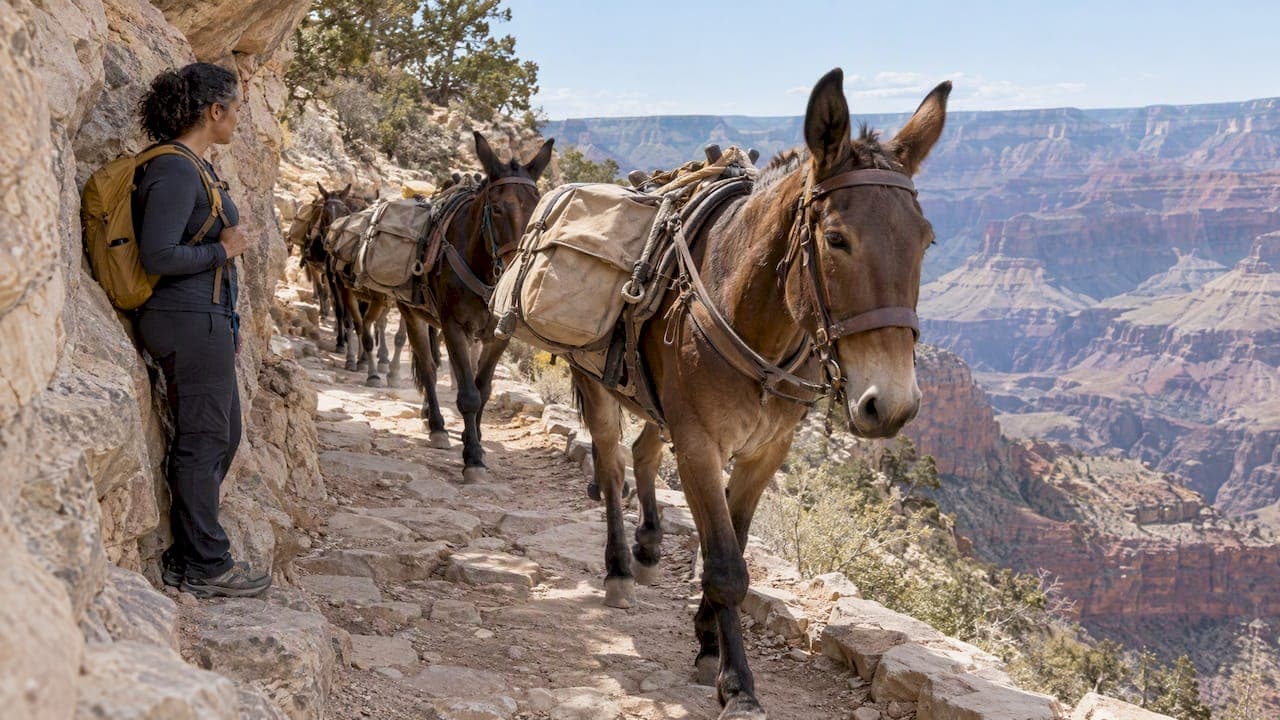
If a mule train comes toward you on the Bright Angel Trail, step off to the uphill side, away from the edge, stay quiet and still, and do what the wrangler tells you. Don't go back onto the trail until the last mule is 50 feet past you. That is the National Park Service's guidance, and it applies whether you are hiking down for an hour or climbing out after a long day. Below you'll find how the encounter plays out, why mules always get the right-of-way, when they are on the trail, and how to plan a hike so the meeting is a highlight and not a scare.
TL;DR
- Step to the uphill side of the trail, away from the drop-off, and wait quietly and still until the last mule is 50 feet (15 meters) beyond you.
- Commercial mule strings have the right-of-way. Hikers yield, every time.
- Expect mules on Bright Angel. The trail is steep, and the climb back out can take at least twice as long as the descent.
- Want to ride one? South Rim rides are booked through the park's concessioner, up to 15 months ahead, and fill early.
- Prefer to walk with a guide who handles the logistics? A private hike below the rim is the alternative.
Table of Contents
- Why you will meet mules on Bright Angel
- What to do when a mule train approaches
- When mules are on the trail
- Trail conditions that make mule encounters trickier
- Riding a mule on Bright Angel: how it works
- Our perspective: meeting mules is a gift, if you are ready for it
- Plan a Bright Angel day around the mules
- Walk Bright Angel with a private guide
- FAQ
- Sources
Why you will meet mules on Bright Angel
The Park Service says plainly that mules use Bright Angel Trail regularly, so hikers should expect to meet them. Two kinds of traffic share the path: guided mule trips for visitors, and working animals that carry supplies. Rangers use mules to haul food, equipment and other essentials to places vehicles can't reach.
The trail was built and maintained with stock in mind. The NPS describes it as well maintained and graded for stock, which is one reason it feels more forgiving underfoot than some other corridor trails. It is still steep. The same page calls it steep and difficult, and says the return climb may take at least twice as long as the way down.
The practical upshot: a mule encounter is not an accident or an inconvenience. It is part of hiking this trail. Knowing the routine in advance turns a nervous moment into one of the more memorable ones of the trip.
What to do when a mule train approaches
The steps below follow the NPS guidance for Bright Angel. Read them before you start down, not when you hear hooves.
- Stop and move to the uphill side. Choose the side of the trail against the canyon wall, away from the edge. Never stand on the outside of a switchback where a startled animal could crowd you toward the drop.
- Listen for the wrangler. The guide at the front or back of the string will tell you where to stand and when to move. Follow those directions over any general rule, including this one.
- Stay quiet and still. No sudden movements, no loud talking, no waving a trekking pole around. Mules are calm, experienced animals, but they react to unexpected motion.
- Wait for the last mule. Don't step back onto the trail until the final animal is 50 feet (15 meters) beyond you. Strings can be long, and the tail of the line is easy to misjudge.
- Resume at your own pace. Take a drink, check your footing on the churned dirt, and continue.
Small habits that help
Remove or lower anything flapping on your pack, such as a loose rain jacket tied at the waist. Put your camera away until you are asked to hold still, then take photos from where you stand, without stepping toward the animals. Keep children close and quiet, and keep a hand on their packs. If you hike with a trekking pole, plant it and keep it still.
Why you yield
The Park Service states that commercial mule strings have the right-of-way. Even private stock riders must pull off the trail and, if necessary, backtrack to a spot where they can do so safely. If riders on horseback have to give way, hikers certainly do. A string of loaded animals can't stop on a narrow ledge the way a person can.
When mules are on the trail
There is no fixed schedule that guarantees a mule-free walk, and you shouldn't plan around one. But the park publishes timing rules for private stock users that show how the corridor is managed. For Bright Angel, downhill stock travel is listed as after 9 a.m. in summer (April through October) and after 10 a.m. in winter (November through March). Uphill from Phantom Ranch, private stock either arrives by 10 a.m. in summer (10:30 a.m. in winter) and waits for the concessioner's strings, or leaves after 1 p.m. in summer (2 p.m. in winter).

Those rules are for private stock, not an official timetable for commercial rides, so treat them as context, not a promise. What they tell a hiker is that the busiest stock traffic overlaps with the mid-morning hours when many day hikers are also on the trail. If you want a quieter experience, an early start puts you ahead of most of it. If you want to see the animals, mid-morning is when a meeting is most likely.
Our own Bright Angel day hike guide covers routes, safety and timing in more detail, and the rest house guide shows you where to pause and regroup.
Trail conditions that make mule encounters trickier
Most uncomfortable mule moments are really trail-condition moments. A few facts from the NPS worth carrying with you:
- Surface and width. The path is maintained dirt, steep and well defined. Mule traffic churns it up, and loose dirt on a steep section is slippery.
- Ice. The upper trail may be extremely icy in winter or early spring, and the NPS highly recommends over-the-shoe traction devices. Stepping aside on ice is much harder than on dry dirt, so put traction on before the trailhead, not after the first slip.
- Heat and storms. The NPS lists summer heat and monsoon storms among the trail's hazards, and notes that water availability can be interrupted. Fill your bottles at the last working source and check current water status at the visitor center.
- Shade. The trail has some shade in the morning and afternoon, which helps, but midday sun is exposed.
If you want to compare Bright Angel with its neighbor before choosing, our South Kaibab vs Bright Angel comparison lays out the trade-offs.
Riding a mule on Bright Angel: how it works
Some visitors would rather be on the mule than beside it. The NPS says South Rim mule rides are offered year-round and sends visitors to the park concessioner for details and booking. Rides are run by the concessioner, not by us, so confirm current routes, prices and departure times on the official booking channel.
For the overnight option, the NPS describes a two-day round trip to the Colorado River, with overnight riders staying and eating at Phantom Ranch.
Booking and who can ride
The park's advice is to book early. South Rim rides may be reserved 15 months in advance and fill quickly, and Phantom Ranch reservations run through an online lottery. Don't count on a cancellation turning up. The same NPS page lists rider restrictions for South Rim trips:
| Requirement | NPS-listed limit |
|---|---|
| Minimum age | 9 |
| Minimum height | 57 inches (4 feet 9 inches) |
| Weight | Under 200 pounds, or 225 pounds fully dressed, depending on the trip |
| Language | Riders must understand English instructions |
| Minors | Must be accompanied by a parent or guardian |
Check the weight limit for the specific trip you want, since it differs between rides. If anyone in your party doesn't meet these limits, that is worth knowing a year ahead, not at the corral.
Riding versus hiking
A mule ride puts your weight on the animal's legs and your attention on the scenery. A hike gives you control of pace and stops, but the return climb is demanding. Riders see the same switchbacks and the same rock layers, such as Jacob's Ladder through the Redwall limestone. Walkers can linger at the rest houses and side viewpoints. Neither is better. They suit different groups, and plenty of visitors do one on one trip and the other on the next.
Our perspective: meeting mules is a gift, if you are ready for it
We guide hikes below the rim, and mule trains come up in almost every conversation about Bright Angel. Guests tend to worry in advance, and almost none regret the meeting afterward. The wranglers are professionals who deal with hikers daily, and the animals are steady. What causes trouble is hikers who haven't thought about it: someone stopping on the outer edge to take a photo, or a group spread across the trail while they argue about directions.

Our approach is to brief guests at the trailhead. We talk about where the uphill side will be on the sections ahead, and we keep the group compact so that everyone steps aside together. When a string approaches, our guide takes the lead in speaking with the wrangler, so guests don't have to decide anything in the moment. That is much of the value of a private guide. You don't just get a person who knows the trail, you get a person who handles the awkward moments for you.
Our tours are fully private, with door-to-door hotel or B&B pickup and park fees included. That means we can start at the time that suits your group and not a shared-bus schedule. If you'd like to see mules but not be caught in a crowd, tell us, and we plan the day with that in mind. If you'd rather avoid the busiest hours, we plan around that instead. The point is that the timing is yours to set.
— Chris
Plan a Bright Angel day around the mules
A few decisions shape how you experience the trail.
Pick your turnaround. The NPS notes the return climb can take at least twice as long as the descent. Choose your turnaround point by the time you have for the climb, not by how good you feel on the way down. The rest houses are natural markers.
Time your start. Starting early gets you ahead of much of the heat and crowd. Starting later increases the chance of seeing a string, but means more heat on the climb back.
Stay close to the trailhead. A South Rim stay makes early starts easy. Our comparison of Yavapai and Maswik lodges helps you choose, and if you are building a longer Southwest loop, Bryce Canyon lodge packages are one way to look at your next stop.
Pack for stopping, not just walking. You may spend several minutes standing still on a slope. Carry a layer, water and a snack you can reach without taking off your pack.
Beginners. If this is your first canyon hike, read our guide to guided hikes for beginners, which covers heat risk and pacing.
For wider trip planning, our Grand Canyon travel planner and hiking guide pull the logistics together. If you'd like to know what wildlife you might see besides mules, see our Grand Canyon wildlife guide.
Walk Bright Angel with a private guide
If you want the trail, the views and the mule encounter without managing every decision, our Grand Canyon Hiking Tour is a private guided hike below the rim, from $349 per person. It is 100% private, with no shared buses or strangers, and park fees are included. Our guides speak English and German. We pick you up at your hotel or B&B and tailor the pace to your group.
Prefer the rim to the inner canyon? The Private Grand Canyon Day Tour starts from $319 per person, and the Grand Canyon Sunset Tour from $349 per person. You can also look at all private Grand Canyon tours from Sedona, Flagstaff and Williams to see which departure point works for you.
FAQ
Can I ride a mule down the Bright Angel Trail?
Yes, through the park's concessioner. The NPS says South Rim mule rides run year-round and should be booked through the concessioner. Overnight rides go to Phantom Ranch and back over two days, and reservations can be made up to 15 months ahead.
What should I do if mules come toward me on the trail?
Move to the uphill side, away from the edge, and follow the wrangler's directions. Stay quiet and still, and wait until the last mule is 50 feet (15 meters) past you. Commercial mule strings have the right-of-way, so hikers always yield.
How difficult is the Bright Angel Trail?
The NPS calls it steep and difficult. The trail is well maintained and graded for stock, but the return climb may take at least twice as long as the descent. Summer heat, monsoon storms and winter ice are the main hazards, so plan your turnaround conservatively.
Who can ride a South Rim mule?
The NPS lists a minimum age of 9 and a minimum height of 57 inches (4 feet 9 inches). Weight must be under 200 pounds, or 225 pounds fully dressed, depending on the trip. Riders must understand English instructions, and minors must be accompanied by a parent or guardian.
Sources
- Bright Angel Trail, U.S. National Park Service
- Private Stock Use at Grand Canyon, National Park Service
- Mule Trips, Grand Canyon National Park
- Hiking Frequently Asked Questions, Grand Canyon National Park
- Day Hike: Bright Angel Trail, National Park Service