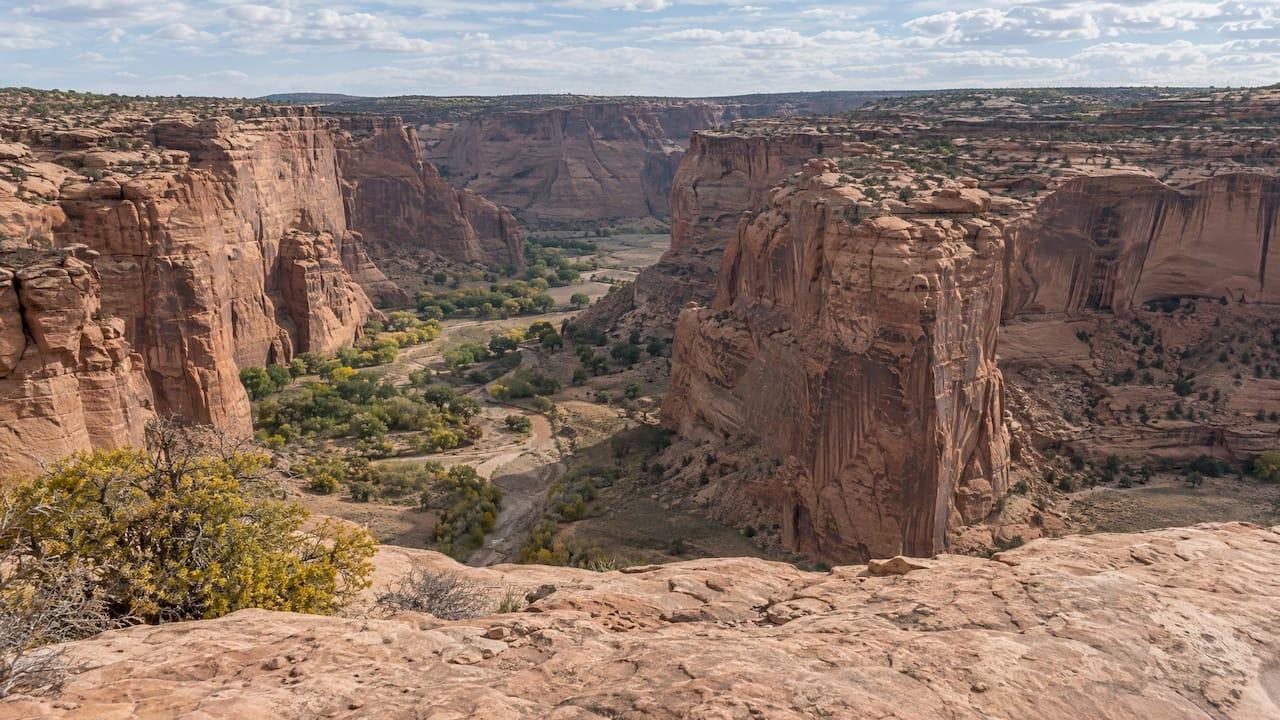
Canyon de Chelly (pronounced d'SHAY) is a national monument in northeastern Arizona where you can see the canyon for free from the rim, but you can only go down to the canyon floor with an authorized Navajo guide and a permit. Plan around that one rule and the rest of the trip falls into place. If you are building a wider Northern Arizona trip, we run private, Navajo-guided and Grand Canyon itineraries from Sedona, Flagstaff, Williams and Tusayan, and we explain below where they fit alongside a visit here.
TL;DR
- Two paved rim drives lead to 10 overlooks. They are free, open year-round, and need no guide or permit.
- Going into the canyon itself requires an authorized guide and a backcountry permit. The 2026 permit fee is $15 per person, paid in cash.
- The White House Trail is the only public trail you can hike on your own. It is about 2.5 miles round trip with roughly 600 feet of elevation change.
- Allow half a day for the overlooks or a canyon tour, and a full day if you want both.
- This is a lived-in landscape. Diné (Navajo) families farm and raise livestock on the canyon floor, so treat it as someone's home.
Table of Contents
- What Canyon de Chelly is
- Two ways to see it: the rim and the canyon floor
- The rim drives
- The White House Trail: the one hike you can do alone
- Going into the canyon: guides, permits and costs
- How long to allow
- Getting there, services and practical details
- Fitting Canyon de Chelly into a Northern Arizona trip
- Our perspective
- Plan the rest of your Arizona days with us
- FAQ
- Sources
What Canyon de Chelly is
The monument is managed in partnership by the National Park Service and the Navajo Nation, on Navajo Trust Land. According to the National Park Service, it preserves nearly 5,000 years of occupation, from Archaic people and Basketmakers through the Pueblo, Hopi and Navajo periods, including cliff dwellings and rock imagery.
The scale is easy to underestimate. The NPS foundation document notes that the red de Chelly sandstone walls rise up to 1,200 feet from the canyon wash, and that the canyon system holds one of the largest concentrations of pictographs and petroglyphs in North America.
The monument was authorized in 1931 and covers approximately 84,000 acres entirely within the Navajo Nation. According to the NPS history page, roughly 40 families live within its boundaries. That is the key difference from most national park sites: you are visiting a working community, not an empty preserve.
Two ways to see it: the rim and the canyon floor
Every visitor chooses between two experiences, and most people who have time do both.
| Rim drives and overlooks | Canyon floor tours | |
|---|---|---|
| Guide needed | No | Yes, an authorized Navajo guide |
| Permit | None | Backcountry permit |
| Cost | Free | Tour price plus permit |
| Time | 2 hours per rim | Roughly half a day |
| Best for | Views, photography, first look | Ruins up close, rock art, canyon life |
The rules behind that table come from the NPS frequently asked questions: canyon backcountry travel requires a permit and an authorized guide, and driving off-road on your own is not permitted.
The rim drives
The NPS basic information page describes two free, paved drives that reach 10 overlooks in total, all open year-round.
- North Rim Drive: three overlooks, about 2 hours, best for morning photos. Massacre Cave can be viewed from the Massacre Cave Overlook.
- South Rim Drive: seven overlooks, about 2 hours, best for afternoon photos.
That light advice is worth following. The red walls glow when the sun is low and flatten at midday, so a morning on the North Rim and an afternoon on the South Rim gives you the best of both. If you shoot, bring a longer lens: the ruins sit in alcoves far below the rim.
The White House Trail: the one hike you can do alone
The White House Overlook and Trail is the only public trail you can hike without a permit or a guide, according to the NPS. It is about 2.5 miles round trip, drops roughly 600 feet on switchbacks to the White House Ruin, and takes around 2 hours. Pets are not allowed on the trail per the NPS things to do page.

The NPS operating hours page calls it moderately strenuous, with vault toilets at the top and bottom, and recommends avoiding the hottest hours, 10 a.m. to 4 p.m. Start early, carry more water than you think you need, and remember that the climb back up is the hard part.
The trail's status has changed in recent years: it was listed as closed on an NPS page updated in April 2025 and is listed as open on a page updated in October 2026. Because the Navajo Nation may add staffed hours or seasonal fees in future, check the NPS page for the trail's status the week you travel.
Going into the canyon: guides, permits and costs
The canyon floor is where the ruins, petroglyphs and farms are, and the NPS is clear on how to get there. Private companies registered with the Navajo Parks and Recreation Department offer canyon tours by vehicle, horseback or on foot, and you contact them directly for prices and reservations. Reservations are recommended from March through October, according to the NPS tours page.
The same page gives the 2026 backcountry permit fee as $15 per person, paid in cash, plus a 6% Navajo Nation tax. The fee was $8 before 2026. Bring small bills.
A few things to know before you book:
- Pick the format first. Vehicle tours cover more ground, hiking tours get you onto sand and slickrock, and horseback tours suit riders. Ask each operator how long the tour runs and what the vehicle seats.
- Book ahead in season. Spring and fall fill first, and the NPS recommends reservations from March through October.
- Leave the pets at home. Pets are not allowed on canyon tours or in the Welcome Center.
- Expect no shortcuts. No drones, rock climbing, base jumping, or ash scattering are allowed, and there are no public areas for off-road vehicles, ATVs, UTVs or bicycles.
- Respect the homes. Families live and graze livestock down there. Our guide to Navajo Nation etiquette for visitors covers photography, asking permission, and how to behave around homesites.
The NPS also notes that entering the canyon is at your own risk. Check the forecast, carry plenty of drinking water and dress in layers. Emergency and cell service is limited in remote areas, so tell someone your plans.
How long to allow
The NPS suggests these timings:
- 2 hours: all 7 South Rim overlooks or all 3 North Rim overlooks.
- Half a day: all 10 overlooks, or one canyon tour.
- One day: all 10 overlooks plus a tour.
- Two days: an all-day tour plus the White House Trail, or Canyon de Chelly plus nearby sister parks.
For most travelers, one full day works if you start at the Welcome Center, take a morning tour, and spend the afternoon on the South Rim. Add a night if you want sunrise light and a slower pace.
Getting there, services and practical details
The NPS recommends driving to Chinle via Highway 191, then turning east on Indian Route 7. The park entrance and Welcome Center are about 3 miles from that junction. You can also come in from the east on Indian Route 64. The NPS advises against Indian Route 7 between Sawmill and the Spider Rock turnoff, because it is unpaved and unmaintained. Put the Welcome Center into your navigation rather than relying on a general map.
On the ground:
- Welcome Center: open daily 8 a.m. to 5 p.m., closed Thanksgiving, Christmas and New Year's Day.
- Entrance fee: none. Donations are appreciated at the Welcome Center.
- Chinle: 2 miles from the park, with a grocery store, gas stations, a bank, a post office and 3 motels, per the NPS plan your visit page.
- Camping: Cottonwood Campground, managed by the Navajo Nation, has 93 first-come, first-served sites with no showers or hookups.
- Time zone: the Navajo Nation observes daylight saving time from March to November, unlike the rest of Arizona. Check your tour start time against the right clock.
Ranger-led activities, including hikes, are generally offered from Memorial Day through Labor Day.
Fitting Canyon de Chelly into a Northern Arizona trip
Canyon de Chelly sits well off the usual Grand Canyon circuit, and the best trips treat it as its own destination rather than a stop squeezed between two others. Most visitors from the US, Canada and Europe pair it with other Four Corners sights such as Monument Valley, Hubbell Trading Post, Navajo National Monument and Petrified Forest, all named by the NPS as nearby.

If your itinerary also includes the Grand Canyon, Sedona or Page, that part is easy to make seamless. Our private tours include door-to-door pickup, an expert local guide, and all park fees and dining. Our guides speak English and German.
Here is how our Northern Arizona tours line up with the interests that bring people to Canyon de Chelly:
| If you came for | Consider | Starting price |
|---|---|---|
| Ancient cultures and ruins | Grand Canyon & Ancient Ruins | from $339 per person |
| Slot canyons and Navajo-guided landscapes | Antelope Canyon & Horseshoe Bend | from $419 per person |
| The great canyon itself | Private Grand Canyon Day Tour | from $319 per person |
| Hiking below the rim | Grand Canyon Hiking Tour | from $349 per person |
| Golden-hour light | Grand Canyon Sunset Tour | from $349 per person |
If the Navajo-guided side of Arizona is what draws you, our overview of Navajo-guided slot canyon tours explains how those visits work, and our Navajo Nation page gives the wider context.
Our perspective
Canyon de Chelly rewards travelers who slow down. The rim gives you the view, but the meaning of the place is in the people who still live there and the thousands of years written on the walls. A knowledgeable local guide turns that from scenery into a story.
That is how we think about every itinerary we run. A private tour means no shared bus, no strangers and no schedule built around someone else. It means your guide can linger where you are fascinated, skip what you are not, and pick you up at your hotel or B&B so the drive is part of the day rather than the work of it.
For couples, families and small groups who value that kind of unhurried, all-inclusive day, we think the private format is the best way to see Northern Arizona. Our own guests agree: we hold 679+ five-star reviews, and in 2025 we were named a Top 10 North America tour operator in the Arival TourReview Spotlight Awards, which is based on aggregated guest review data.
If you are combining Canyon de Chelly with the Grand Canyon, Sedona or Antelope Canyon, build the Arizona days around how much you want to see and how much you want to enjoy. Do fewer places, properly.
Chris
Plan the rest of your Arizona days with us
For the Grand Canyon portion of your trip, our Private Grand Canyon Day Tour starts from $319 per person. It is a private, door-to-door day with an expert guide, and park fees and dining are included. If ruins are your draw, Grand Canyon & Ancient Ruins starts from $339 per person.
Want help sequencing your days? Our Grand Canyon travel planner is a good place to start, and you can see every itinerary on our tours page.
FAQ
Do I need a guide to visit Canyon de Chelly?
Only for the canyon floor. You can drive both rim drives, visit the overlooks and the Welcome Center, and hike the White House Trail without a guide. Entering the canyon backcountry requires an authorized guide and a backcountry permit.
How much does it cost to visit Canyon de Chelly?
There is no entrance fee, and the rim drives are free. Canyon tours are priced by the operator, and the 2026 backcountry permit is $15 per person, paid in cash, plus 6% Navajo Nation tax. Cottonwood Campground also charges a fee.
How long do I need?
Half a day covers either all 10 overlooks or one canyon tour. A full day covers both, and the NPS suggests two days if you want an all-day tour plus the White House Trail or the neighboring parks.
Can I fly a drone or bring my dog?
No drones are allowed. Pets on a leash are welcome at the overlooks and campground, but not in the Welcome Center or on canyon tours.
What is the best time to visit?
The rim drives are open all year, with morning light best on the North Rim and afternoon light on the South Rim. Tour reservations are recommended from March through October, and ranger-led activities are generally offered from Memorial Day to Labor Day.
Sources
- Arizona: Canyon de Chelly National Monument, National Park Service
- Canyon de Chelly Foundation Document Overview
- History & Culture, Canyon de Chelly National Monument
- Basic Information, Canyon de Chelly National Monument
- Frequently Asked Questions, Canyon de Chelly National Monument
- Things To Do, Canyon de Chelly National Monument
- Operating Hours & Seasons, Canyon de Chelly National Monument
- Tours of the Canyon, Canyon de Chelly National Monument
- Plan Your Visit, Canyon de Chelly National Monument