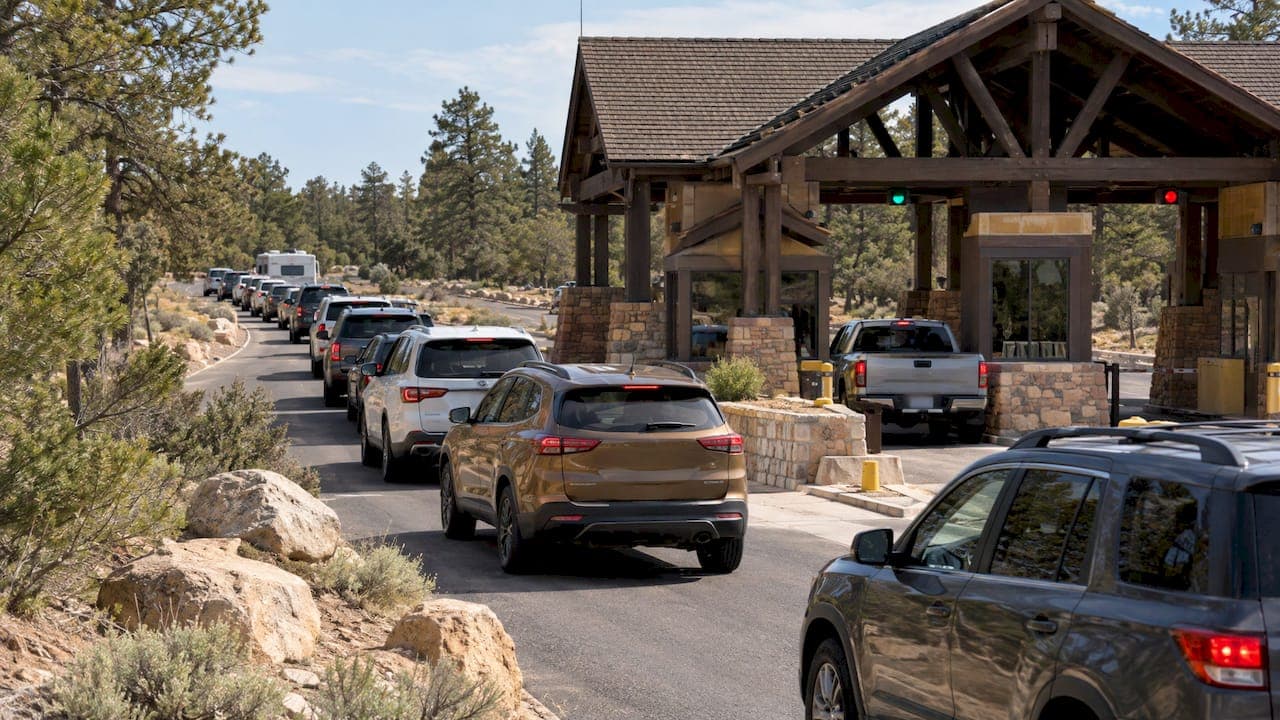
The best time to arrive at the Grand Canyon South Rim is before 9:30 a.m. or after 4 p.m. The park never closes, so you can enter at any hour, but the middle of the day is when entrance lines grow. This guide covers when the park opens, how long the waits get, and how to plan your first hours at the rim.
TL;DR
- The South Rim is open 24 hours a day, 365 days a year, and every visitor needs an entrance pass. There is no timed-entry system.
- In spring break and summer, aim to reach the South Entrance Station before 9:30 a.m. or after 4 p.m.
- Between 9:30 a.m. and 4 p.m. in peak season, waits at the South Entrance can reach up to two hours.
- Weekdays are generally calmer than weekends, especially from Memorial Day through Labor Day.
- A private, door-to-door tour takes the entrance line, parking and timing decisions off your plate.
Table of Contents
- Does the Grand Canyon actually open and close?
- The short answer: when to arrive by season
- How long is the wait to get in?
- Which days and weeks are busiest
- Know your entrance before you set out
- What is open when you arrive
- A simple arrival plan that works
- Parking: the second queue
- Our perspective
- Let us handle the timing
- Matching your arrival to your trip style
- If you are staying overnight
- Mistakes that cost travelers an hour or more
- FAQ
- Sources
Does the Grand Canyon actually open and close?
Not at the South Rim. According to the National Park Service, the South Rim is open 24 hours a day, 365 days a year, and all visitors must have an entrance pass. Most South Rim services run year-round, though some facilities close in winter, and reservations for lodging and dining are strongly recommended in spring, summer and fall.
That is why you see conflicting answers online. When a page says the park is open 9 a.m. to 4 p.m., it is usually describing a visitor center or a specific service, not the gate. Staffed entrance stations, the visitor center, shops and restaurants each keep their own hours. The canyon itself, and the rim trail, are there whenever you are.
Two more facts take pressure off your planning:
- Reservations are not required to enter the park, and there is no timed-entry system. You will not lose a slot by running late.
- Your entrance pass is valid for one to seven days and covers both the South and North Rim when the North Rim is open.
So the question is not really when the park opens. It is when you want to meet the crowds, and when you want to avoid them.
The short answer: when to arrive by season
NPS guidance varies slightly from page to page, but the pattern is consistent: early morning and late afternoon are easy, midday is not. Here is how the official numbers line up.
| Situation | Arrival window to aim for | Source basis |
|---|---|---|
| Spring break and summer | Before 9:30 a.m. or after 4 p.m. | South Entrance Station page |
| High visitation in general | Before 10 a.m. or after 2 p.m. | NPS Fees & Passes page |
| Spring break (2023 advisory) | Before 9 a.m. or after 5 p.m. | NPS spring break tips |
If you want one rule of thumb, use the strictest: be at the gate by 9 a.m. in peak season. It satisfies every version of the guidance, and it gives you a cushion for a slow drive, a coffee stop or a missed turn.
In quieter months, such as winter outside holiday weeks, the midday squeeze eases. Even so, an early start gives you softer light on the canyon walls and an easier time finding a parking space.
How long is the wait to get in?
In spring break and summer, lines at the South Entrance Station can stretch to two hours between 9:30 a.m. and 4 p.m. NPS described a similar pattern in a spring break advisory, noting that entrance traffic regularly backed up with waits of one to two hours between 10 a.m. and 4 p.m., and parking lots began filling around noon.

That second detail matters as much as the line. Getting through the gate at 11 a.m. does not mean you are done waiting. If the lots near the visitor center are full by noon, you may circle for a space or park far from the rim and rely on shuttles.
A two-hour wait is the worst case, not the average. On a calm weekday in the shoulder season you may drive straight through. But a trip built around the canyon should not depend on luck. If you have a single day, losing two hours at the gate is losing a quarter of your sightseeing time.
One practical tool: NPS advises checking the South Entrance Station webcam when timing your arrival. If you are staying nearby, a quick look in the morning tells you whether to leave now or have breakfast first.
Which days and weeks are busiest
NPS identifies the busiest visitation periods as spring break (March and April), Memorial Day through Labor Day, late May through early September, and major holiday weeks. It also says weekdays are generally preferable because weekends can be busier, especially from Memorial Day through Labor Day.
So a Tuesday in June is better than a Saturday in June, and a Saturday in October is usually better than either. If your dates are flexible, think about how you shape the whole trip. Reading up on booking a weekend stay and comparing weekday deals is a reasonable first step when you are trying to shift your canyon day away from the weekend crowd, since lodging is often cheaper midweek too.
A few combinations to avoid if you can:
- Memorial Day weekend, with the entry line at its worst.
- The first days of spring break, when families arrive together.
- Holiday weeks, when lodging fills and day visitors add to the load.
Know your entrance before you set out
NPS lists three park entry points: the South Entrance near Tusayan, the East Entrance at Desert View, and the North Rim entrance. Most South Rim visitors use the South Entrance Station, which sits 1.6 miles north of Tusayan and 4.9 miles south of the Grand Canyon Visitor Center.
That has a few consequences for your plan:
- Staying in Tusayan is the shortest path. You are about 1.6 miles from the gate, so you can time your departure to the webcam and the clock.
- Coming from Williams, Flagstaff or Sedona means a longer drive first. Build in that drive when you choose your target time. Hitting the gate at 9 a.m. may mean leaving your hotel well before breakfast.
- The East Entrance at Desert View is an alternative if you are coming along the eastern side, and it works well when you want to see the canyon from the east and work your way west.
- The North Rim is a different trip. Driving between the South and North Rim takes at least five hours, so do not plan to combine them in one day.
If you are choosing where to base yourself, our guides to Grand Canyon tours from Tusayan and tours from Sedona explain how pickup works from each starting point.
What is open when you arrive
The gate is one thing, the services are another. For fall 2026, NPS lists the Grand Canyon Visitor Center as open daily from 9 a.m. to 4 p.m. after a mid-October change from an 8 a.m. opening. Hours shift by season, so treat any single number as a snapshot.
NPS also keeps a current conditions page that points to the latest South Rim hours for visitor centers, restaurants, shops and other services. Check it the day before you go. It is the one page that will tell you if a facility has closed or a road has changed.
A useful way to think about it: if you arrive at 6 a.m., you will have the canyon, the trail and the quiet to yourself, but you may be eating a packed breakfast and waiting for a counter to open. If you arrive at 9 a.m., the services are awake and the crowds are only starting. If you arrive after 4 p.m., the visitor center is closing, but the lines are thin and the late light is some of the best of the day.
A simple arrival plan that works
Here is the sequence we would suggest for a peak-season day on the South Rim.
- The evening before: Check the NPS conditions page, fill the gas tank, and pack water, snacks and layers. The rim is high and mornings can be cold even in summer.
- Wake early: Leave early enough to reach the South Entrance Station by about 8:30 to 9 a.m. Look at the webcam before you go.
- Park once: Choose a lot near the visitor center and leave the car. The rim trail and the shuttle network cover most of what you want. Our shuttle routes guide shows how the lines connect.
- Start at the rim, not the building: Walk to your first viewpoint while the light is soft. Come back to the visitor center later for maps and ranger programs.
- Plan the middle of the day indoors or on a trail: Lunch, museums, a shaded section of the Rim Trail. Avoid driving back through the gate at its busiest.
- Stay for the late light: The hours after 4 p.m. are when the line thins and the canyon colors deepen.
For a full schedule built around this approach, see our one-day South Rim itinerary or the half-day plan if you are short on time. If you are staying longer, the South Rim itinerary spreads the sights across several days.
Parking: the second queue
The entrance line gets the headlines, but parking is where many day visitors lose their morning. Lots near the visitor center fill by around noon in busy periods, according to NPS. If you arrive early, you will park close. If you arrive at midday, you may be doing laps.
Two ways to deal with it. Arrive before the lots fill, or arrive without a car to park. Our South Rim parking playbook walks through both options in more detail, including how door-to-door transportation changes the equation.
Our perspective
Most arrival advice treats the gate as the problem. In our experience guiding guests on the South Rim, the real issue is that a day at the canyon is short, and every hour spent in a line or a parking lot is an hour you are not seeing it.
That is why we run every tour as a fully private experience. There are no shared buses and no strangers, and your guide plans the day around the conditions: when the line is building, when the light is best, where the quiet stretches of rim are. Pickup is door-to-door from your hotel or B&B, and park fees are included, so the logistics are handled before you reach the entrance.
For many of our guests, the arrival question disappears. They are not choosing between 9 a.m. and 9:30 a.m. They are choosing what they want to see, and the schedule is built around that. If you would rather spend your trip at the rim than behind the wheel, that is what a private tour is for.
Chris
Let us handle the timing
If you would rather not watch the webcam or plan around the lines, our Private Grand Canyon Day Tour is available from 319 USD per person. It is a private, guided day with door-to-door pickup, luxury vehicle transportation, park fees and dining included, led by an expert local guide in English or German.
We also run a Grand Canyon Sunset Tour from 349 USD per person for travelers who want the late-afternoon window that NPS suggests for avoiding crowds, and a guided hiking tour below the rim from 349 USD per person. You can see every option on our private Grand Canyon tours page or browse our full tour list.
Matching your arrival to your trip style
The right arrival time depends on what you want from the day. A few common cases:
Photographers and early risers. Arrive in the dark and watch the canyon appear. The park is open, so you can be at the rim before the first staffed counters open. Bring layers and a headlamp.

Families with young children. A 9 a.m. target is realistic if you are staying in Tusayan, less so if you are driving in from Flagstaff or Williams. Consider the afternoon window instead, when lines ease and children have had a rest.
First-timers with one day. Be at the rim by 9 a.m., walk a section of the Rim Trail, eat lunch away from the busiest cafe lines, and stay until late light. If you are visiting from Sedona, a private tour removes the drive and the entrance question in one step.
Hikers. Trails below the rim are best started early, especially in summer. Our Grand Canyon Hiking Guide covers the practical side, and the guided hike tour handles the logistics.
Travelers comparing rims. The South Rim is the most accessible and the most visited. If you are weighing alternatives, our South Rim vs West Rim comparison explains the trade-offs, and the Grand Canyon Travel Planner helps with the wider trip.
If you are staying overnight
The easiest way to beat the entrance line is to sleep close to it. Lodging inside the park and in Tusayan puts you minutes from the gate, and NPS notes that reservations are strongly recommended in spring, summer and fall. If you are choosing between in-park lodges, our Yavapai vs Maswik comparison is a good starting point.
If you cannot stay close, the trade-off is time. A drive from a gateway town can eat the early window you were hoping for, and that is where a pickup at your hotel door makes the biggest difference.
Mistakes that cost travelers an hour or more
- Assuming the park has a 9 to 4 schedule. The park is open around the clock. Only certain facilities keep those hours.
- Arriving at 10:30 a.m. in July. This is the heart of the two-hour window.
- Skipping the conditions page. Hours and closures change by season.
- Driving between viewpoints. Parking again and again is slower than parking once and using the shuttle or trail.
- Forgetting the pass. Every visitor needs one, and it is valid for one to seven days depending on the type.
FAQ
What time should you get to the Grand Canyon?
In spring break and summer, reach the South Entrance Station before 9:30 a.m. or after 4 p.m. to avoid the longest lines. NPS also recommends before 10 a.m. or after 2 p.m. during high visitation. Aiming for 9 a.m. fits both.
How early can you arrive at the Grand Canyon?
As early as you like. The South Rim is open 24 hours a day, every day of the year. Some facilities close in winter and most counters open later in the morning, so bring what you need for breakfast and warmth.
What is the wait time to get into the Grand Canyon?
In spring break and summer, the wait at the South Entrance Station can reach up to two hours between 9:30 a.m. and 4 p.m. Outside peak periods, and at the edges of the day, the wait is much shorter. Check the entrance webcam before you leave.
Do you need a reservation to enter the Grand Canyon?
No. NPS says reservations are not required to enter the park and there is no timed-entry system. You do need an entrance pass, which is valid for one to seven days. Lodging, dining and some activities do need reservations in busy seasons.
Is a private tour worth it for avoiding the lines?
A private tour does not change the park's rules, but it does change your day. Your guide handles the drive, the entrance and the timing, and you do not need to find parking. Park fees are included in our tours.
Sources
- Operating Hours & Seasons, Grand Canyon National Park (NPS)
- Grand Canyon South Entrance Station (NPS)
- Fees & Passes, Grand Canyon National Park (NPS)
- Spring break tips announcement (NPS)
- Permits & Reservations, Grand Canyon National Park (NPS)
- Visitor Centers, Information Desks, and Museums (NPS)
- Alerts & Conditions, Grand Canyon National Park (NPS)