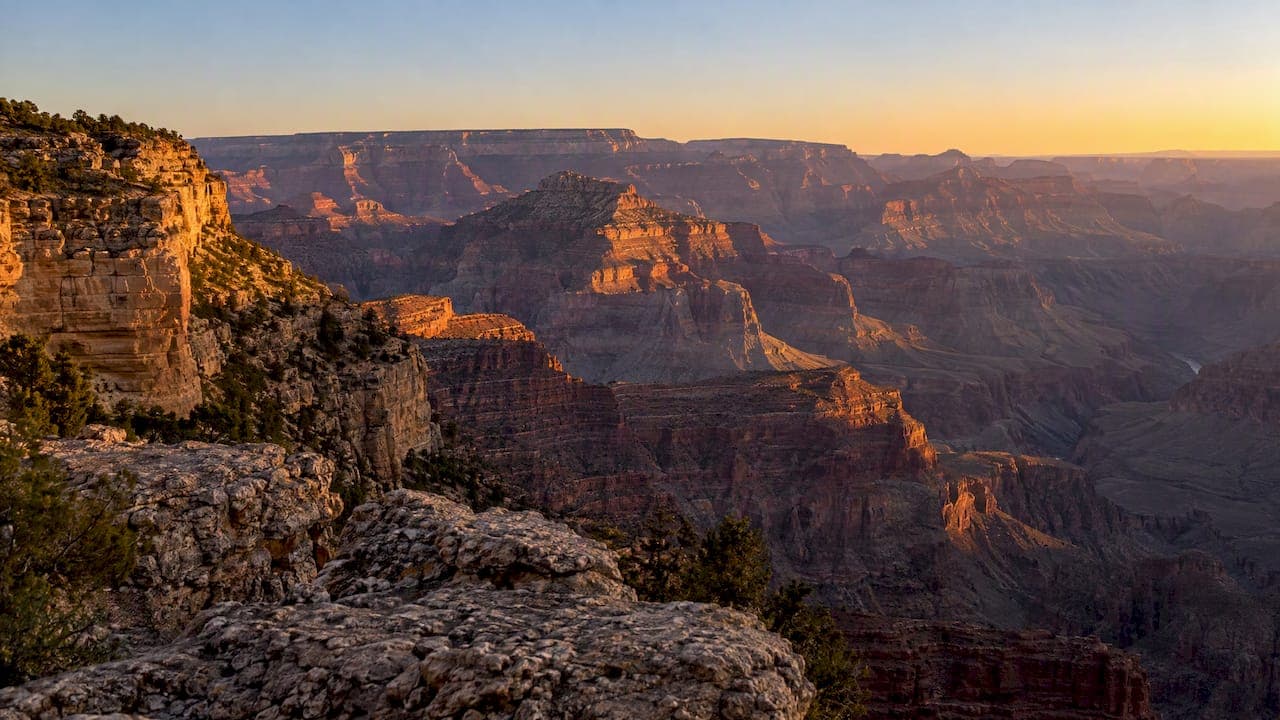
Golden hour at the Grand Canyon is the stretch just after sunrise and just before sunset, when low sun turns the rim walls amber, copper and rose and the shadows give the canyon its depth. The National Park Service describes it as the time shortly after sunrise or before sunset, when the light is soft and warm. The best evening window starts roughly 90 minutes before sunset. The best morning window starts about 30 minutes before sunrise. Below you will find how that shifts by season, where to stand, and how to avoid the mistakes that cost people the shot.
TL;DR
- Golden hour happens twice a day at the Grand Canyon. Sunset is easier for most visitors, sunrise is quieter.
- The NPS suggests arriving up to 90 minutes before sunset and staying at least 10 minutes after. For sunrise, arrive 30 minutes before and stay an hour.
- Hopi Point is the park's classic sunset overlook. Mohave and Pima Points are less congested. Yaki Point and Mather Point suit sunrise.
- Sunset ranges from about 5:14 pm in December to 7:46 pm in June, and the park stays on Mountain Standard Time all year.
- Stay six feet from the rim, and leave the rim at the first thunder or lightning.
Table of Contents
- What golden hour means at the Grand Canyon
- Golden hour times by season
- How early to arrive, and how long to stay
- Where to watch golden hour on the South Rim
- Photography tips for the golden hour
- Safety at the rim in the evening
- Our perspective: golden hour is a logistics problem
- Make it effortless with a private sunset tour
- FAQ
- Sources
What golden hour means at the Grand Canyon
Photographers often define golden hour as the window when the sun sits between about 6° above and 4° below the horizon, according to a sunrise almanac. In practice you do not need a calculator. You need to be at the rim while the light is low, and a little early, because the canyon rarely follows the textbook.
The reason is the terrain. Ridges, buttes and the canyon walls themselves can delay the sun's arrival or cause it to vanish earlier than a flat-horizon calculation says, a point made in one monthly guide to the South Rim. At the Grand Canyon the interesting light is not only the sun on your face. It is the sun raking across temples and buttes below the rim, so the show often peaks when the sun is already low or just gone.
That is also why midday is the weakest time to shoot. The NPS advises against photographing at high noon, because direct overhead sun creates harsh light and flat, unflattering shadows.
Golden hour times by season
The Grand Canyon National Park stays on Mountain Standard Time year-round. Arizona does not observe daylight saving time, so the clock in the park does not jump in spring or fall. That matters if you are driving in from a state that does, or arriving from Europe and juggling time zones.
Across the year, sunrise at the Grand Canyon runs from about 5:11 am in June to 7:38 am in January. Sunset runs from roughly 5:14 pm in December to 7:46 pm in June. Use those as the outer edges, then check the park's own table for your exact date.
| Season | What to expect | Planning note |
|---|---|---|
| Winter (Dec–Feb) | Earliest sunsets, latest sunrises, shortest golden windows | Sunrise is civilized, sunset comes before dinner. Dress for cold and ice on paths. |
| Spring (Mar–May) | Moderate times, changeable skies | Clouds can add drama to sunset. Wind is common. |
| Summer (Jun–Aug) | Earliest sunrise, latest sunset, longest golden windows | Monsoon storms build in the afternoon. Watch the sky. |
| Fall (Sep–Nov) | Times drift earlier each week | Often clear and comfortable, a favorite season for both sunrise and sunset. |
Golden-hour windows tend to run longer in midsummer, when the sun's path is shallow, and shorter in winter. For the park's official table, use the NPS sunrise and sunset page. If you are deciding which month to come at all, our best time to visit the Grand Canyon guide and the Grand Canyon weather guide cover temperatures, crowds and storms.
How early to arrive, and how long to stay
The NPS gives a clear rule of thumb: arrive 30 minutes before sunrise and stay an hour or longer after. For sunset, arrive up to 90 minutes before and stay at least 10 minutes after the sun drops.

The 90 minutes is not padding. You need time to park or ride the shuttle, walk to the overlook, find a spot with a clear view, and watch the color change as the sun lowers. The stay-late advice matters just as much. The NPS notes the sky can keep glowing red, pink or orange after the sun has set, and that afterglow is often the softest, most even light of the evening.
A practical sunset timeline for a fall evening:
- 90 minutes before sunset: reach the viewpoint, claim a spot, and take wide frames while the canyon is still bright.
- 60 to 30 minutes before: the light warms and the walls begin to separate into layers. This is the heart of golden hour.
- Sunset: switch to details, silhouettes and the sky.
- 10 to 20 minutes after: the afterglow. Do not pack up.
- Then: bring a flashlight or headlamp for the walk back. Rim paths get dark quickly.
Where to watch golden hour on the South Rim
The NPS names its own favorites. For sunset, it recommends Hopi Point. If you want somewhat fewer people, it points to Mohave and Pima Points. Along Desert View Drive, it lists Yaki, Navajo and Desert View. For sunrise, it suggests Mather or Yaki.
Hopi Point for sunset
Hopi Point projects far into the canyon, which gives a wide sweep of temples and buttes. The NPS notes it is one of the most popular viewpoints on Hermit Road for sunset, and its restroom is the only one on Hermit Road between Grand Canyon Village and Hermits Rest. Expect a crowd on clear evenings. Arrive early and be willing to walk a little along the rim for a clearer frame.
Mohave and Pima Points for fewer people
Further west along Hermit Road, Mohave and Pima Points offer a calmer evening. If Hopi Point looks packed, this is the move. You trade a little convenience for elbow room.
Yaki Point and Mather Point for sunrise
The NPS calls Yaki Point a prime spot for dawn. Mather Point is the other sunrise recommendation and is easy to reach from the main visitor area. For a true sunrise over a distant horizon, the NPS says Point Imperial is the highest viewpoint at Grand Canyon. It sits on the North Rim, which has a different season and different access, so check conditions before planning around it.
For a longer list with shuttle access, see our guide to South Rim viewpoints for sunrise and sunset and our notes on Grand Canyon sunset spots.
Getting there: Hermit Road access
This is the detail that catches people out. Between March 1 and November 30, Hermit Road can only be reached by the free Hermits Rest (Red) Route shuttle, on foot, by bicycle or by commercial tour. You cannot simply drive your own car out to Hopi Point in those months. Shuttle schedules and seasonal road changes shift through the year, so confirm the current routes with the park before you build a sunset plan around them. One guide to dawn photography also stresses that shuttle routes and seasonal closures can shape your plan, which is why checking current NPS conditions is worth five minutes.
Photography tips for the golden hour
Good golden-hour photos at the Grand Canyon come from patience more than gear. A few habits make the biggest difference:
- Shoot the light, not just the view. Turn around. The warm light on the opposite rim, or on a side canyon, often beats the sun itself.
- Frame for layers. Low sun creates shadow between rock layers, so include foreground ridges and distant walls together.
- Use a tripod only where it is safe and does not block others. Overlooks fill up fast at sunset.
- Bracket exposures. The sky is far brighter than the canyon after the sun drops. Take several exposures or use your phone's HDR mode.
- Keep shooting after sunset. The afterglow is a separate scene.
Our Grand Canyon photography guide and the photographer's roadmap to photo spots go deeper on access and framing.
Safety at the rim in the evening
Golden hour pulls people to the edge, and that is where accidents happen. The NPS asks visitors to stay at least six feet from the rim and 25 yards from large animals, to leave the rim if lightning or thunder occurs, and not to block traffic while taking pictures. Elk are common near the village in the evening, so keep your distance even when the animal is calm.

Summer needs one more note. During monsoon season, photographers face a greater lightning risk, because cameras and tripods are conductive. If you hear thunder, leave the rim and shelter in a building or vehicle rather than waiting for the clouds to improve. In July and August, a spectacular storm sky and a dangerous one can be the same sky. If you are visiting in the heat of the year, our summer safety guide explains why to avoid the hours between 10 a.m. and 4 p.m.
Our perspective: golden hour is a logistics problem
Most visitors who miss golden hour do not miss it because of weather. They miss it because of the day around it. They spend the afternoon in a queue, reach the rim with ten minutes to spare, and then fight a crowd for one bad angle.
We run private tours for a living, and the pattern is consistent. The best evenings are the ones where the timing was worked out backward from sunset: where you will stand, how you will get there, how long the walk is, and what you will do while the light changes. That is the difference between a snapshot and a memory. Because our tours are fully private, we can set the pace around the light rather than around a group schedule, and we can let you stay for the afterglow without anyone checking a watch.
If you are staying in Sedona, Flagstaff or Williams, build the day so the canyon is the last thing you see, not the first. Arrive early, eat before dusk, and leave the rim after the colors fade, not before. And if you are deciding between sunrise and sunset, choose sunset for a relaxed trip, and sunrise if you want empty overlooks and do not mind a very early start.
— Chris
Make it effortless with a private sunset tour
If you would rather not manage shuttles, parking and timing yourself, our Grand Canyon Sunset Tour is a private tour built around exactly this window, from 349 USD per person. Our tours are 100% private, with door-to-door hotel or B&B pickup, expert local guides, and park fees and dining included. You can see how this works from Sedona, and our Grand Canyon Travel Planner helps you fit it into a longer trip.
If you want a full day at the canyon with sunset as the finale, the Private Grand Canyon Day Tour starts from 319 USD per person. For more ideas on planning the evening, read our Grand Canyon sunset itinerary.
FAQ
Where can I see the best sunset in the Grand Canyon?
The NPS recommends Hopi Point for sunset, and Mohave and Pima Points if you want less congestion. Along Desert View Drive, Yaki, Navajo and Desert View are also recommended. Arrive well before sunset in any case, since good spots fill early.
What is the golden hour after sunrise?
It is the period shortly after the sun clears the horizon, when light is soft and warm. At the Grand Canyon, the NPS suggests arriving 30 minutes before sunrise and staying at least an hour after it. Mather Point and Yaki Point are recommended for sunrise.
How long should I stay after the sun sets?
Stay at least 10 minutes after sunset. The NPS notes the sky may keep glowing in red, pink or orange after the sun is below the horizon, so the afterglow is part of the show. Carry a light for the walk back.
Does the Grand Canyon change time zones in summer?
No. Grand Canyon National Park stays on Mountain Standard Time year-round, according to the NPS. Check your sunset time against that clock, not a neighboring state's.
Sources
- Grand Canyon National Park: Photography (NPS)
- Sunrise/Sunset Times and Moon Phases, Grand Canyon (NPS)
- Grand Canyon Photography (NPS)
- Hopi Point Bus Stop, Hermits Rest (Red) Route (NPS)
- Sunrise and sunset times in Grand Canyon, Arizona
- Golden Hour at Grand Canyon South Rim
- Grand Canyon Golden Hour: Best Times and Locations
- Grand Canyon Photography: Dawn, Sunset, and Night Sky