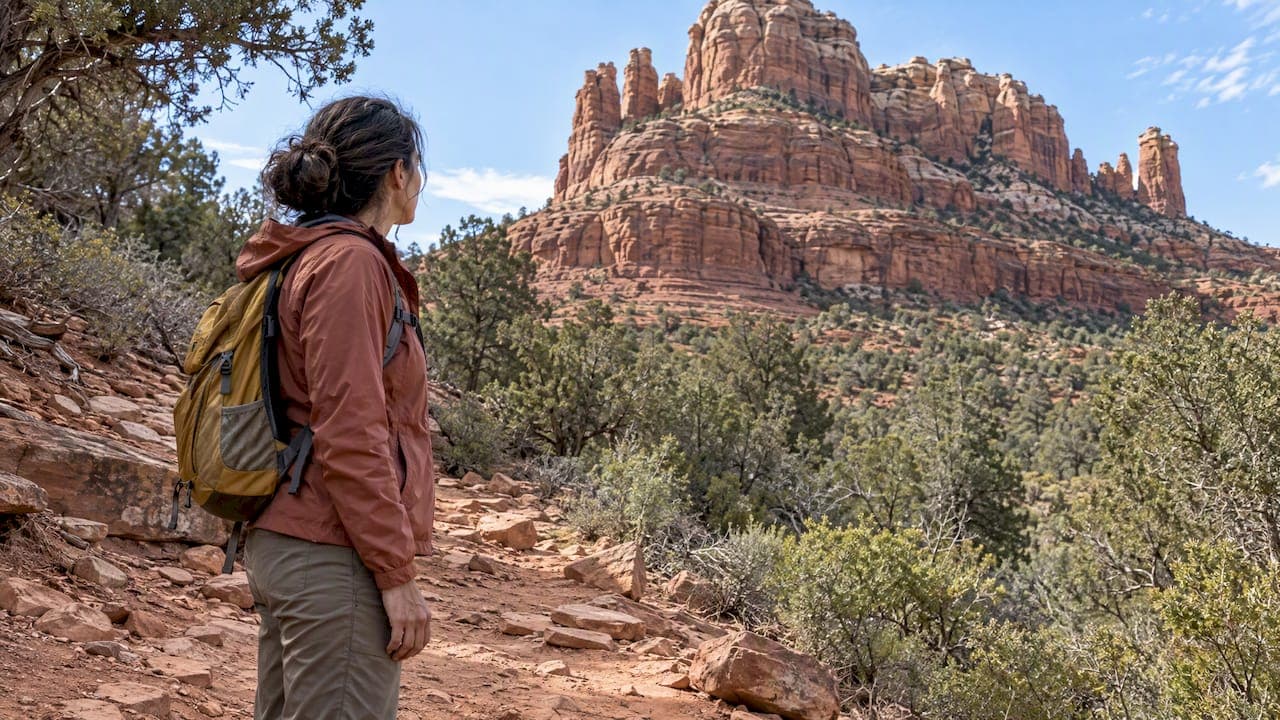
A Sedona vortex is a place many people believe concentrates spiritual or "earth" energy. Scientists have found no peer-reviewed evidence of any measurable energy there, yet countless visitors still report real feelings of calm and uplift. Below we cover where the main sites are, what experts say, and how to visit safely and respectfully.
TL;DR:
- Airport Mesa suits beginners; Cathedral Rock demands a steep scramble, while Bell Rock has flat paths and the chapel requires little walking.
- Regional magnetic anomalies reflect local geology, but no peer reviewed research links them to named vortex sites; reported calm or tingling remains subjective.
- Most trailheads in Coconino National Forest usually require a Red Rock Pass or America the Beautiful Pass; carry water and stay on marked trails in desert heat.
- The Forest Service accommodates spiritual visitors but restricts damaging rituals; leave no ritual debris, avoid fires, and respect Indigenous sacred places.
Table of Contents
- What is a Sedona vortex, and where did the idea come from?
- Where are the main Sedona vortex sites?
- What do scientists and land managers say about vortex energy?
- How did Sedona become a spiritual destination?
- What should you know before visiting a vortex site?
- What can you actually do at a vortex?
- Chris on what makes a vortex visit worthwhile
- Sedona tours that pair well with a vortex visit
- FAQ
- Sources
What is a Sedona vortex, and where did the idea come from?
In Sedona, a vortex is a spot believed to concentrate spiritual or earth energy that supports meditation, healing or insight. The word is borrowed for tourism and spirituality, not physics. The plural is usually written "vortexes," though "vortices" also appears.
The term was coined for Sedona by psychic Page Bryant around 1979–1980. Self-help and New Age figures then spread it widely. Arizona Highways traces the same story, noting that the New Age movement and events like the Harmonic Convergence cemented Sedona's reputation as a spiritual destination.
The label stuck because it was simple, memorable and easy to put on a map. Once a name exists, guidebooks, shops and tours build around it. That branding is a big part of why people now plan whole trips around red rock "energy."
Where are the main Sedona vortex sites?
Several places come up again and again. The Sedona lists and maps the commonly named sites, and local visitor centers can give you current maps and parking details.
- Airport Mesa: A short drive from town, with a viewpoint and short trails. It is the easiest site for a first visit, and our Airport Mesa sunset guide covers timing.
- Cathedral Rock: A steep, rocky scramble rather than a casual stroll. Plan on solid shoes and extra time, with trailhead parking.
- Bell Rock: Easy to reach from Highway 179, with flat paths around the base and optional climbing higher up.
- Boynton Canyon: A longer canyon walk with a trailhead near Enchantment Resort. See our Boynton Canyon vortex hiking guide for trail details.
- Chapel of the Holy Cross: A chapel built into the rock, reached by a short walk from its parking area. It is the least strenuous option on the list.
Most trailhead parking falls under Coconino National Forest, where a Red Rock Pass or America the Beautiful Pass is typically required.
What do scientists and land managers say about vortex energy?
The scientific answer is blunt. ASU geologist Dr. Steven Semken says there is no clear definition of the energy being claimed, and that energy in physics is conserved rather than concentrated at special spots the way vortex believers describe.
The picture is slightly more nuanced on the ground. Aeromagnetic surveys show magnetic anomalies in the wider region tied to geology, such as ancient crystalline basement rock and magnetite-bearing basalts. But no peer-reviewed work connects those anomalies to the named vortex sites.

Land managers take a practical stance. The Forest Service does not scientifically endorse vortex energies, but it accommodates spiritual visitors while restricting rituals that harm public land.
So why do people keep reporting the same sensations? Experts call it a case study in belief: many visitors describe near-identical tingling, calmness and uplift, and those shared accounts create a self-reinforcing cultural reality. Add expectation, a dramatic landscape and a break from daily routine, and a genuine emotional response is unsurprising. Feeling something is real. Proving a physical cause is another matter.
How did Sedona become a spiritual destination?
Sedona's spiritual identity is recent and largely modern. After Page Bryant's naming in the late 1970s, the 1987 Harmonic Convergence drew about 5,000 participants and boosted the town's reputation. A 2019 report cited roughly 3 million visitors a year, and the vortex brand shaped much of what Sedona sells: crystal shops, healing sessions, guided energy tours and meditation retreats.
The landscape carries far older meaning. Yavapai-Apache and other Indigenous peoples hold sacred connections to this land that predate the New Age era by centuries. Treat red rock sites as living cultural places, not stage sets. Stay quiet, leave nothing behind, and follow any posted guidance.

What should you know before visiting a vortex site?
A little preparation keeps a visit safe and low-impact.
- Parking: Most trailheads sit in Coconino National Forest and need a Red Rock Pass or America the Beautiful Pass. Visitor centers can point you to current options.
- Heat: Start early or late, and carry more water than you think you need. National Park Service guidance on desert hiking hazards covers heat, snakes and cactus, and advises staying on trails.
- Snakes: Rattlesnakes are active in warm months. Our Sedona snakes guide explains what to do if you meet one.
- Small injuries: Pack basic first aid. This bug bite symptoms guide for hikers helps you recognize and treat stings on the trail.
- Etiquette: Do not leave ritual debris, build medicine wheels or burn anything, and respect Indigenous sacred places.
Pro Tip: Short on time or energy? Our Sedona easy hikes list includes family-friendly options and weekend parking tips.
What can you actually do at a vortex?
Visitors commonly describe tingling, calm, emotional uplift or a sense of focus. These are personal and subjective, and nobody can promise you will feel them. The scenery alone is a good reason to go.
Low-effort ways to explore:
- Sit for a short, quiet meditation.
- Take a slow, mindful walk instead of a fast hike.
- Catch a sunrise or sunset from a viewpoint.
- Photograph the rock formations in changing light.
- Join a guided Sedona scenic tour for local context.
Jot a few notes in a journal afterward, then compare your reaction at different sites. Drink water, and stay aware of your footing and surroundings.
Chris on what makes a vortex visit worthwhile
Whatever you believe about energy, the best part of these places is simple: the scenery plus unhurried time to reflect. I would not chase a feeling. Pick one or two sites, arrive early, and let the landscape do the work. If logistics are the hurdle, pairing a short vortex stop with a private Sedona highlights tour makes the day easier. Carry your pass, respect the land, and stay safe.
— Chris
Sedona tours that pair well with a vortex visit
If you would rather skip the parking and planning, we run private Sedona sightseeing and guided-hike experiences with door-to-door pickup. Our Sedona Highlights Tour starts from $189 per person and offers Sedona sightseeing with local interpretation. Pick a date, tell us what you want to see, and we will handle the rest.
FAQ
What does the vortex in Sedona do?
Believers say it concentrates spiritual energy that supports meditation and reflection. Scientists have found no measurable energy tied to these sites, but many visitors still report feeling calmer or uplifted.
What is Sedona, Arizona known for?
Sedona is known for its red rock formations, hiking and scenic viewpoints. Its spiritual reputation, built around the vortex idea, is also a major draw for the roughly 3 million tourists cited in a 2019 report.
How are vortexes identified?
They are not identified by instruments. The sites were named and popularized by Page Bryant and later New Age writers, and today they are mapped in visitor guides such as the Sedona.
Where are the vortexes located?
The best-known sites are Airport Mesa, Cathedral Rock, Bell Rock, Boynton Canyon and the Chapel of the Holy Cross, all in or near Sedona. Our site guide above explains how to reach each one.
Sources
School of Journalism and Mass Communication - ASU](https://cronkitehhh.jmc.asu.edu/blog/2024/04/sedonas-vortex-believe-or-not-to-believe/)
- Visitsedona
- Alternative Energy? | Arizona Highways
- Sedona Vortex Map | Find Vortex Sites on an Interactive Map