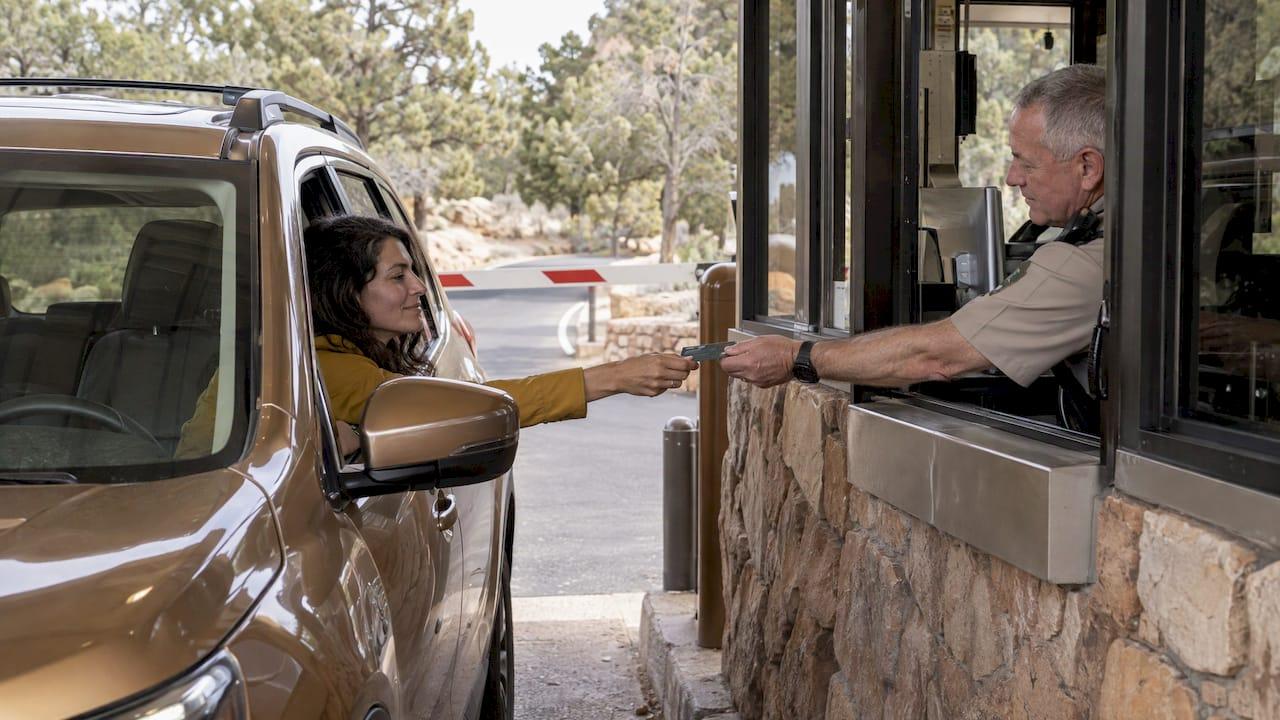
Entering Grand Canyon National Park in 2026 costs $35 per private vehicle, $30 per motorcycle, or $20 per person on foot or by bicycle, and the pass is good for seven days. Since January 1, 2026, visitors who are not U.S. residents and are 16 or older pay an extra $100 each unless they hold a nonresident annual pass. Everything below explains how those numbers work, which pass fits your trip, and how park entry is handled when you book a private tour.
TL;DR
- A standard Grand Canyon pass is $35 per vehicle (up to a 15-person van), $30 per motorcycle, or $20 per person for hikers and cyclists aged 16 and over. It lasts seven days and covers both rims.
- Non-U.S. residents aged 16 and over pay a $100 nonresident fee on top, or buy the $250 America the Beautiful Non-Resident Annual Pass.
- Entrance stations do not accept cash. Bring a credit or debit card, or buy a pass online ahead of time.
- Our private tours include all park fees in the tour price. International guests can confirm how the nonresident fee is handled when they reserve.
Table of Contents
- Standard Grand Canyon entrance fees in 2026
- How long the pass lasts and what it covers
- The $100 nonresident fee for international visitors
- Annual and discount passes
- Fee-free days: who qualifies
- How to pay at the entrance
- Is park entry included in a guided tour?
- Fee versus total cost: what a Grand Canyon day really costs
- Our perspective on the entrance fee
- Book a private tour with park entry included
- Planning around the fee
- FAQ
- Sources
Standard Grand Canyon entrance fees in 2026
The National Park Service fee page for Grand Canyon lists three standard options:
| Way you enter | Fee | What it covers |
|---|---|---|
| Private vehicle | $35 | All passengers, up to a 15-person van |
| Motorcycle | $30 | Up to 2 motorcycles with up to 4 total passengers |
| On foot or by bicycle | $20 per person | Visitors aged 16 and over |
Children under 16 do not need an entrance pass. The NPS explains that where a park lists both a private vehicle price and a per-person price, the per-person price applies if you arrive by bike or on foot. At the Grand Canyon that matters if you come by train, shuttle or a tour that drops you in the park and you are charged individually.
A family of four in one car pays $35 total. Four adults walking in separately would pay $20 each. That gap is why most self-drive visitors pay by vehicle.
How long the pass lasts and what it covers
Admission is valid for seven days and includes both the South Rim and the North Rim. The North Rim is only open for the season from May 15 through October 15 for most visitors, so the seven-day window rarely helps unless you are traveling in that period and have the time to drive between rims. The two rims are roughly a day's drive apart by road, so most travelers choose one.
The NPS notes that no refunds are given because of inclement weather. If a storm closes a viewpoint for an afternoon, your pass is still valid for the rest of the week, so you can come back to the rim the next morning.
No timed-entry reservation is required for basic park entry, according to the same NPS page. You pay at the gate and drive in. Lines at the South Entrance can build in the late morning of busy days, which is why arrival time matters as much as the fee itself.

The $100 nonresident fee for international visitors
The biggest change for 2026 affects travelers from Canada and Europe. The Department of the Interior announced on November 25, 2025 that starting January 1, 2026, nonresidents without an annual pass pay a $100 per person fee at 11 of the most visited national parks, in addition to the standard entrance fee. Grand Canyon is on that list, alongside parks such as Yellowstone, Yosemite and Zion.
Key details:
- The fee applies to non-U.S. residents aged 16 and over.
- It applies in addition to the vehicle or per-person fee.
- It also applies to nonresidents who enter as part of a commercial tour, according to the NPS commercial tours FAQ.
- Holders of the nonresident annual pass do not pay it.
A worked example for a European family
Take two adults and two teenagers aged 16 and 17 from outside the U.S., arriving in a rental car. The vehicle fee is $35. The nonresident fee is $100 per person for each of the four, so $400. The total is $435 at the gate.
If the same family buys the $250 America the Beautiful Non-Resident Annual Pass, the pass covers the vehicle and the nonresident fees for everyone in it, up to 15 passengers. The cost is $250. A couple with no children comes out at $235 without the pass ($35 plus $200) and $250 with it, so the pass only pays off once you add a third park, a larger party or a second visit. Where per-person fees are charged, the pass covers the holder plus three additional adults.

That is the math to run before you land. If your itinerary also includes Zion, Bryce Canyon or Yosemite, which carry the same surcharge, the annual pass usually makes sense quickly.
Annual and discount passes
The NPS passes page and the Grand Canyon fee page list these options:
| Pass | Price | Who can buy |
|---|---|---|
| Grand Canyon Annual Pass | $70 | U.S. citizens and residents |
| America the Beautiful Resident Annual | $80 | U.S. citizens and residents |
| America the Beautiful Non-Resident Annual | $250 | Non-U.S. residents |
| Senior Annual | $20 | U.S. citizens and residents aged 62+ |
| Senior Lifetime | $80 | U.S. citizens and residents aged 62+ |
| Military (annual and lifetime), Access, 4th Grade, Volunteer | Free | Eligible U.S. citizens and residents |
All America the Beautiful passes other than the nonresident annual pass are for U.S. citizens and residents only. If you are comparing a one-park pass with the multi-park option, our guides to whether the America the Beautiful pass is worth it and national park passes walk through the break-even points.
Fee-free days: who qualifies
The National Park Service lists fee-free entrance days each year, usually tied to holidays such as Presidents Day, Memorial Day, Independence Day weekend and Veterans Day. In 2026 these apply to U.S. citizens and residents only. Nonresidents still pay the standard fee and the $100 nonresident fee on those days.
Fee-free days are also the busiest days. If you are flexible, a weekday outside holiday weeks gives you a calmer rim and shorter lines for a fee that is only $35 per vehicle. Check the NPS page for the current year's list before you plan around one.
How to pay at the entrance
The entrance stations do not take cash. According to the NPS fee page:
- Credit cards, debit cards, digital passes and America the Beautiful passes are accepted at the South Entrance near Tusayan, the East Entrance at Desert View and the North Rim Entrance.
- You can buy a pass with cash or card from businesses in Tusayan, 1.6 miles south of the South Entrance Station.
- A private vehicle pass can be bought online through recreation.gov before you arrive.
Buying online saves a few minutes at the booth and removes the surprise of a cash-free gate, which catches a few drivers every week.
Before you leave, look at the live views from the South Rim and entrance. They give you a quick read on weather, haze and how the rim looks that morning, which is useful when you are deciding between sunrise and a later start.
Is park entry included in a guided tour?
It depends on the operator, so read what each tour lists. On our side, our tours are designed to be all-inclusive, with park fees and dining included in the price. A few things are useful to know about how the system works behind the scenes.
Tour companies with a federal Commercial Use Authorization pay entrance fees themselves. Per the NPS CUA page, paying entrance fees is the responsibility of the CUA holder, and the application fee does not cover them. The NPS commercial tours FAQ states that commercial vehicles with a capacity of 1 to 25 are charged $8 per person, with visitors aged 15 and under exempt. It also says interagency passes are not accepted for commercial tour entry.
Two practical consequences for you:
- If you bring your own America the Beautiful pass, it does not reduce the commercial entry charge when you ride in a commercial vehicle. The older NPS page on commercial tours says it can be used when clients enter in their own vehicle in a caravan or meet a guide in the park.
- International guests aged 16 and over are subject to the nonresident fee on a commercial tour as well, unless covered by the nonresident annual pass. When you reserve with us, tell us where you live and we will go through how it applies to your group.
The benefit of an all-inclusive private tour is that you do not stand at the booth, juggle cards or work out passes at 7 a.m. with a car full of jet-lagged travelers.
Fee versus total cost: what a Grand Canyon day really costs
The entrance fee is the smallest part of most visits. A self-drive day adds fuel, parking, meals, a rental car and the time spent hunting for a space. Our guide to South Rim parking explains how quickly lots fill at midday.
Here is a simple comparison for a couple from the U.S. leaving from Sedona or Flagstaff:
| Item | Self-drive | Private tour |
|---|---|---|
| Park entry | $35 per vehicle | Included |
| Driving | 2 to 3 hours each way, your own | Door-to-door in a luxury vehicle |
| Parking | Your search | Handled by your guide |
| Interpretation | Signs and a map | Expert local guide |
| Dining | Your own | Included |
A self-drive trip is cheaper in cash terms. A private tour is for travelers who value their time on the rim more than the logistics, which is exactly who we build our tours for.
Our perspective on the entrance fee
We hear the same question every week: how much is it to get in, and is it included? The honest answer is that the fee is the easy part. The planning around it is where people lose hours.
We built our tours so that park fees are in the price and you never have to think about a booth, a card reader or a line of cars. Your guide knows which entrance suits your plans, when the rim is quietest and where to put you for the light. That is the point of a 100% private tour: no shared bus, no strangers, and an itinerary that bends to your group.
If you are coming from Europe or Canada, we suggest talking to us before you book flights, because the 2026 nonresident rules change the math for every group. We would rather you arrive with a clear picture than a surprise at the gate.
Chris
Book a private tour with park entry included
If you want a Grand Canyon day without handling fees, passes and parking, our Private Grand Canyon Day Tour starts from $319 per person, with door-to-door hotel or B&B pickup, an expert guide and all park fees included.
If you would rather be on the rim at golden hour, the Grand Canyon Sunset Tour starts from $349 per person. For walking below the rim, see the Grand Canyon Hiking Tour, from $349 per person. Travelers staying in Red Rock country can look at Grand Canyon tours from Sedona, and our travel planner helps you choose between itineraries.
Planning around the fee
A few habits make the day smoother whatever pass you hold:
- Decide your entrance early. The South Entrance near Tusayan is the main route to the village and the most popular viewpoints. The East Entrance at Desert View suits travelers coming from the Painted Desert side.
- Carry a card. No cash is accepted at the stations.
- Count your teenagers. Anyone 16 or older is a fee-paying adult for the nonresident fee and for per-person entry.
- Check your passes. If you hold an America the Beautiful pass, confirm it is valid for the current year and that it fits your residency.
- Choose a realistic day. Our one-day South Rim itinerary and South Rim viewpoint guide help you shape the hours once you are inside.
If you are weighing the South Rim against other rims, our comparison of the South Rim and West Rim explains why the South Rim is the usual choice for first visits. Visitors with mobility needs can use our accessibility guide.
FAQ
How much does it cost to enter the Grand Canyon in 2026?
A private vehicle pass is $35, a motorcycle pass is $30, and walkers or cyclists aged 16 and over pay $20 each. The pass lasts seven days and covers the South Rim and the North Rim. Non-U.S. residents aged 16 and over pay an additional $100 each unless they hold a nonresident annual pass.
Do children have to pay the Grand Canyon entrance fee?
Children under 16 do not need an entrance pass. For vehicle entry, the whole car is covered by the single fee anyway. The nonresident fee also applies only to visitors aged 16 and over.
Can I pay cash at the Grand Canyon entrance?
No. The entrance stations take credit and debit cards, digital passes and America the Beautiful passes. You can pay cash for a pass at businesses in Tusayan, 1.6 miles south of the South Entrance, or buy a vehicle pass online in advance.
Is the entrance fee included in a private Grand Canyon tour?
Our private tours are all-inclusive, with park fees included in the per-person tour price, such as from $319 for the Private Grand Canyon Day Tour. International guests aged 16 and over are subject to the federal nonresident fee on commercial tours, so tell us where you live when you reserve and we will go through it with you.
Are there free entrance days at the Grand Canyon?
Yes, the National Park Service sets several fee-free days each year, usually around holidays. In 2026 they apply only to U.S. citizens and residents, so nonresidents still pay. Check the NPS fee page for the current list.
Sources
- Fees & Passes, Grand Canyon National Park (NPS)
- Grand Canyon South Entrance Station (NPS)
- Department of the Interior press release on national park access
- Entrance Fees by Park (NPS)
- Nonresident Fees (NPS)
- Entrance Passes (NPS)
- Nonresident Fees on Commercial Tours FAQ (NPS)
- Entrance Fees, Commercial Tours (NPS)
- Commercial Use Authorizations, Grand Canyon (NPS)
- Grand Canyon webcams: South Rim and entrance views