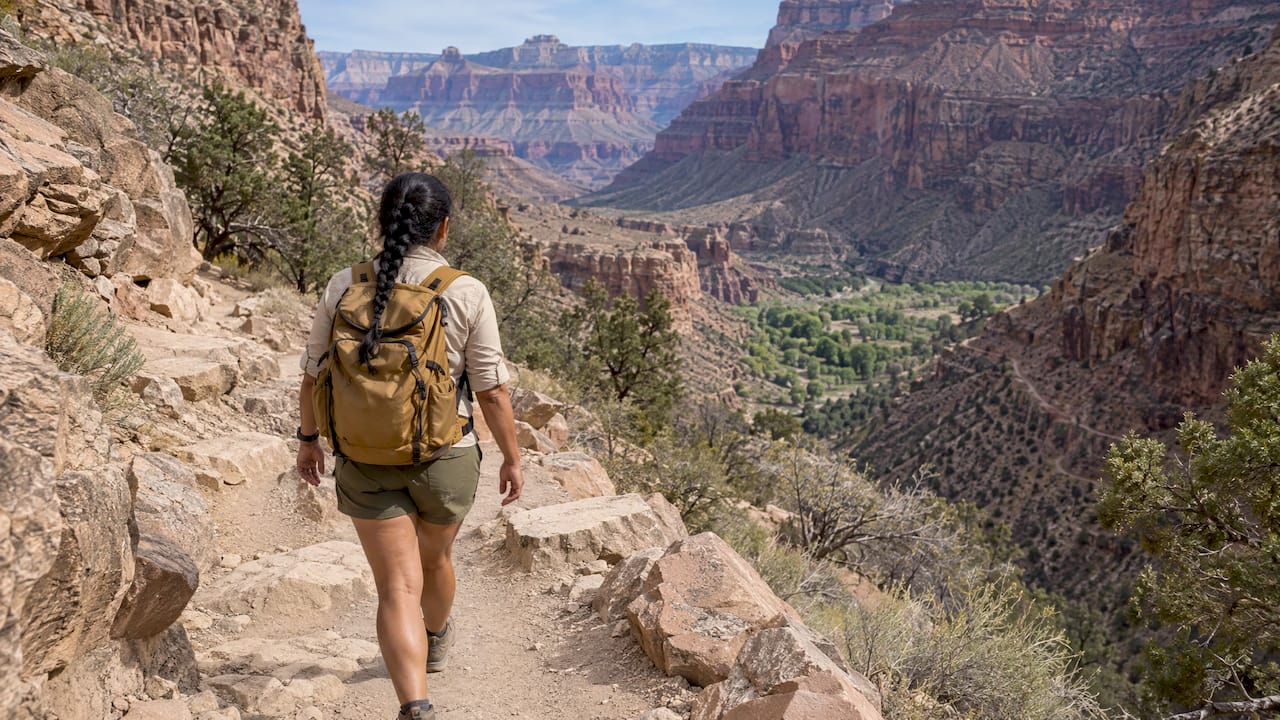
The Indian Garden hike is 4.5 miles down Bright Angel Trail from the South Rim, and 9 miles round trip with about 3,040 feet of elevation change, according to the National Park Service. The park now calls the spot Havasupai Gardens. Budget 6 to 9 hours for the round trip, start at first light, and plan the climb out as the real hike. If you would rather spend the day on the canyon walls than on logistics, a private guided hike below the rim takes the planning off your hands.
TL;DR
- Bright Angel to Indian Garden is 4.5 miles one way, 9 miles round trip, with roughly 3,040 feet of elevation change and 6 to 9 hours of hiking time.
- Going down is the easy part. Allow at least twice as long for the climb out as for the descent.
- Water at the resthouses is seasonal and can be turned off. Check status at the trailhead QR code or Visitor Center, and carry your own water regardless.
- Summer shade temperatures routinely pass 100°F, so avoid the inner canyon from 10 a.m. to 4 p.m.
- A private guided hike lets you set the pace, the turnaround and the start time with a local expert.
Table of Contents
- What "Indian Garden" means today
- Bright Angel to Indian Garden: the numbers
- How long it really takes
- What the trail is like
- Water, resthouses and what to check before you go
- Heat: the rule that matters most
- A sensible day plan
- Is Indian Garden the right goal for you?
- Our perspective
- Hike below the rim with a private guide
- FAQ
- Sources
What "Indian Garden" means today
Maps, trail signs and older guidebooks still say Indian Garden, and many hikers search that way. The park service officially renamed the site Havasupai Gardens in 2022, as Grand Canyon Trust reports, to honor the Havasupai Tribe and its history in the canyon. You will see both names, and they mean the same oasis of cottonwoods about halfway to the river.

It is the classic turnaround for a day hiker. It has shade, toilets, a ranger station and emergency phones, according to the NPS hiking FAQ. That makes it a natural place to rest, eat and decide honestly whether you have the legs for the climb back.
Bright Angel to Indian Garden: the numbers
The trailhead sits near Kolb Studio on the South Rim at about 6,850 feet. From there:
| Item | What to expect |
|---|---|
| Distance to the gardens | 4.5 miles one way, 9 miles round trip |
| Elevation change | About 3,040 feet |
| Typical time | 6 to 9 hours round trip |
| Trail surface | Maintained dirt, steep and well defined |
| Permit for a day hike | None needed; camping below the rim requires one |
The distance and elevation come from the NPS Bright Angel Trail page. Other sources round slightly differently, so you will see 8.9 to 9 miles and 3,018 to 3,060 feet quoted. The shape of the day is the same in all of them.
Most of the elevation change is packed into the upper four miles of switchbacks, and the trail levels out as it approaches the gardens. That matters for your legs. The first hour feels like a gift, then the grade gets inside your knees, and the return trip repeats every foot of it in reverse, uphill.
How long it really takes

The NPS puts the round trip at 6 to 9 hours. Its hiking FAQ adds that most first-time canyon hikers climb at roughly one mile per hour, and that coming out can take twice as long as going down.
Here is a worked example for a reasonably fit visitor in spring or fall:
- Descent to the gardens: about 2.5 to 3 hours with photo stops.
- Rest, snack and refill at the gardens: 30 to 45 minutes.
- Climb out: 4.5 to 5.5 hours at a steady, unhurried pace with short breaks.
That lands near 8 to 9 hours door to door, the top of the NPS range. If you start at 7 a.m., you finish in the afternoon with daylight to spare. If you start at 10 a.m., you finish after dark or hike through the hottest hours. The start time is the single biggest decision you control.
What the trail is like
The NPS describes Bright Angel as well maintained and graded for stock, fairly easy to descend and much harder to climb. Expect these features:
- Switchbacks. The upper four miles are a long staircase of turns cut into the wall, with open views down canyon.
- Resthouses. There are two on the way, at 1.5 miles and 3 miles, each a handy goal for the descent and a reference point for the climb.
- Shade. The canyon walls give some, especially early and late in the day. There is no cover for long stretches at midday.
- Mules. Commercial mule trains use this trail. The NPS day hike guide tells hikers to step off on the uphill side, stay quiet and still, follow the wrangler's directions, and not return to the trail until the last mule is 50 feet past.
- Ice. The upper section can be extremely icy in winter and early spring, so check conditions and pack traction if the rim has had snow.
If you are comparing routes, the NPS notes Bright Angel is about two miles longer than South Kaibab but has water, some shade and a halfway oasis. Our guide to South Kaibab vs Bright Angel walks through which suits which hiker.
Water, resthouses and what to check before you go
The water system is the item most hikers get wrong. The NPS says water at the Mile-and-a-Half and Three-Mile Resthouses is normally seasonal, running from May through October, and is year-round at the gardens. But pipelines break, and the park has turned water off at all three points at times. Seasonal trail water is subject to waterline breaks, as the NPS day hike guide puts it.
So the rule is simple: never plan around water you have not confirmed.
- Scan the QR code at the trailhead or ask at the Visitor Center for the current water status.
- Read the trailhead signs for weather, trail information and closures.
- Carry all the water you need for the whole trip anyway. The NPS lists not carrying enough as a common mistake, and says each person in a group should carry their own.
- Confirm the trail is open. Recent NPS updates showed Bright Angel open from the trailhead to River Resthouse while other inner canyon areas were closed after flash flooding. Conditions change, so look at the official page the morning you go.
The NPS also advises talking to a ranger before attempting Havasupai Gardens as a day hike. That is worth doing, especially if it is your first inner canyon day.
Eating and drinking on a schedule
Drinking only when thirsty is a trap in dry canyon air. Sip steadily on the way down, and eat as well as drink. Water alone is not enough on a long hot day: the Lake Powell Chronicle reports that rangers urge balancing heavy water intake with salty snacks or electrolytes to avoid hyponatremia. For a deeper look at fluid planning, this piece on hydration on the trail covers what to drink, how much and when. Our daypack checklist lists what else belongs in the bag.
Heat: the rule that matters most
The inner canyon is far hotter than the rim. HikingGuy notes that temperature rises roughly 3.5°F to 5.5°F for every 1,000 feet you descend, so the gardens can run close to 18°F hotter than the rim. The NPS says summer shade temperatures routinely pass 100°F.
What to do with that:
- Stay off inner canyon trails from 10 a.m. to 4 p.m. in hot months. This is the NPS guidance, and rangers repeat it strongly.
- Start before sunrise in summer. Many hikers turn around at the 1.5-mile or 3-mile resthouse instead of pushing to the gardens.
- Wear a sun hat and use cool, wet clothing. The NPS also says to consume about twice the calories you would for normal exercise.
- Allow at least twice as long for the climb as the descent.
- Know the red flag. Emergency medicine physician Dr. Jeremy Joslin, quoted in this report, says any change in mental status or behavior signals heat stroke and calls for immediate cooling and help.
From July to September, monsoon storms can bring violent lightning. If a storm builds, take shelter right away. Our write-up on Grand Canyon summer safety goes through the 10 a.m. to 4 p.m. rule in more detail.
The usual first-timer mistake is overcommitting on the downhill. It feels effortless, so people keep going, then arrive at the gardens already tired with the full 3,000-foot climb ahead. Set a turnaround time before you start, and honor it even when you feel strong.
A sensible day plan
Here is how a careful day looks in spring or fall.
- Night before: check the NPS pages for trail status and the weather. Pack water, salty snacks, sun protection and layers.
- Sunrise start: be at the trailhead with enough light to see the first switchbacks.
- First resthouse (1.5 miles): a quick check of your pace and energy. If the downhill felt hard, this is a fine turnaround.
- Three-Mile Resthouse: another checkpoint, and the point where many day hikers decide the gardens are too far.
- Havasupai Gardens: sit in the shade, eat a real snack, refill if water is on, and set your return time.
- Climb out: slow and steady, with short breaks in shade. Do not sprint the first mile uphill.
If you want a bigger objective, the next landmark is Plateau Point, a long day for fit hikers. See our Plateau Point hike plan. For a general route and timing overview, the Bright Angel day hike guide covers the options.
Is Indian Garden the right goal for you?
Be honest about three things: your fitness, the season and your group. This is a strenuous hike for most people. The NPS suggests hikers make their first inner canyon trip on a corridor trail like this one, which is good news, because it has the best support: water when available, a ranger station and emergency phones.
If you are traveling with children, older relatives or anyone newer to hiking, a shorter section to one of the resthouses delivers canyon views without the full commitment. Our guide to easy Grand Canyon hikes lists lower-effort options on the South Rim.
Medical conditions, heart or lung problems, and pregnancy are reasons to talk to your own doctor before any inner canyon hike.
Our perspective
Most people who ask us about Indian Garden are really asking one thing: how do I see inside the canyon without the day turning into a struggle? The trail is beautiful, but the logistics around it are what trip the visitor up: the early start, the water status, the parking and shuttle timing, and the decision about when to turn around.
That is why our private hiking tour is built around the guest, not around a group schedule. Tours are 100% private, with no shared buses or strangers, door-to-door pickup, expert local guides and all park fees included. You decide the pace, and your guide helps you choose a turnaround that fits your group.
If a full 9-mile day is more than you want, a guided hike below the rim still gives you the inner canyon view, and the rest of the day stays relaxed.
Chris
Hike below the rim with a private guide
Our Grand Canyon Hiking Tour is a private, guided hike below the rim, from $349 per person. It includes door-to-door pickup, an expert local guide and park fees, and tours run privately for your party only. We pick up from Sedona, Flagstaff, Williams and Tusayan, so you can start from wherever you are staying. See the details on our Sedona departure page.
If you want a gentler day, our Private Grand Canyon Day Tour starts from $319 per person. The Grand Canyon Travel Planner can help you choose between the options.
FAQ
How far is Bright Angel Trail to Indian Garden?
It is 4.5 miles one way and 9 miles round trip, with about 3,040 feet of elevation change, per the NPS. Some trail sites list slightly different figures, such as 4.6 miles to the gardens, but the NPS numbers are the ones to plan with.
Can you day hike to Indian Garden and back?
Yes, and the NPS lists it as a day hike that takes 6 to 9 hours. It advises checking with a ranger first, starting early, being in good condition and not going past this point as a summer day hike. No permit is needed for a day hike.
Is there water at Indian Garden?
Water at Havasupai Gardens is normally available year-round, while the upper two resthouses are seasonal. Water can be turned off by waterline breaks, so check the trailhead QR code or Visitor Center the day you go and carry your own supply.
What is the best time to hike to Indian Garden?
Spring and fall are the most comfortable seasons, with a start at or before sunrise. In summer, begin well before dawn and keep off the inner canyon trails between 10 a.m. and 4 p.m. Winter can bring ice on the upper switchbacks.
Sources
- Bright Angel Trail (U.S. National Park Service)
- Hiking Frequently Asked Questions (Grand Canyon National Park)
- Day Hike: Bright Angel Trail (NPS)
- Hike Bright Angel Trail into the Grand Canyon (Grand Canyon Trust)
- Tragedy on the Bright Angel Trail (Lake Powell Chronicle)
- Bright Angel Trail Guide (HikingGuy)
- Hikers face urgent Grand Canyon heat warning (5thnews)