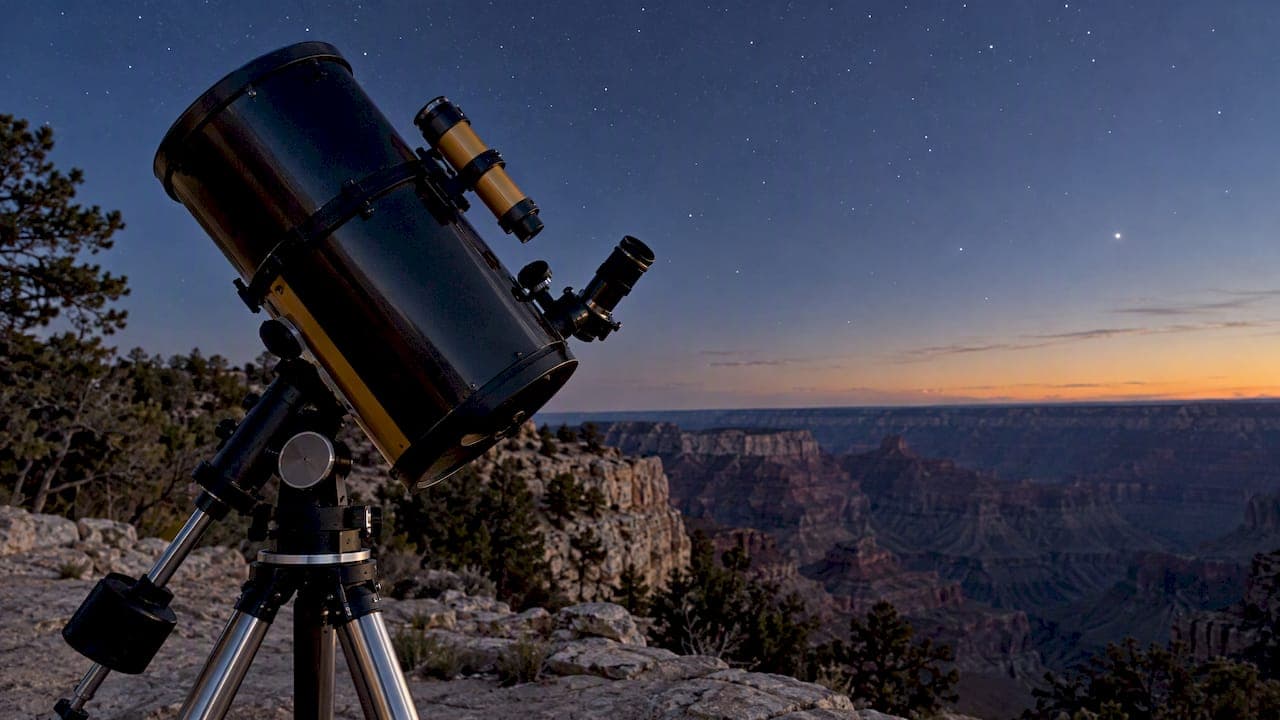
There is no permanent public observatory on the rim of the Grand Canyon. You can still look through a telescope there, and it takes a little planning. The best chance is the free annual Grand Canyon Star Party on the South Rim, when volunteer astronomers set up their own instruments. The rest of the year, the most dependable big telescopes are about 80 miles away at an observatory in Flagstaff. This guide explains how each option works, when to go, what to bring, and how to fit a night under the stars into a Grand Canyon trip.
TL;DR
- The Grand Canyon Star Party is free and runs for about a week each June on the South Rim. Volunteers bring the telescopes.
- Outside that week, the park offers year-round astronomy programs, but the most consistent public telescope access is at Lowell Observatory in Flagstaff.
- The Moon matters more than almost anything else. Aim for a new moon or third quarter, and bring a red flashlight, never a white one.
- A private evening tour takes the driving and the logistics off your plate, so you can spend the dark hours looking up.
Table of Contents
- Is there a telescope at the Grand Canyon?
- The Grand Canyon Star Party
- Lowell Observatory in Flagstaff
- Choosing between the two
- Stargazing at the canyon without a telescope
- Staying safe after dark on the rim
- Our perspective: plan the night, not just the telescope
- Build a night around the canyon
- Private tours that pair with the night sky
- What to pack for a telescope night
- FAQ
- Sources
Is there a telescope at the Grand Canyon?
The short answer is yes, but not a fixed one you can walk up to any night. Grand Canyon National Park is a certified International Dark Sky Park. According to the National Park Service, its work to reduce light pollution makes practically anywhere in the park a good place to stargaze. That is why the telescopes come to the canyon rather than the other way around.
In practice, you have three ways to get an eyepiece to your eye:
- The Grand Canyon Star Party (June). Amateur astronomers from across the country volunteer their own equipment, so what you see depends on who shows up and what they brought.
- Park astronomy programs (year-round). The National Park Service says it offers astronomy programs outside the Star Party. Check the park's current schedule before you plan around one.
- A managed observatory nearby. The park's own guidance points out that access to professional-grade telescopes is most consistently found at facilities such as Lowell Observatory in Flagstaff, not at the rim.
If you own a telescope, you can also set up at a dark spot of your own. Most travelers do not, which is where the first three options come in.
The Grand Canyon Star Party
The Star Party is the closest thing the canyon has to a public observatory, and it is free. The National Park Service describes a nightly guest speaker presentation at 8:00 PM, followed by telescope viewing. Green-laser constellation tours run at 9:00, 9:30 and 10:00 PM.

What it is like on the field
The event is held on the South Rim. A club that helps staff it says the field behind the main Visitor Center holds around 80 telescopes each night, and visitors wander between them. Volunteers are happy to talk, point out objects and let you look. Expect planets, star clusters, nebulae and galaxies when the sky cooperates, with the Milky Way overhead.
Two timing notes from the park:
- Telescope viewing is best after 9:00 PM, once the sky is fully dark.
- Many volunteers stay until at least 11:00 PM, and some keep going later on clear nights.
Arrive early if you want a seat for the speaker, and bring a folding chair or cushion.
Dates
The 2026 event ran from June 6 to June 13, so it has already passed for this year. The Star Party is held in June around the time of the new moon, and the club that helps run it lists May 29 to June 5, 2027 for the next one. Confirm on the National Park Service page before you book anything, because dates and locations can shift. The 2025 event, for comparison, included both the South and North Rims, while 2026 was South Rim only.
The honest limits
Because the instruments belong to volunteers, the lineup changes from year to year and from night to night. Clouds can also cancel a night. And it is a public event, so you will share the field with other visitors. If you want a guaranteed session and a smaller crowd, the next option is better.
Lowell Observatory in Flagstaff
When the Star Party is not on, the reliable option is Lowell Observatory. It sits at 7,250 feet on Mars Hill in Flagstaff, and its visitor page calls it home of Pluto's discovery and a place for year-round public stargazing.
What you can look through:
- The Giovale Open Deck Observatory. Six high-powered telescopes are set up for the public. Lowell describes using live-color video cameras on some of them, which shows deep-sky objects in color and detail that the eye alone cannot pick up.
- The historic Clark Telescope. Built in 1896 by Alvan Clark & Sons, it offers a view through a piece of astronomy history.
Practical details, as published by Lowell when we wrote this: adult admission is $35, and a typical visit lasts about two hours. The campus is typically open until 10:00 PM, with telescope viewing starting around sunset. Groups of 15 or more get discounted rates, and private group stargazing sessions start at a $575 flat rate. Check the ticket page for current prices and hours, since they change by season.
Flagstaff sits at the same latitude band as the canyon's South Rim, so the sky you see there is a good preview of what you will see from the rim. It is a different experience, though. You are at a campus with exhibits and staff, not at a canyon edge.
Choosing between the two
| Grand Canyon Star Party | Lowell Observatory | |
|---|---|---|
| Where | South Rim, behind the Visitor Center | Flagstaff, Mars Hill |
| When | About one week each June | Year-round, typically open until 10:00 PM |
| Cost | Free | $35 adult admission (as published) |
| Telescopes | Volunteers' own instruments, around 80 per night | Six open-deck telescopes plus the historic Clark refractor |
| Best for | Seeing the canyon sky and a large field of instruments | Dependable viewing on almost any date |
| Risk | Clouds, date constraints, crowds | Fewer canyon views, more of a campus feel |
If your trip falls in the June window, do both. If it falls in any other month, build your telescope night around Flagstaff and take your canyon stargazing with the naked eye.
Stargazing at the canyon without a telescope
You do not need an eyepiece to be stunned. Under a dark sky, the Milky Way is visible as a band of light across the sky, and the National Park Service calls Grand Canyon one of the best places to view it thanks to its elevation, clean air and distance from city lights.
Pick your spot
The park's night sky guidance points to the North Rim's Cape Royal and the South Rim's Desert View Watchtower as stronger choices than the busy village areas. Move away from lit buildings and parking lots, even by a short walk.

Photographers should know one more thing. The National Park Service explains that the North Rim is often preferred for Milky Way photography, because the galaxy's core lies to the south and the North Rim lines it up better with the canyon. From the South Rim, the canyon often ends up on the wrong side of the frame.
Watch the Moon
The Moon changes the whole night. The park says viewing is most rewarding around the new moon or third quarter, while a bright first quarter or full moon washes out many stars and deep-sky objects. Look up the moon phase before you choose your date. A moonlit night is lovely for a walk on the rim, but a poor one for a telescope.
Protect your night vision
This is the mistake nearly every first-timer makes. Your eyes need roughly 30 minutes to adapt to the dark, and one blast of white light resets that. The park's advice is to bring a red flashlight, or cover your own with red cellophane. Keep your phone screen dim and turned away, especially near people at eyepieces.
Staying safe after dark on the rim
Night at the canyon means darkness next to a very large drop. The National Park Service advises visitors to stay at least six feet from ledges, and falls from the edge are one of the two most common causes of death in the park's history, along with heat-related illness. Cold nights at elevation also surprise people who arrived on a hot afternoon.
Some common-sense rules for a night out:
- Stay well back from the edge, and do not step off paths to get a better angle for a photo.
- Use only a red light, and keep it pointed at the ground.
- Dress in layers. Rim elevation means evenings cool quickly.
- If you are hiking before the stargazing, read our guide to summer safety at the canyon, since the park advises avoiding the canyon floor between 10:00 AM and 4:00 PM in summer.
Our perspective: plan the night, not just the telescope
We are a locally owned Northern Arizona private tour operator, and we hear one question from guests again and again: can we see the stars from the Grand Canyon? The answer is yes, and the sky is better than most people expect. The real question is how to get there and back.
The canyon is remote, the roads are dark, and the rim is a place where you do not want a tired driver. That is why we think of stargazing as a logistics problem first and an astronomy problem second. The most common plan we see go wrong is a long day of sightseeing, followed by a late drive back to Sedona, Flagstaff or Williams with no one rested enough to enjoy the sky.
Our view is simple:
- Pair the telescope with a daytime itinerary you will not regret. A packed day plus a 10:00 PM observatory visit is too much for most families.
- Choose your base for the night you want. Flagstaff puts you close to Lowell Observatory. Sedona suits a stargazing evening of its own.
- Let someone else drive. Our tours are private, with door-to-door pickup, so your group stays together and nobody is stuck behind the wheel.
- Be honest about the Star Party. It is wonderful, but it is a one-week event with volunteer equipment. We would never promise you a specific telescope on a specific night.
We have written more on this in our post about stargazing at the Grand Canyon with private tours, and a broader Arizona stargazing guide covers other dark-sky spots across the state.
— Chris
Build a night around the canyon
Here are three ways to fit a night sky into a Grand Canyon trip, depending on your dates.
If you are visiting in early June
Time your South Rim stay around the Star Party. Spend the day on the rim, have an early dinner, and be on the field by 8:00 PM for the speaker, then stay for the telescopes after 9:00 PM. Our South Rim itinerary and list of South Rim viewpoints will help you plan the daylight hours.
If you are visiting any other time
Spend your canyon day on the rim, then plan a separate evening at Lowell Observatory in Flagstaff on a night close to the new moon. Do not try to do both in one long day. Giving each experience its own evening makes both better.
If you want a sunset first
Evening light on the canyon is a highlight in itself, and it fits naturally before a dark sky. Our guide to Grand Canyon sunset spots shows where to stand. If you are staying in Sedona, our write-up on Sedona stargazing covers a stargazing evening closer to your hotel.
Private tours that pair with the night sky
If you are planning a canyon trip with a stargazing evening, we can build the day around it. Our tours are private: no shared buses, no strangers, door-to-door pickup from your hotel or B&B, luxury vehicles, expert local guides who speak English and German, and park fees included.
The tours most relevant to this trip, with prices as published on our site:
| Tour | Price |
|---|---|
| Grand Canyon Sunset Tour | From 349 USD per person |
| Private Grand Canyon Day Tour | From 319 USD per person |
| Sedona Stargazing Tour (see all private tours) | From 179 USD per person |
We do not run a telescope session at the canyon rim, and we would not claim to. What we do is handle the day, the driving and the timing so your evening is relaxed. If you would like to combine the canyon with a dark sky, our Grand Canyon travel planner is a good place to start, or you can browse private Grand Canyon tours from Sedona, Flagstaff and Williams.
What to pack for a telescope night
A short list that makes a real difference:
- Red flashlight or a regular flashlight wrapped in red cellophane. Avoid white light and phone lights near telescopes.
- Warm layers, a hat and gloves. Even in summer, the rim cools quickly after sunset.
- Folding chair or cushion. Seating at the Star Party speaker fills early.
- Binoculars. A pair of 7x50 or 10x50 binoculars adds a lot between telescope visits, particularly for the Milky Way and star clusters.
- A moon calendar. Check the phase before you finalize dates.
- Water and a snack. Services are limited late at night, particularly outside the main village.
For a night that follows a hiking day, keep your daypack light and your phone charged. Our Grand Canyon hiking guide covers what to carry below the rim.
FAQ
Can you look through a telescope at the Grand Canyon?
Yes, mainly during the annual Grand Canyon Star Party, a free event each June on the South Rim where volunteer astronomers share their telescopes. The park also offers year-round astronomy programs, so check its current schedule. For dependable access on other dates, Lowell Observatory in Flagstaff has public telescopes most nights.
When is the next Grand Canyon Star Party?
The 2026 event was June 6 to June 13. A club that helps run it lists May 29 to June 5 for 2027. Dates follow the new moon, so they move each year. Confirm with the National Park Service before booking.
Do I need to bring my own telescope?
No. At the Star Party, volunteers bring the instruments and let visitors look. If you do bring your own, the event invites it, along with binoculars and a red light. At Lowell Observatory, the telescopes are provided as part of admission.
What is the best time of night to use a telescope?
After about 9:00 PM, once the sky is fully dark. The Star Party's telescope viewing is best after that hour, and many volunteers stay until at least 11:00 PM. Pick a night near the new moon for the darkest sky.
Can a private tour include stargazing?
We offer a Sedona Stargazing Tour, listed on our tours page from 179 USD per person. For a Grand Canyon trip, we can talk through how to pair a day or sunset tour with a separate dark-sky evening, so you are not driving tired.
Sources
- Grand Canyon Star Party 2026, National Park Service
- Night Skies, Grand Canyon National Park
- Grand Canyon Photography, National Park Service
- 35th Annual Grand Canyon Star Party, National Park Service
- 36th Annual Grand Canyon Star Party, National Park Service
- Tourism and the Leisure Class, National Park Service
- Grand Canyon Star Party 2027 dates, Tucson Amateur Astronomy Association
- Plan Your Visit, Lowell Observatory
- Buy Tickets, Lowell Observatory
- Stargazing at the Giovale Open Deck Observatory
- Historic Clark Telescope Viewing